

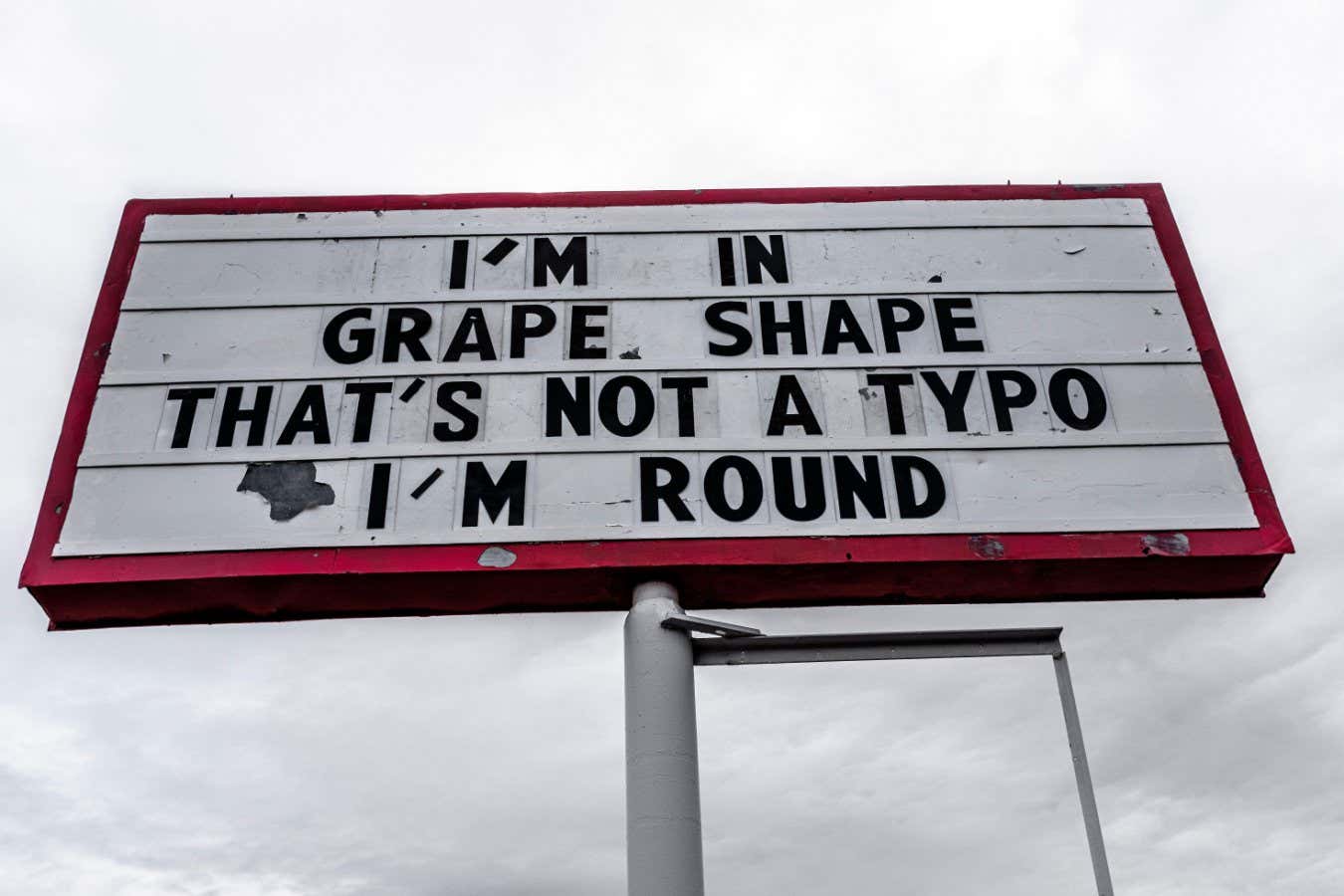
Typos are a sign of a human writer… for now
Marc De Simone/Alamy
Recently, a friend told me over coffee about some disheartening feedback she had received. “They said it was good,” she said, “but that it read like it was written by AI.” Knowing her, I understood immediately what had happened. Her credibility was being questioned not because her work was poor, but because it was too good – too clear, too fluent, too polished.
The rapid acceleration of artificial intelligence tools is changing how we think about good writing. In the digital age, it is increasingly important to signal that an actual person – not a faceless large language model – is behind the words. One paradoxical way of doing this is, surprisingly, to damage the quality of your own writing.
Alan Turing even made such a suggestion in the 1950s: sprinkle in a few deliberate typographical errors to appear more convincingly human. The irony, of course, is that Turing was addressing that advice to machines.
My friend’s experience isn’t an isolated one. Writing well, once a mark of skill, has become, for a growing number of readers, reviewers and hiring managers, a source of moral suspicion. The skills we once used to signal intelligence and effort – clarity, precision, a well-turned sentence – are starting to lose their meaning.
The problem lies in our inability to easily detect AI-written content, making false positives (that is, wrongly accusing someone of using AI tools) a serious concern. Studies have shown that neither humans nor AIs can reliably distinguish between human- and machine-generated writing. When human- and AI-generated writing is intermixed, performance becomes even worse. As a result, many universities that had been using plagiarism-detection tools for AI detection have stopped due to concerns about their reliability.
In this climate of uncertainty, some writers have reached for the only signal still available to them: the aptly named human error. A repeated word, a small grammatical slip, a slightly clunky phrase – these have started to function less as signs of carelessness and more as proof of a genuine human hand. The defect has become the credential.
Errors are already being deployed strategically in competitive contexts – university submissions, job applications, professional correspondence. Recruiters have begun advising applicants to leave a single deliberate typo in a cover letter, precisely to signal that an interested human wrote it.
Of course, none of this is stable, and the currency of the error signal is on borrowed time. Once imperfection becomes a recognised sign of authenticity, it immediately becomes available for imitation. Users will ask AI systems to sound rougher, less polished and more human. The systems will comply and soon become adept at performing calibrated incompetence.
The path ahead towards reclaiming authenticity is unclear. Perhaps some situations will demand more direct proof of authorship without the assistance of AI: face-to-face, unmediated assessments, handwritten submissions and real-time explanations. Or, in a world increasingly saturated by AI tools, maybe the decisive skill will simply be knowing how to use them well. Some universities have allowed students to use AI in exams, so long as they submit their prompts as part of the assessment.
What seems certain, however, is that the old traces of authenticity and authorship have become harder to define and locate – and even where they exist, they arrive shadowed by suspicion.
Topics:
