

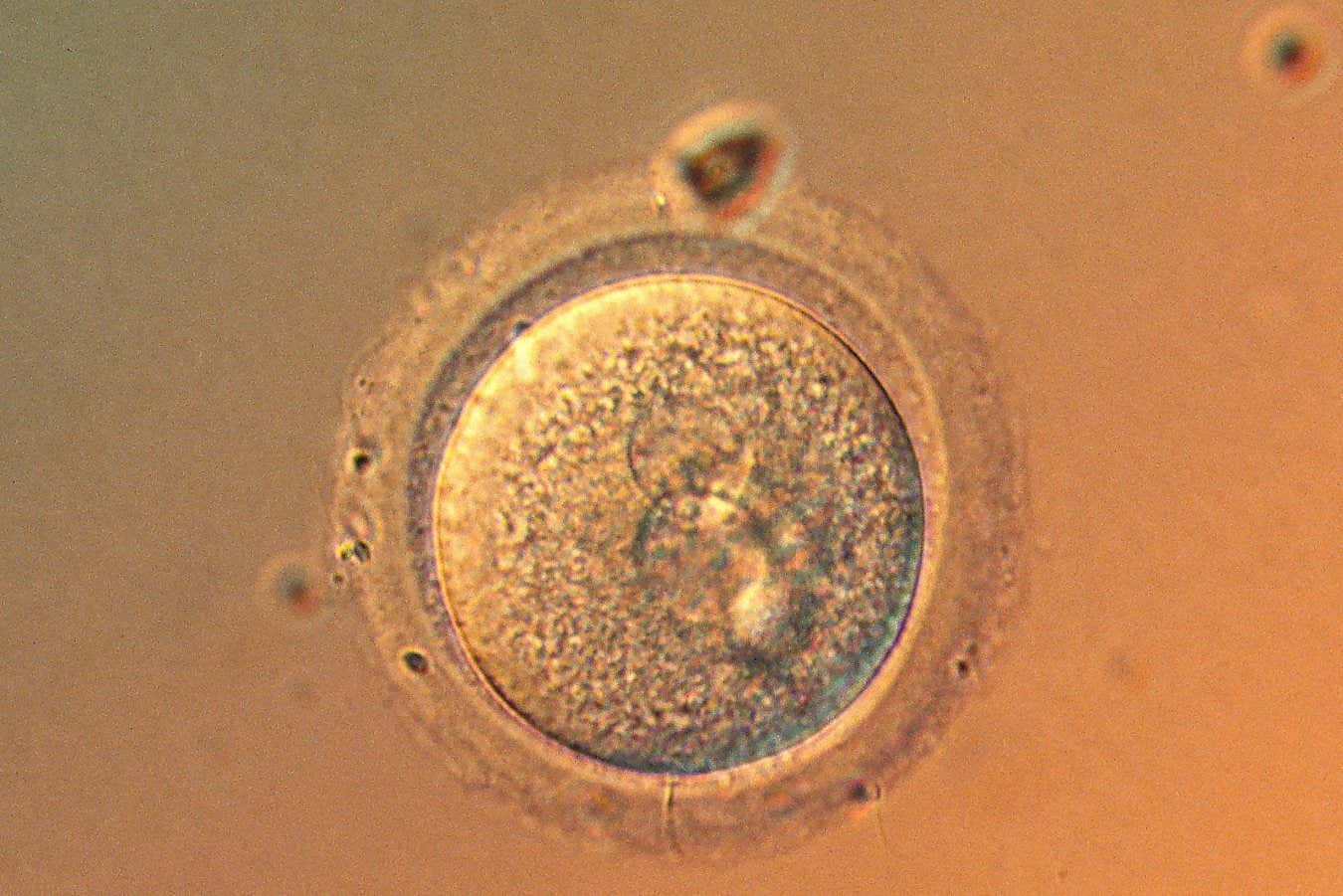
Light micrograph of a human egg cell after fertilisation
CC STUDIO/SCIENCE PHOTO LIBRARY
When a rogue researcher in China revealed in 2018 that he had used CRISPR to create three gene-edited children, his actions were almost universally condemned by biologists around the world. The main objection was not that gene-editing babies is wrong in itself, but that the CRISPR technique used was not safe and had a very high risk of causing harmful mutations.
Now, a team in the US has used an improved form of CRISPR, known as base editing, to edit healthy embryos and shown that it can be done without introducing unwanted mutations. So are we now at the point where we could consider allowing the use of the technique? The answer is no, because a major obstacle remains.
Our DNA consists of two strands. The first form of CRISPR to be developed uses a protein called Cas9, which hooks up with a piece of guide RNA that helps it find a specific place in the genome. Once there, Cas9 cuts through both strands. When a cell tries to repair the damage, it often makes mistakes, introducing small mutations that can disable genes.
So CRISPR-Cas9 is a destructive technique even when it works as intended, and it sometimes goes wrong, with the cut ends of DNA being reattached in the wrong places, causing large mutations and chromosomal abnormalities.
But many improved forms of CRISPR have been developed. For instance, CRISPR base editors change a single DNA letter to another, and during the process cut only a single strand of DNA. So base editing can be used to make precise repairs with much less chance of anything going wrong. The technique has already saved lives and a number of trials are under way – for instance, to test it as a treatment for conditions that result in very high cholesterol.
But editing embryos is very different from treating diseases. In adults, it doesn’t matter if gene editing doesn’t work perfectly in every cell – often only a fifth of cells in the liver, say, need to be successfully edited to treat a disease. In a human embryo, however, gene editing has to work perfectly, because that embryo will give rise to every cell in the body.
In 2017, a team in China reported promising results in a small study that used human embryos discarded during IVF because of abnormalities. They found base editing made the desired change in almost every embryo with very few unintended changes.
Now, Dieter Egli at Columbia University in New York and his colleagues have done a larger study using healthy two-cell embryos donated by parents, with broadly similar results. The team tried making two changes. One was successfully made in three-quarters of cells, with no unwanted changes. The other change worked only in around half of the cells, and often caused unwanted changes.
The researchers think the reason it worked well in one case and not so well in the other is down to the guide RNAs used – with better design and testing of guide RNAs, it should be possible to avoid off-target effects, they say.
But the biggest problem is that base editing didn’t work in every cell in each embryo, an issue called mosaicism. If a mosaic embryo develops into a child, only some of the cells in their body will have the intended change, which means they could still develop the disease the gene editing was meant to prevent, say. The three gene-edited children growing up in China may all be mosaics.
The trouble with this is that there is currently no way to be sure a gene-edited embryo isn’t a mosaic. When there is a risk of children inheriting a serious disease, a single cell can be removed from IVF embryos for genetic testing. This could be done with gene-edited embryos, too, but if the embryos are mosaic, testing a single cell isn’t enough.
So while these latest results are promising, they are not going to persuade any regulators that it is now safe to try germline gene editing, as it is known. The mosaicism problem is going to have to be solved first.
How? Well, one way would be to use gene-edited sperm or eggs. If the editing is done before an egg is fertilised and starts to divide, there should be no mosaicism. That has not been done in humans, but a start-up recently claimed it can generate sperm in the lab from sperm stem cells – and if that’s true it should be possible to gene-edit those sperm stem cells.
That sort of approach might us get to the point where we can safely gene-edit children. Whether we should is a whole different question.
Topics:
