

Juba, South Sudan – In the days before Lankien was attacked, doctors at the local hospital rushed to evacuate patients. Some were women in labour. Others were being treated for gunshot wounds. By the evening of February 3, just hours after the last patients were carried out, a bomb struck the empty facility, ripping a crater through its warehouse.
Fighting was underway in surrounding areas as South Sudan’s military pressed forward with a counteroffensive aimed at retaking territory seized by opposition armed groups. As the army advanced eastward through Jonglei State, it captured town after town, pushing opposition fighters towards the Ethiopian border.
In the aftermath of the bombing, residents said they were forced to flee into surrounding marshland on the morning of February 7 as mortar fire struck the town. Some eventually returned and described extensive destruction.
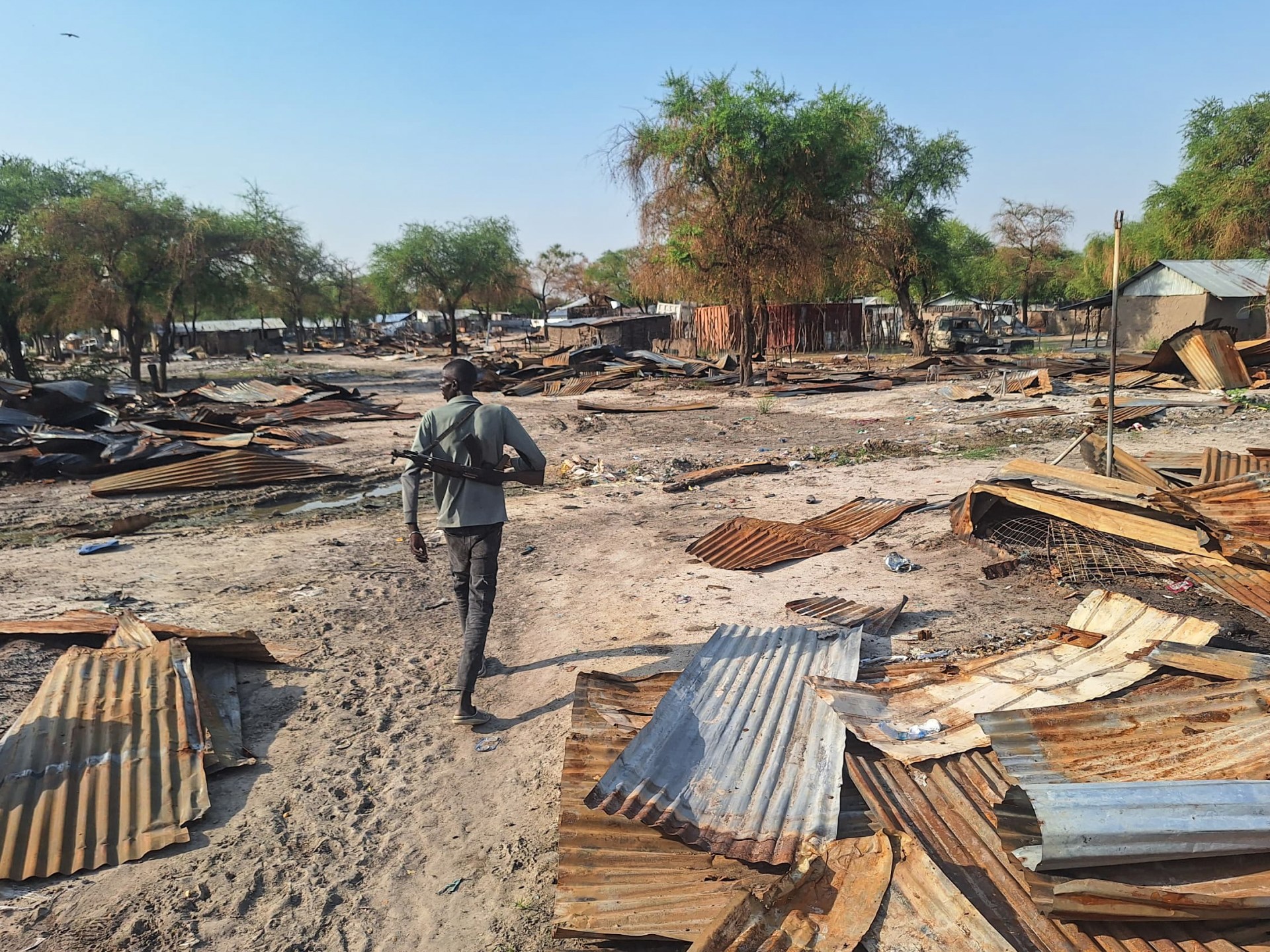
The hospital had been looted and burned. Its cold-chain storage unit, used to preserve vaccines, was set on fire. Vehicles were sprayed with bullets and stripped for parts. Solar-powered water systems had been dismantled. The local market was reduced to twisted metal sheets, while homes on the outskirts appeared to have been burned.
“Anything that can support the life of human beings was deliberately destroyed,” said Emmerson Gono, deputy head of mission for Doctors Without Borders, known by its French initials MSF, who visited Lankien in April, adding that this was his assessment based on what he observed.
A counteroffensive across Jonglei
Since the start of what authorities refer to as “Operation Enduring Peace,” satellite imagery analysed by the Centre for Information Resilience (CIR), combined with verified videos, images and witness accounts, indicates widespread destruction across a swathe of Jonglei that has long been a stronghold of opposition groups.
Both the military and opposition forces have been accused of razing villages and attacking civilians in recent months. In this area of Jonglei, which is home to a section of the Nuer ethnic group that officials often cast as hostile to the state, more than a dozen residents who spoke to Al Jazeera said they believed the military was responsible for targeted destruction that experts say has pushed tens of thousands of people towards the brink of famine.
In most of the 23 incidents CIR documented between late January and February, civilian structures, including homes, health facilities and markets, appear to have been burned and looted. CIR said the destruction was “likely to be more widespread and potentially part of what it described as a deliberate military strategy”.
“Using satellite imagery, we were able to map how troop movements from west to east followed a path of burning and looting,” said CIR researcher Kiria Borak, stressing that satellite imagery alone cannot determine intent or responsibility.
Some officials and humanitarian actors have attributed the destruction in Jonglei to clashes between government troops and opposition forces. However, residents told Al Jazeera that opposition fighters were not present when their villages were attacked. Those accounts could not be independently verified due to restricted access to the area.
Government officials did not respond to requests for comment on the specific allegations described in this report. In earlier statements, authorities have said military operations are conducted in self-defence and that civilians are not deliberately targeted.
Political backdrop
Violence has escalated since 2025, when opposition leader and first vice president Riek Machar was arrested on charges of subversion, allegations he denies. Machar and President Salva Kiir were once on opposing sides of the country’s 2013–2018 civil war, which killed hundreds of thousands of people before a peace agreement brought them into a fragile unity government.
The implementation of that agreement stalled amid delays in unifying armed forces into a national military and repeated postponements of national elections.
Following Machar’s arrest, the government undertook a campaign of aerial bombardments to beat back a simmering rebellion in rural areas. Machar’s political group declared the peace deal dead and began launching hit-and-run attacks on military positions.
Between December and January, opposition fighters, buoyed by support from local armed youth, seized several military garrisons in Jonglei, prompting the government to announce a counteroffensive on January 28.
Then-army chief Paul Nang ordered forces, drawn from the national army, intelligence units, police and allied militias, according to UN investigators, to retake territory held by opposition groups.
Analysts say the involvement of allied militias operating alongside formal units has complicated the determination of command responsibility.
‘Burning homes’
Five individuals who fled Lankien told Al Jazeera they witnessed events unfold on February 7.
They said government-aligned forces reached the outskirts of the town after fighting in a nearby village. Around late morning, mortar fire struck the town, followed by the arrival of ground forces in armoured vehicles.
Gai Ket, 32, said he had been cutting firewood when explosions began. He rushed back to town to look for his wife and children.
“The first thing I saw was smoke. SSPDF was burning homes,” he said, referring to the national army.
When he reached his house, he found his wife dead, with a severe wound to her chest. Bodies lay scattered across the neighbourhood. “Everything was gone,” he said.

Another resident, Puoch Duol, said he returned at night to search for his grandmother, who had been too weak to flee. He said he found her body among several others near the ruins of burned homes.
Satellite imagery reviewed by CIR indicates significant destruction in Lankien between February 7 and 9. On February 7, the army announced it was in control of the town.
MSF has said government forces were in control of Lankien in the days after the attack but has not assigned responsibility for the destruction. It said the government is the only party to the conflict with the capability to carry out aerial bombardments.
Government-appointed officials told Al Jazeera that opposition fighters looted the town during their withdrawal. Opposition representatives deny this, saying their forces were not present at the time. Neither account could be independently verified.
A pattern of destruction
Residents described a similar pattern of destruction across towns and villages stretching from the Nile River to the Ethiopian border. Armed men in military-style uniforms arrived in armoured vehicles, often after opposition forces were reported to have withdrawn, according to residents.
Homes and markets were burned, while health facilities and humanitarian compounds were looted. Civilians took refuge in swamps and forests, while those too weak to flee were killed or went missing.
CIR geolocated social media footage from Pathai showing fighters moving among burning structures towards a road leading into the town’s western entrance. The identities of those in the footage could not be independently verified.
Jany, an aid worker based in the town of Walgak, described an attack on February 5.
“We saw smoke everywhere. They were firing guns and burning houses,” he said.
Satellite imagery shows significant structural damage in Walgak between February 3 and 7, shortly after the town changed hands.
Humanitarian sources tracking developments in the area reported that multiple villages in the vicinity of Walgak were burned or destroyed during the same period. These accounts could not be independently verified due to restricted access and ongoing insecurity.
Remote sensing data shows clusters of fire activity across the region during the same period. However, satellite imagery alone cannot determine the cause or responsibility for the fires.
Command rhetoric and discipline
From the start of military operations, remarks by commanders raised concerns over civilian safety.
A video circulated on social media shows Johnson Olony, a deputy army chief who is also head of the Agwelek armed group, telling troops not to spare lives or property during operations. The government later said the remarks did not reflect official policy, and Olony apologised.
In another video, a commander identified as Wal Nyak appears to threaten violence against perceived opposition supporters. “Whether you are a woman or a girl, we will kill you all … We don’t want supporters of Riek Machar here,” he says.
![Reports and satellite imagery point to burned villages and mass displacement across Jonglei. [Satellite imagery © Vantor]](https://www.aljazeera.com/wp-content/uploads/2026/06/6970434469048635518-copy-1781418505.jpg?w=770&resize=770%2C407&quality=80)
The authenticity and full context of the footage could not be independently verified.
Humanitarian impact
Aid agencies say the consequences of the destruction reported in the area are severe and likely to last for months or longer.
At least 28 health facilities in Jonglei were damaged or looted this year, according to the UN. Seventy percent are no longer functioning.
The Integrated Phase Classification (IPC), a United Nations-backed analysis body, says there is a risk of famine in multiple counties, while more than 70,000 people are already facing the highest possible severity of hunger.
Nicholas Kerandi of the UN Food and Agriculture Organization said the impacts on food security and public health “are likely to persist through the remainder of the year and potentially beyond”.
Others say the alleged abuses in Jonglei have pushed South Sudan’s already fractured state to breaking point.
“The tribes don’t trust one another, the citizens don’t trust the government, and the government doesn’t trust its citizens,” Ter Manyang Gatwech, a human rights advocate from Jonglei, told Al Jazeera.
“Unless there is a miracle, South Sudan will disintegrate,” he said.
