

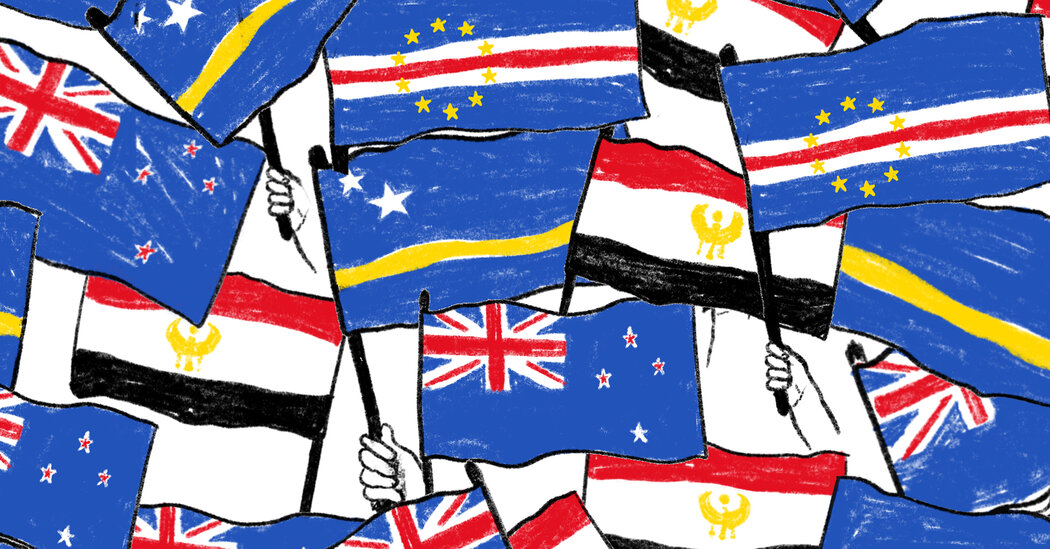
The World Cup has already seen America’s thumping victory in its opener, a thriller involving Iran and a hat trick from Lionel Messi. In a written online conversation, the Times Opinion editors John Guida and Tim Schneider hosted Vanessa Barbara, the editor of the literary website A Hortaliça; Sean Jacobs, the author of the newsletter Eleven Named People; and Nate Silver, who writes the newsletter Silver Bulletin, to discuss the glorious (and not-so-glorious) soccer on display, the politics shaping the tournament and, of course, who’s going to win it all.
John Guida: We’ve already seen a lot of great action and glorious fun. What is your favorite moment of the tournament so far?
Nate Silver: I’ll start with the obvious one: Messi’s third goal against Algeria, completing the hat trick. Not just because of what it meant historically for the sport — tying the lifetime World Cup goals record — but more selfishly, because the model I designed liked Argentina a lot, whereas betting odds regarded it as more in Tier 1B, despite its constant success on the international stage (winning the 2022 World Cup and the 2024 Copa América).
Vanessa Barbara: I’d like to talk about Vozinha, Cape Verde’s goalkeeper, who has become a celebrity in Brazil. He had just 50,000 followers on Instagram before the match against Spain, when he made several amazing saves that guaranteed a 0-0 draw. A campaign from the digital sports channel CazéTV encouraged Brazilians to follow him. Now he has skyrocketed to over 13 million followers. He got the nickname Vozinha (“Little Grandma” in Portuguese) because he was raised by his grandparents.
Sean Jacobs: It’s between Messi’s hat trick and Cape Verde’s dogged defense against Spain to draw 0-0. Cape Verde’s squad is made up mostly of players outside the top five leagues — the biggest European domestic leagues — including an Irish Cape Verdean who was recruited via LinkedIn. It was a team effort, but the goalkeeper, Vozinha, whom Vanessa mentioned, was a standout. The last goalkeeper who performed such heroics was Tim Howard for the United States against Belgium in the 2014 World Cup.
Tim Schneider: And he was in tears at the final whistle. Wonderful stuff. Is there anything that has especially surprised you in the first week of the competition?
Jacobs: Off the field, I am amazed at FIFA’s persistence with its dynamic ticketing policy, where the price is not fixed but is based on fluctuating demand, mostly upward, skewing who we see in the stands. (By contrast, Brazil and South Africa had tickets set aside for poorer fans.) On the field, despite some heroics and small countries scoring their first goals ever in a World Cup, the results line up with the rankings. That said, some of the African countries — Morocco, Egypt and Ivory Coast — are playing with confidence and swagger.
Silver: Several themes: First, how good the (U.S.) Americans were. Second, how totally OK it’s been to expand the tournament to 48 teams. Almost all of the matches have been eminently entertaining. It’s fun to have underdogs like Cape Verde. I’ve already become an advocate for expanding to 64 teams.
But third and maybe most important, how open and attacking the play has been, with 3.1 goals per game through everyone’s first match. Anything over 3 would be a threshold not reached since the 1958 tournament. Some of that is because scores balloon upward with lopsided matchups, like Germany 7-1 against Curacao. But there are lots of subtle things. Allowing more substitutions lets better-rested striking talent come on in the second half. And I think the format of this World Cup, in which three points (meaning just one win or three draws) is probably good enough to get you into the knockout stage, is encouraging some teams to go for it. We might see the play tighten up a bit from here, though.
Barbara: I was also very surprised by the American team, as well as by the high scores (Sweden 5-1 over Tunisia, Norway 4-1 against Iraq, England 4-2 versus Croatia). And I really, really refuse to talk about Brazil right now.
Guida: OK, so we will not talk about Brazil right now. America is not President Trump, and the United States is not the only host country, but in America, the Trump administration has certainly helped shape the conditions. A Somali referee was barred, the Iranian team has been refused to stay overnight, and travel bans have limited fans from certain countries from attending. So we see traces of the president’s hand. Has it been more or less visible than you expected when the tournament started?
Barbara: It’s very visible from here. For Latin American fans raised on the community-driven passion of soccer, the U.S. approach to the tournament feels like an exercise in political hostility and commercial sanitization, not a cultural celebration. It kind of sends a message to the global south: We want your soccer, but we don’t want your people.
Jacobs: Yes and no. The thing with the World Cup is that once the competition starts, the football on the field takes over. This is part of the World Cup’s seduction. But the continuous treatment of Iran is scandalous — that the team is permitted entry into the United States only a day before each match. Second, we could see in the France-Senegal match that the partial travel ban on Senegalese fans affected their support in the stadium. And though the official American broadcaster, Fox, is not a state broadcaster, its hydration break, which is basically an ad break, lines up well with Trumpism. The Spanish-speaking channels do not cut away for the water break.
Silver: I’d say less so. But I’ve been through this before. Every time, there is criticism of FIFA and everything else in the days leading up to the tournament, and the vibes feel off. Then the tournament starts, and that melts away.
Keep in mind that the previous two tournaments were played in Russia and Qatar. The history of global soccer, in some sense, is a history of the world’s political problems, from South Africa being suspended for many years because of apartheid to Russia now being essentially banned from UEFA. The sport has continued to thrive despite all of that, which feels like an optimistic metaphor in some ways.
Schneider: Summoning some optimism of the will, then, which countries would you say could really do with a lift at this tournament?
Barbara: Haiti. First, Trump said that Haitian immigrants ate dogs and cats in Springfield, Ohio, which was confirmation that they occupied a special place in his hierarchy of contempt. Then Trump’s administration moved to revoke Temporary Protected Status for Haitian nationals, a decision under review by the Supreme Court. And there’s the travel ban. When Brazil takes the field against Haiti in Philadelphia on Friday, there will be very few Haitian fans in the stands; they have been barred from entering the country.
Jacobs: Starting with the hosts: the United States. Because while the game is very popular with millennials and Gen Z, the U.S. side struggles in World Cup competition, and Americans don’t identify with the national team like fans elsewhere do. If it reaches the semifinals, it would do a lot for the game here. Same with Canada. Mexico has consistently made the round of 16, and its domestic game, the backbone of the national team, is in the doldrums, so same there.
Outside of that, Brazil. Because the team is a sentimental favorite of the global south but also, from what I’ve heard from Brazilian friends, because Luiz Inácio Lula da Silva’s electoral chances would get a boost from a title.
Silver: The stat I keep coming back to is that only three teams outside Europe and South America have ever reached the World Cup semifinals: the United States in the first edition, in 1930; South Korea at home in 2002; and Morocco in the last tournament, in 2022. So I find myself broadly rooting for the rest of the world, from the United States, Mexico and Canada to Ivory Coast and Japan. The African teams, in particular, have player talent that’s pretty equal to that of Europe and South America, in terms of how it’s valued in club football. To break up the duopoly and have a tripolar world of Europe, the Americas more broadly and Africa and the Middle East would make for a better sport.
Guida: You are all thinking expansively about the tournament and the countries involved and how appealing it is to have such a broad mix. It mirrors, to an extent, a lot of the discourse about a post-American world and the potential of a new global order. Do you see evidence of it at the World Cup?
Barbara: I’m a pessimist. Framed as an exercise in decentralization, the expansion to 48 teams is, in reality, a blueprint for centralizing power and wealth behind a veneer of inclusion. The steep cost of tickets and strict visa regimes lead to a very select audience, effectively filtering who is allowed in.
Jacobs: No. This is supposed to be a joint bid, but the United States got the bulk of the games and determined how the tournament is run. Usually, FIFA takes over the stadiums and the areas around them, or the governments cooperate on security and relax immigration rules before and during the World Cup. Very little of that happened here. Even mighty FIFA, which normally expels a soccer federation if the state interferes in football matters, bends to Trump.
Silver: It’s funny how the rise and fall of soccer strength often mirrors political trends. France has been much better than Germany in recent years, and that aligns with a period when I’d argue that France is regaining status as the de facto capital of Europe, at Germany’s expense. Our PELE ratings are calculated all the way back to 1872 and use gross domestic product as a predictor of team success: If it grows, the football results usually follow. Though the United States and China, which didn’t even come close to qualifying, have been noteworthy exceptions.
Schneider: Some pessimism of the intellect there! Perhaps in the same vein, what does this unusually close fusion of FIFA and the Trump administration suggest for the future? Would it be too much to see in it a new kind of state-capitalist globalization?
Barbara: The bromance between Gianni Infantino, FIFA’s president, and Trump is a case study in modern transactional governance. Infantino’s ease in dealing with autocrats and populist leaders points to a particular model for what lies ahead. Principles such as human rights, institutional transparency and cultural authenticity are pushed aside in favor of revenue generation and high-production broadcasts.
Jacobs: FIFA has a history of cozying up to authoritarians and strongmen, like Mussolini in 1934 and Argentina’s military junta in 1978. So no surprise there. But this is indicative of the new age associated with American capitalism, its mix of corruption and strong-arm tactics. Increasingly — the next World Cup aside — FIFA will surely favor hosts where there is little accountability, to pull off what is basically a high-stakes heist. After all, no country has ever benefited economically from hosting a major sports event like the World Cup. This is our future.
Silver: You mean the winner of the FIFA Peace Prize? As much as I wouldn’t want to overdo the parallels, FIFA and Trump are examples of crony capitalism on steroids. And they each get away with it by having inherited a product that’s too good to fail. Soccer is the world’s sport, and club leagues are generating spectacular revenue.
Guida: Let’s ease our way back from politics to the game. The political scientist and sports fan Matt Glassman wrote that though soccer is “indisputably the greatest spectator sport in the world,” it is “objectively not that great of a game.” He added: “The underlying issue is that the correct strategy is really passive and risk averse, which makes long stretches of the game pretty dull. And the ball goes out of bounds a ton, which is also dull.” Thoughts?
Barbara: The Italian coach Arrigo Sacchi described soccer as “the most important of the least important things in life.” I don’t think soccer is too boring, but my 7-year-old daughter begs to differ. She watched three minutes of Brazil versus Morocco and said, “I thought this would be more interesting.” Then she went out to punch holes in bottle caps and turn them into spinning tops. There’s a cultural side to that; we Latin Americans are used to transforming soccer matches into parties, with the television on in the background and people taking turns paying attention to the play.
Jacobs: I disagree. I grew up in South Africa, no football powerhouse, so for me, the 0-0 draw between Spain and Cape Verde was football at its highest expression. The tactical defense of Cape Verde in holding off a team of some of the world’s best players gave me pure joy. By contrast, the back-and-forth between Iran and New Zealand or between Japan and the Netherlands felt endless — in a good way. Watching England versus Croatia fighting like two punch-drunk boxers until England wore Croatia down, in a bar with no air-conditioning on Bedford Avenue in Brooklyn — that’s football.
Silver: Let’s keep in mind that action in the N.F.L. is extremely discontinuous. Baseball had grown slow and plodding before the pitch clock. I like that World Cup matches fit within roughly a two-hour window, which very much has led me to do some binge watching.
But this tournament has featured a notably more attacking mind-set than past ones. Around three goals per game, rather than roughly 2.5, matters a lot. You really notice the speed out there. You have to time your bathroom breaks carefully because some of the counterattacks have been very potent, like the Democratic Republic of Congo against Portugal.
Schneider: We can all agree that football — sorry, soccer — is the best game in the world. Speaking of best things and switching gears a little: What team uniform has most caught your eye?
Barbara: Definitely Haiti’s original jersey. It had a great design honoring their revolution, but FIFA banned the imagery for being political. It’s a shame the team had to change it.
Jacobs: My son Leo loves Senegal’s home shirt. It depicts the minibus taxis (cars rapides) of the capital, Dakar, in the background. I also like Ecuador’s navy blue away jersey.
Silver: I’d have to say, by far, Norway, with the flag on the front and the funky Viking-style lettering on the back. And Erling Haaland wearing his name as Braut Haaland to honor his mother.
Guida: Haaland had his share of goals in Norway’s opener. What has been your favorite goal of the tournament?
Barbara: Messi’s second goal in the match against Algeria. I can’t explain exactly why. I wish I had his composure when he gets a pass in the penalty area and gently curls a shot into the corner. He’s turning 39 next week. Can I insert a heart emoji here?
Jacobs: I couldn’t choose among these three: Messi’s first goal against Algeria, Gio Reyna with the outside of his boot against Panama and Hwang In-beom’s ankle breaker for South Korea against the Czech Republic.
Silver: Probably Kylian Mbappé’s spectacular strike from 30 yards to put France ahead 3-1 against Senegal after a few moments of danger. In the first half, France looked a little bit Spain- or Portugal-like in its inability to put things together. It’s actually not uncommon for teams to be tight in their first match. It’s not like these are N.B.A. teams that have already played 82 games together by the time you get to the championship. Whatever halftime adjustments France made proved auspicious.
Schneider: To finish, we have to ask: Who is going to win the thing?
Barbara: My bet is Argentina or France. But the World Cup is essentially a surprise. That’s why I need to point out that while Nate developed a model to run 100,000 World Cup simulations, he’d still end up losing to my 10-year-old niece, Isadora, if he joined our family betting pool.
Jacobs: France. It won in 2018 and was in the final in 2022. A few members of the team play together at Paris Saint-Germain, the European club champion, including the world’s best, Ousmane Dembélé. And Mbappé turns up at the World Cup. Argentina is my second choice because of Messi.
Silver: At the start of the tournament, our model had Argentina and Spain as the top tier and France and England as 1B. Now that’s compressed just a bit. But this is ultimately a team sport. Argentina’s talent is very good, and it doesn’t necessarily start or end with Messi. It has consistently had the best international results over the past cycle. And it plays with an assurance that I think even the other top-flight teams lack.
Vanessa Barbara is the editor of the literary website A Hortaliça and writes Portuguese fiction and nonfiction.
Sean Jacobs, a former professor of international affairs at the New School, is the author of the newsletter Eleven Named People.
Nate Silver, the founder and former editor of FiveThirtyEight and the author of “On the Edge: The Art of Risking Everything,” writes the newsletter Silver Bulletin.
John Guida and Tim Schneider are Times Opinion editors.
The Times is committed to publishing a diversity of letters to the editor. We’d like to hear what you think about this or any of our articles. Here are some tips. And here’s our email: letters@nytimes.com.
Follow the New York Times Opinion section on Facebook, Instagram, TikTok, Bluesky, WhatsApp and Threads.
