

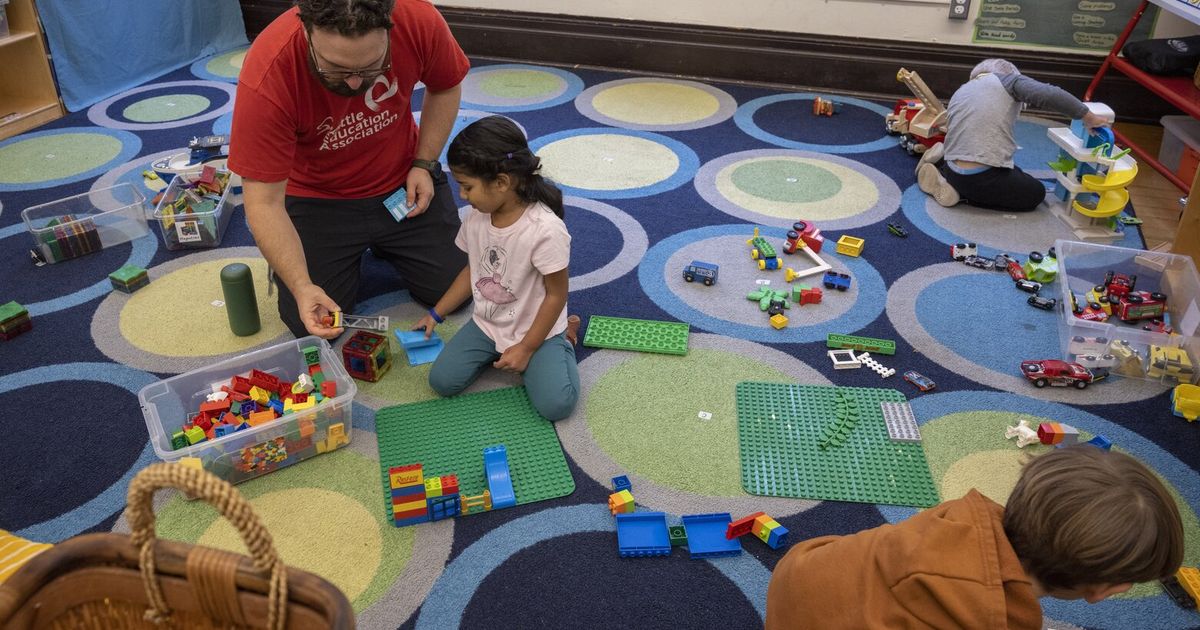
Seattle has reached a significant milestone — year 11 of the nationally recognized Seattle Preschool Program has been completed. The 3- and 4-year-olds who entered the first SPP classrooms in the 2015-16 school year are now teens heading into high school.
We both worked hard to secure passage of the special tax levy in 2014, which launched SPP. It passed with 69% approval. Voters renewed and expanded SPP in November 2018, with 69% voting “yes” again. It was expanded again last year, with 80% approval, the highest ever for any city government education levy. What began with just 15 preschool classrooms will this fall be offered in more than 160 classrooms, serving more than 2,600 children.
Author Erin’s daughter, Emi, was part of the first classroom cohort. She learned to resolve conflicts, follow directions, play well with others, ask for help, manage emotions, listen and work as part of a team. Nobel economist James Heckman at the University of Chicago has shown that these skills are best learned before age 5. If they aren’t, a child’s ability to catch up is much more difficult. As Heckman says, skills beget skills.
Tragically, many of our city’s early learners enter kindergarten already behind. Last September, 27% of Seattle kids entering a public school kindergarten classroom did not meet the six readiness standards measured by the Washington Kindergarten Inventory of Developing Skills. Half of Black children, 40% of Hispanic children and 49% of low-income children didn’t meet those standards.
While nearly 75% of SPP students are either children of color or living in poverty, 66% met the WAKIDS standards upon entering kindergarten in the 2025-26 school year. That’s a remarkable achievement compared with all Seattle kindergartners. High-quality preschool works.
Seattle’s preschool program offers dual-language classrooms (Spanish-English, Somali-English and others), inclusive classrooms for children with disabilities, research-based curricula and health assessments. Preschool program classroom teachers with early learning credentials are paid the same as K-12 teachers, and if they don’t yet have a degree, SPP provides tuition assistance. Because Head Start and ECEAP, the state’s preschool program, primarily serve families earning less than $51,000, many families can’t afford preschool. Seattle’s program is free for families earning up to 94% of the state median income, which is $135,000 for a family of four. Families earning more pay on a sliding scale. These equity-building measures strengthen SPP and serve as a model for high-quality preschool services.
The case for preschool goes beyond academic readiness — it is also a case for democracy itself.
In these turbulent times, when the foundations of our democracy are at risk, how we serve children and their families in the first five years of life is crucial. In fact, the front lines of democracy in America are not Congress, political parties, social media or news networks. They run through preschool classrooms.
Playing well with others, as preschoolers do, is not a nicety. It is essential to the survival of democracy. Jonathan Cohen, a scholar at Columbia University’s Teachers College, has identified the “essential skills” needed to participate in democracy — “the ability to listen to ourselves and others … the ability to be critical and reflective … the ability to be flexible problem-solvers and decision-makers … the ability to resolve conflicts in creative, nonviolent ways … learning to compromise and work together toward a common goal.” These social-emotional and practical skills are taught in high-quality, play-based preschool classrooms.
These democracy-building outcomes for children endure well into adulthood. A rigorous analysis of Head Start found that participants were more likely to complete high school, 23% less likely to live in poverty as adults and 27% less likely to receive public assistance. These are all building blocks of self-sufficient citizens and stable communities.
The Trump administration has slashed Head Start funding. Last year, it abruptly closed five of the country’s 10 Head Start regional centers, including the Seattle center. This makes the city’s sustained local investment in SPP even more consequential.
There’s an economic benefit to preschool, too.
In Washington, D.C., 90% of 4-year-olds and 70% of 3-year-olds are now enrolled in publicly funded preschool. Since the program began, the city’s maternal labor-force participation rate has risen by about 12 percentage points, 10 of which are attributable to the availability of preschool. Public policies that support parents’ employment choices almost always yield benefits — higher earnings, a larger tax base and better long-term outcomes for children — that outweigh the costs.
According to Heckman’s research, comprehensive, high-quality and integrated birth-to-5 services — affordable childcare, health screenings, home visits and preschool — deliver a 13% annual return on investment per child. That’s better than the stock market’s historical performance. Investing wisely in our kids makes economic sense.
We can learn from other nations, too. Comparative research shows that America’s socioeconomic opportunity gap is both larger and more persistent than in Australia, Canada or the United Kingdom, three peer countries with a common language, similar economies and similar cultures. Low-income children start further behind in our country and, because of inadequate support, have an even harder time catching up. The gap is evident by age 5 and acts as a bottleneck in a child’s development, limiting future opportunities. We can do better.
As the federal government dismantles the early learning programs that millions of children rely on, Seattle’s commitment to funding preschool locally matters more than ever.
Now is the time to expand, not contract, this democracy-building investment in our nation’s future. Parents know this. Community and school leaders know this. Philanthropists know this, which is why the Ballmer Group Philanthropy recently committed up to $170 million per year for 10 years to create 10,000 additional slots in the state’s ECEAP program.
Eleven years of the Seattle Preschool Program are worth celebrating. And protecting.
