

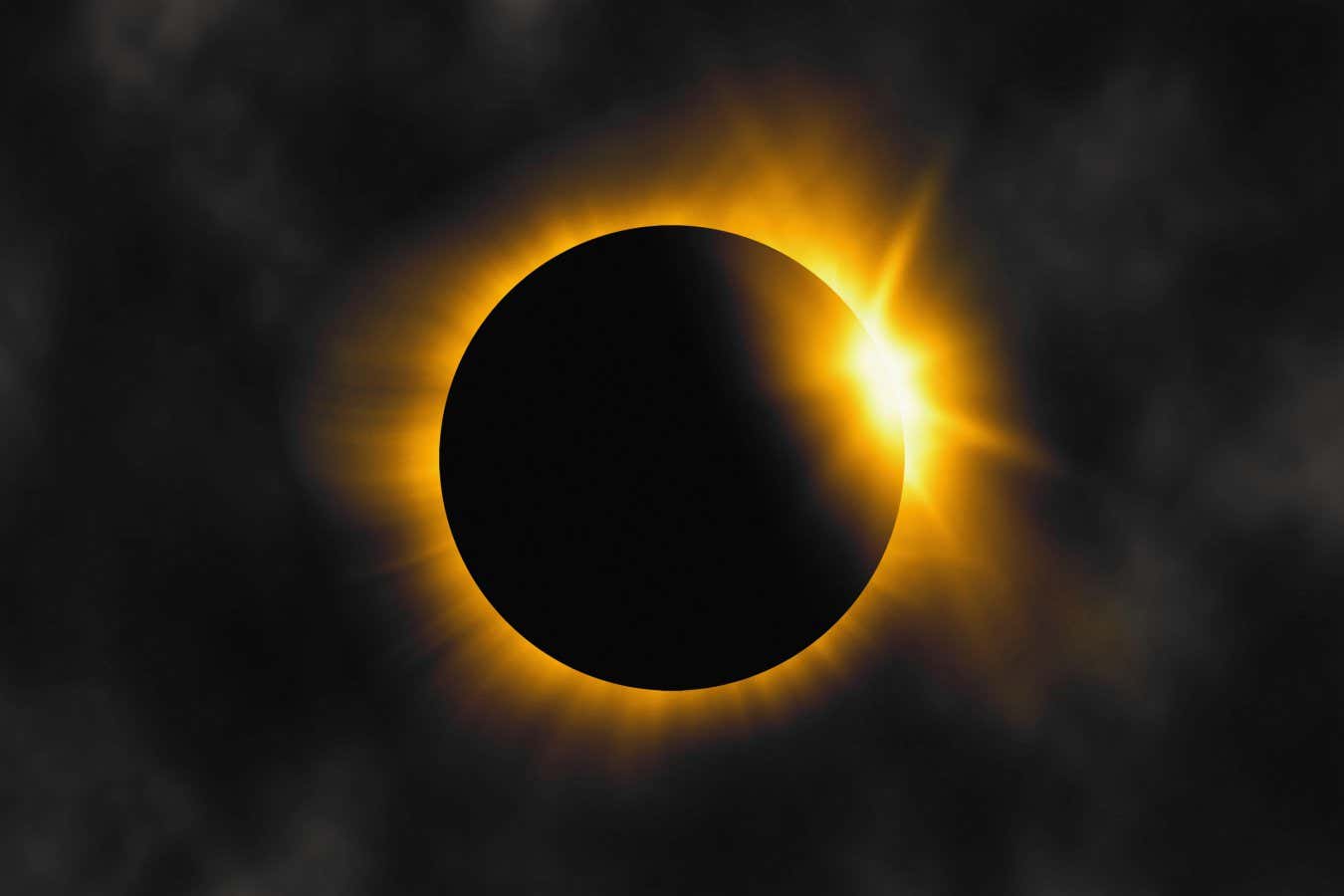
An image of the 2024 total solar eclipse
Allexxandar/Alamy
On 12 August, a total solar eclipse will sweep across parts of Europe and the Atlantic ocean as the moon passes between Earth and the sun, blocking out sunlight. Parts of the US and Africa, along with the entire UK and much of Europe and Canada, will see a partial solar eclipse.
Where can I see the eclipse?
Totality, which occurs when the moon lines up perfectly with the disc of the sun and blocks it out entirely, will begin in Russia around midday before sweeping eastward across the Arctic ocean. It will pass just south of the North Pole and make landfall in northeastern Greenland just after 4.00pm local time.
The shadow will then rush along the eastern coast of Greenland at a speed of more than 3400 kilometres per hour. The maximum length of totality will be about 2 minutes and 18 seconds, as the moon’s shadow crosses from Greenland into the Atlantic ocean. It will cross to Iceland, at which point the eclipse will become visible from more heavily inhabited areas – everywhere it will have passed so far is home only to small villages, research stations and those specifically making the journey to see the eclipse. In Reykjavík, though, totality will be visible for just over one minute at 5.48pm local time. This is the first time a total eclipse has been visible in Iceland since 1954, and the last time one will be visible there until 2196.
After skimming the western coast of Iceland, the total eclipse will make another ocean crossing and reach land again in northern Spain just before 8.30pm local time, grazing the northeast corner of Portugal and crossing the Balearic Islands off Spain’s east coast before the sun sets and the eclipse is over.

European Space Agency (ESA)
What happens during a total solar eclipse?
During totality, when the disc of the sun is completely concealed by the moon, temperatures on the ground rapidly drop by several degrees and daytime transforms into twilight. The stars and the outer reaches of the sun become visible. Usually, the sun’s outermost layer, the corona, is completely lost in the glare from its far brighter inner regions, but when those are blocked out, its shimmering sheets of extraordinarily hot plasma become briefly visible to the naked eye. In all other phases of the eclipse, it is crucial to wear eclipse glasses or use a solar filter while looking directly at the sun to prevent eye damage, but during totality it is safe to look at the corona.
That is precisely what many solar scientists will be doing during August’s eclipse. Total eclipses mark a valuable opportunity to observe the corona and try to unravel its many mysteries, including why it is so much hotter than the sun’s surface.
While the total eclipse will be short and only visible in a few areas, a partial eclipse, with the moon taking a “bite” out of the sun, will last much longer across about a quarter of the entire planet. In many locations across the northern US, all of Canada, much of Europe and northwestern Africa, the partial eclipse will last more than an hour. It won’t be as dramatic as a total eclipse – the corona will not become visible, and the ambient light levels and temperatures won’t drop as dramatically – but will be watchable for many more people. During a partial eclipse, eye protection is needed the whole time. If you don’t have eye protection, there are several ways to watch the eclipse without looking directly at the sun, including using a pinhole camera or even natural shadows to create a projection of the sun’s shape as the moon passes in front of it.

Discovery Tours: Eclipses
Explore our tours and cruises designed to help you make the most of experiencing awe-inspiring solar eclipses in handpicked locations around the world.
Topics:
