

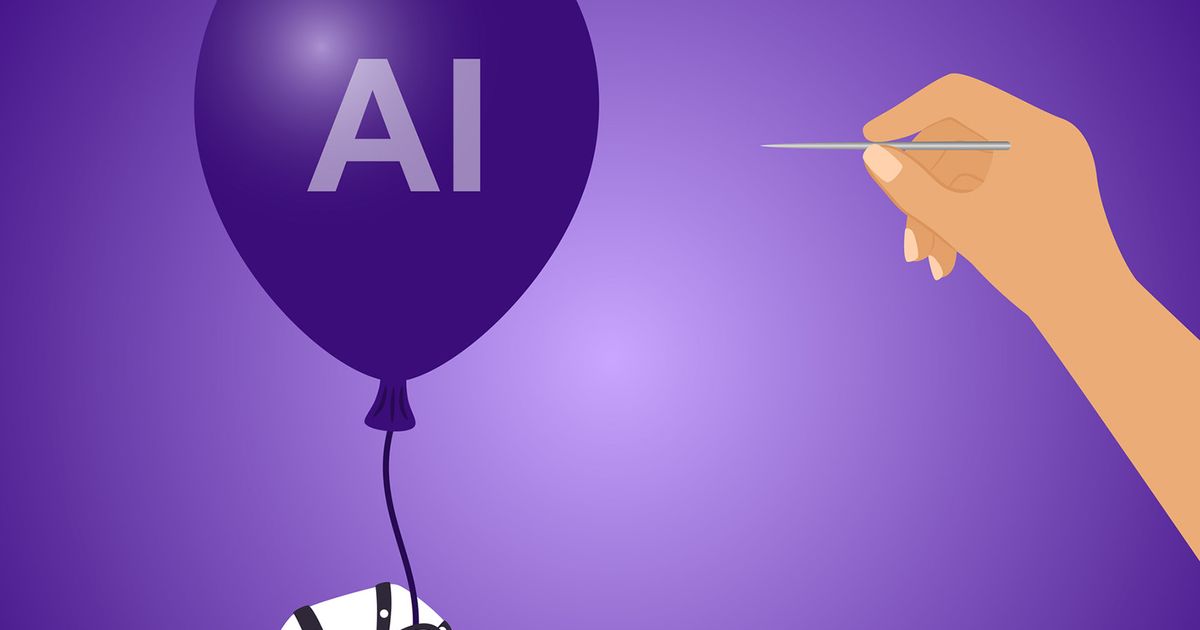
Artificial intelligence has truly arrived. Its hive mind has hatched in the op-ed email inbox as writers submit pieces I suspect are not from their own gray matter but from those massive data centers sprouting in Washington and beyond.
The Seattle Times recently made public its policy around the use of AI in newsgathering, in the interest of transparency and credibility. Readers, you should know what we allow and what we don’t, so you can be sure that humans with news judgment and ethical standards — and a boss — composed and published what you are reading. (Find that policy here: st.news/ai.)
Creators of these policies are always adapting and updating their guardrails. I think too many things in this life are hard, so here is my one-step rule for the op-ed desk: Please don’t submit AI-generated essays. In a similar vein, I am not in the market for op-eds that “sound like AI wrote them.”
The op-eds we publish are governed by the same philosophy as The Seattle Times’ news coverage and our editorials. You should be confident that what you are reading came from the thoughts, feelings and experiences of the person whose name is on the piece. That the narrative glue holding together the writer’s premises is strictly their own.
But, if I entered the prompts to help organize and refine my thoughts, isn’t that still my work? And isn’t it really small potatoes to use a few of the words that a chatbot spit out?
Bluntly, no.
Here’s a very heavily watered-down version of why: Say you’re struggling with articulating just how much you are honked off about something. You want to send your honkery to The Times, but what exactly to say is proving tougher than you thought. You call up Claude or ChatGPT or one of their little friends and enter prompts. It being your new friend, the bot barfs up some paragraphs and, depending on the program, offers you some sycophantic reassurance. So you string it together.
Friend, that is not your work. AI didn’t think up those words itself. It can’t because it doesn’t have a brain. It was trained to predict what it thinks you want, and it got there by crawling across the internet and digesting what it found. True? Copyrighted? Legal? Doesn’t matter. In the early days, AI’s creators said its progeny couldn’t go behind paywalls, as if that were reassuring. Experts who study AI tell me that ship has sailed. Artificial intelligence has trawled the vast sea of everything online, and it just keeps pulling in its net without regard to the bycatch.
Even worse, the more AI-regurgitated content people use, the more that teaches AI what humans want it to regurgitate. It becomes one giant, dumb loop. I don’t want to wade through any more of this. If I read any more about places and people that “thrive,” events that “are reshaping our region” and any issue that must be described with about 12 em dashes, I will reexamine that application for mortuary school. As AI would put it, that’s not creativity. That’s a tell. And it’s not doing the work of a good op-ed, which is making a strong argument backed with reasonable, well-thought-out evidence.
I want your struggle to be real. I, and fellow readers, want to know what makes you the right person to opine about forests, salmon, education, transit fare evaders, solutions to homelessness and, hopefully, ways we can do things better. Your high school English class and the stories you grew up hearing and the place you feel rooted in all make up what you have to say, and how you say it, or write it. The same result provided to a prompt entered by thousands of other people cannot do that. So don’t let it. It’s lazy and it’s disingenuous and it’s stealing from other people who wrote it first. It’s also propping up an industry that, while it has some white hats, has been thrust on us without consent to what it hoovers up, how it is powered and who profits.
I’ve tried and had some success with AI detectors. I know they’re not perfect and they can’t keep up with how AI is changing. In some sort of bizarre anti-intellectual arms race, developers have countered with “AI humanizers” and now detectors exist that claim they can ferret out prose that has been AI-generated and then manipulated again. By the time someone goes to all that trouble, they could have written an op-ed on their own. Based on my gut, I’ve asked a couple of writers if they used AI in constructing their pieces. Why yes, they said, unabashed. From start to finish. Points to me! But I don’t want artificial intelligence to be just one more thing that degrades our discourse, that prevents thoughtful opinions from surfacing and that prevents communities from thriving (ugh). Please keep sending me real opinions from real people.
