

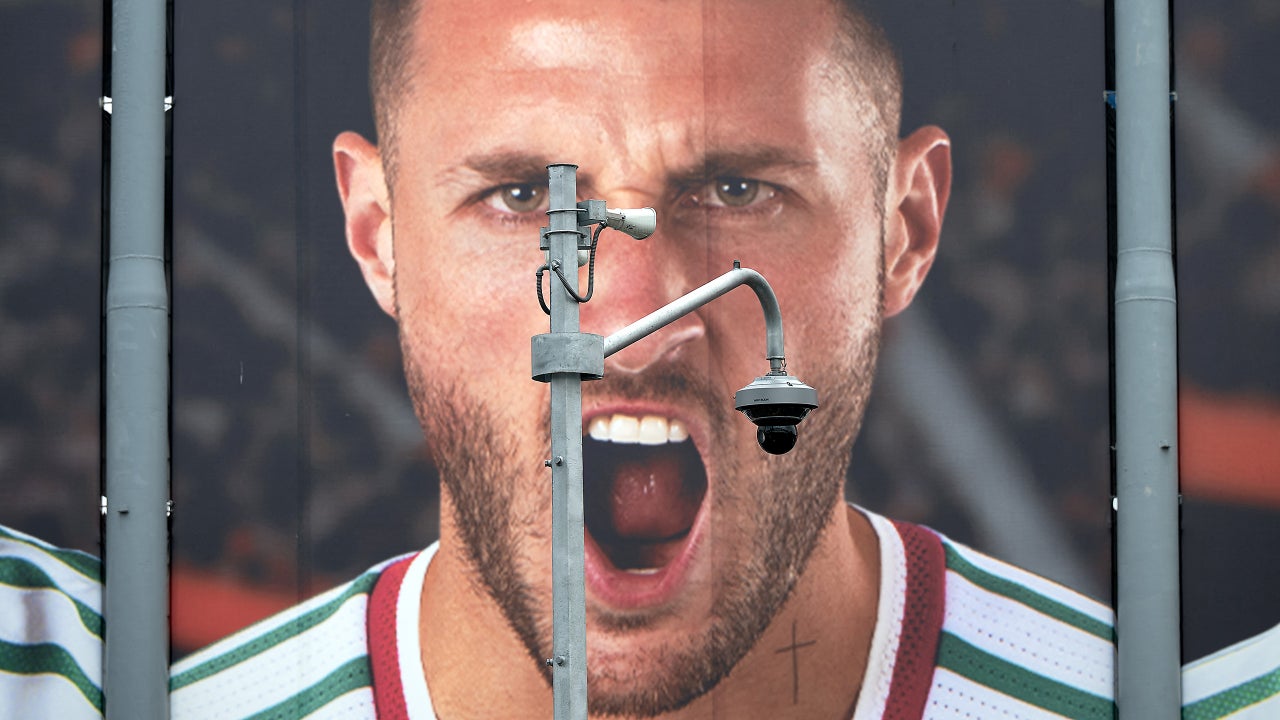
The 2026 FIFA World Cup is the largest sporting event in history. It’s also the most surveilled World Cup ever. If you’re visiting or traveling around host cities, then you and your face, behavior, movement, and devices are being monitored by governments and private companies.
The U.S. government funneled more than $1 billion to protect transit hubs, stadiums, and surrounding areas; improve tactical operations such as bomb squads and SWAT teams; and add and upgrade equipment. It’s been a bonanza for the private sector.
Much of the investment in surveillance was done in the name of preventing harm from unauthorized drone use. Indeed, protecting against that threat is helping fuel the rapidly expanding government-private sector partnership in surveillance technology development and acquisition, which poses a different risk—to privacy.
As an attorney, author, and educator who has worked for decades in privacy and surveillance, I’ve advised law enforcement about using drones and understand that security is critical to keeping people safe. The security argument, however, is too often the catalyst to fund, develop, and increase government surveillance capabilities that erode civil liberties, chill speech, and undermine freedom of association.
And in my experience, surveillance-friendly policies and tech systems, once in place, rarely go away.
Cameras, drones, and AI
The level of surveillance around this World Cup and changes in U.S. law and immigration policies prompted more than 120 civil society groups—including Amnesty International and the American Civil Liberties Union—to issue a travel advisory. They warn that people visiting the U.S. may be subject to harms that breach the country’s legal human rights obligations.
That advisory lists risks of invasive social media screening, searches of electronic devices, racial profiling, arrest, detention, deportation, and even death. European governments have issued travel advisories warning of surveillance and profiling as well.
AI-driven surveillance is playing a major role across the World Cup. The stadiums in host cities are equipped with facial recognition cameras that can collect and analyze facial biometrics of people in and around the stadiums. That data can be retained and used in future ways, unknown and uncontrolled by those whose biometric data has been collected.
The proliferation of facial recognition at events reflects a broader global trend normalizing biometric surveillance as these systems expand across cities.
Many states, like New York, are using federal funding for World Cup security to increase the number, capabilities, and use of drones by law enforcement. Drones are remarkably capable and powerful surveillance tools, easy to load with cameras, microphones, advanced sensors, and weapons.
AI-supported autonomous software allows drones to monitor areas, track movement, and gather intelligence. The drones can be powerful enough to scan entire cities or zoom in and read a milk carton from 60,000 feet (18,288 meters). They can carry technology that allows them to function like a cellphone tower, permitting law enforcement to determine your location or intercept texts and phone calls. Citywide drone networks could become the new normal.
Cameras are proliferating on the ground as well. Robot dogs equipped with cameras are prowling in Texas and New Jersey. And Seattle’s mayor decided to turn on and expand a major closed-circuit television system that had been previously shut down because of biometric privacy concerns.
While Seattle’s mayor said that the city is refining its policies to protect the surveillance data, numerous states and cities—with the aid of federal funding related to World Cup security—are rapidly expanding CCTV systems. Some CCTV systems were installed decades ago in major urban, high-tourism areas, like New York’s Times Square and the National Mall in Washington, D.C.
Today, CCTV systems cover much greater areas, and with advances in AI software, data analytics, and increased technical capabilities, like thermal imaging, far more information can be gleaned from the captured data. CCTV systems can now detect, identify, and classify objects, people, and even people’s behavior. Government data fusion centers can merge that rich data with other intelligence and analyze it to identify individuals and reveal and predict patterns and behavior.
Surveillance cameras in Vancouver, British Columbia, and other World Cup host cities are raising privacy concerns.
Surveillance traveling into and around the U.S.
Proliferating government use of advanced AI surveillance tools is just one element of the privacy risk. The absence of comprehensive data privacy laws and changes in U.S. law and executive policies around immigration and gender make traveling into and around the United States a security, safety, and privacy risk.
On September 8, 2025, the Supreme Court issued a ruling that critics say permits racial profiling in immigration enforcement efforts.
Also, President Donald Trump issued an executive order around gender on January 20, 2025, that mandates federal agencies recognize only male and female sex markers on IDs. European nations, including Germany, have warned their transgender and nonbinary citizens that they may be denied entry to the U.S. because of the directive.
Collectively, these changes affect travel logistics, documentation requirements, and border crossings.
What happens after the games?
The real test is what happens after the World Cup ends and visitors go home. There is little oversight or governance around these federally funded, public-private surveillance tech partnerships. It’s difficult for the public to determine what data is being collected, how that data is being used, shared, and analyzed, and what will happen to these systems, partnerships, and data when the final match concludes.
Federal, state, and local legislators have an opportunity to address much of this by creating data privacy and AI systems compliance safeguards and requiring transparency, but in my view governance efforts to date don’t bode well.
Anne Toomey McKenna is an affiliated faculty member at the Institute for Computational and Data Sciences at Penn State.
This article is republished from The Conversation under a Creative Commons license. Read the original article.
