

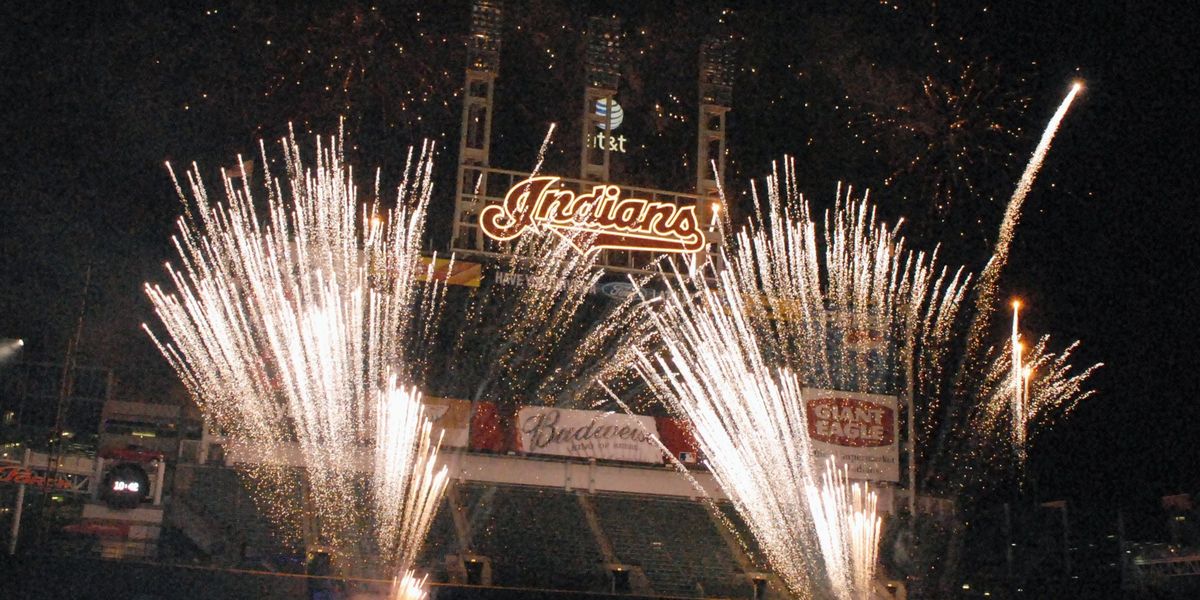
In the 1970s, American Fireworks, a family-run pyrotechnics company in Hudson, Ohio, used a “home run box” to offer quick and easy fireworks displays for the Cleveland Indians (now the Cleveland Guardians) baseball games.
The red wooden crate had metal silos to store the rockets. Each switch on the control panel allowed the operator to set off a different firing sequence. This setup instantly triggered the display whenever a Cleveland batter hit a home run. Before computerized firing systems became common, panels like this represented the state of the art. But they did not eliminate human error. On 15 September 2015, the technician in charge of the Indians’ pyrotechnics accidentally set off the fireworks when the opposing team hit a home run. The embarrassed technician was caught on camera holding his head in his hands.
This home run box and control panel [left] were used to launch fireworks during Cleveland Indians games. The rockets were housed in metal silos within the box.Left: Jahna Auerbach/Science History Institute; Right: American Fireworks
The Early History of Fireworks
Fireworks are one of the many Song Dynasty inventions that migrated from China through the Middle East and into Europe by way of trade routes. Around 200 B.C.E, the Chinese invented small firecrackers by simply tossing pieces of bamboo into a fire. The air inside the bamboo would expand and crack the wood, and the pop supposedly scared away evil spirits. After the invention of gunpowder—a mixture of sulfur, charcoal, and potassium nitrate—about a thousand years later, some clever person thought to pack the powder into the bamboo tubes and ignite them, launching the first fireworks—and the first rockets—into the sky.
 John Bate’s popular 1634 book on fireworks described fire wheels [left] and a flying dragon [right], consisting of a dragon-shaped rocket that sped along a rope. SSPL/Getty Images
By the Renaissance, specialized schools for pyrotechnics had emerged across Italian city-states, and European craftsmen began creating large spectacles for royal occasions and religious celebrations. In 1634, John Bate published the four-volume series The Mysteries of Nature and Art, the second of which described how to create all manner of fireworks. Woodcut illustrations showed fire wheels (now called pinwheels or Catherine wheels), as well as the more ambitious flying dragon—a rocket shaped like a dragon that emitted sparks while speeding across a rope strung between two buildings.
During the 18th and 19th centuries, chemists and alchemists discovered new chemical compounds and isolated new elements that expanded the palette for fireworks. Adding barium nitrate produced green, for example, and strontium nitrate produced red. Chemists also mixed in metal particles to create sparkles.
The 1880s saw the introduction of the loud screech or whistle that precedes the exploding boom. Amédée Denisse, a graphic artist by trade and a fireworks hobbyist, discovered that a cardboard tube containing potassium picrate added that satisfying auditory effect to his fireworks display.
How Did Fireworks Become a 4th of July Tradition?
British colonists brought fireworks to the Americas. In 1608, Captain John Smith set them off to celebrate the founding of Jamestown, Virginia, the first permanent English settlement in what would become the United States. More than a century and a half later, while the Continental Congress was meeting in Philadelphia in July 1776, future U.S. president John Adams speculated in a letter to his wife that Independence Day would be celebrated “with pomp and parade, with shews, games, sports, guns, bells, bonfires and illuminations from one end of this continent to the other.”
Although Adams got the day wrong—he mistakenly thought the committee would complete the revisions to the Declaration of Independence by the 2nd of July—he was correct in foreseeing that Independence Day would be celebrated with lots and lots of fireworks. Just a year later, on 5 July 1777, the Pennsylvania Evening Post reported on the grand exhibition of fireworks the previous night, which began and concluded with 13 rockets representing the 13 colonies.
It’s safe to say that the United States is still obsessed with fireworks. According to the American Pyrotechnics Association, the country spends about US $3 billion on fireworks each year; it’s also the leading importer of fireworks. As the U.S. gears up to celebrate its 250th birthday this 4th of July, expect to see fireworks displays everywhere, from kids with sparklers running in backyards to ambitious professional displays for huge crowds.
 Modern fireworks displays like the Macy’s 4th of July celebration in New York City are computer choreographed and controlled. Roy Rochlin/Getty Images
Fireworks today are an engineering marvel. State-of-the-art displays are computer controlled with precise digital timing, often tied to musical accompaniment. Designers can spend weeks choreographing complicated patterns and assigning launch times, shell types, and colors. The completed script is uploaded to an electronic firing system, which consists of the control panel and hundreds or thousands of firing modules that connect to the rockets. It can take days to set up the launch site for a large-scale display that lasts just minutes.
For example, last year more than 60 licensed pyrotechnicians worked for 12 days to arrange more than 80,000 shells for the Macy’s 4th of July Fireworks in New York City. Each of the firework shells measured up to 25 centimeters in diameter and weighed more than 13 kilograms—a far cry from their bamboo ancestors. More than 120 kilometers of wire connected the bundles of explosives to twelve computers. All that for a 25-minute display.
As much as I unabashedly love fireworks, they’re not for everyone and they do have a downside. The explosions can trigger PTSD for military veterans, and they can also upset animals. Every year, thousands of people are injured by mishandled or damaged fireworks. Known to set off wildfires, fireworks are often banned during droughts. Scientists who’ve studied the environmental impact of fireworks displays have noted their tendency to disperse airborne metallic particles and other harmful particulates.
 A drone light show over Busan, South Korea, shows a member of the K-pop band BTS.Hwawon Ceci Lee/Anadolu/Getty Images
Perhaps to counter those drawbacks, or maybe it’s just the next technological evolution in aerial display, companies are now offering drone light shows. Fleets of hundreds or thousands of LED-toting drones can be programmed to hover in the air and fly in formation, forming logos and other designs that are more stable than exploding fireworks.
These exquisitely choreographed light shows are truly impressive. And yet I relish the full sensory experience of fireworks, including the booms, the smoke, and the smell. So whether you’re celebrating your country’s birth, Guy Fawkes Day, Saint Sylvester’s Night, New Year’s, Diwali, or simply cheering a home run from your favorite team, I hope you get to enjoy this millennia-old technological marvel.
Part of a continuing series looking at historical artifacts that embrace the boundless potential of technology.
An abridged version of this article appears in the July 2026 print issue as “Rooting for the Home Team.”
From Your Site Articles
Related Articles Around the Web
