

On August 12, 2026, lucky viewers in and around Greenland, Iceland and Spain—weather allowing—will be able to see one of nature’s truly glorious sights: a total solar eclipse.
Much has been written about solar eclipses (I wrote an article on April 5, 2024, for Scientific American, myself), so I won’t belabor the usual points. Instead I want to take a closer look at a common claim: that our Earth is special because it’s the only planet in the solar system where such perfectly aligned solar eclipses can occur.
Eclipses depend on a wonderful coincidence: the sun is about 400 times the diameter of the moon, but on average it’s also about 400 times farther away from Earth. These two factors cancel each other out, so the moon and sun appear to be the same size in our sky. This means we can get total eclipses, during which the moon completely blocks the sun, but it also means the moon sometimes just barely blocks the sun’s disk.
On supporting science journalism
If you’re enjoying this article, consider supporting our award-winning journalism by subscribing. By purchasing a subscription you are helping to ensure the future of impactful stories about the discoveries and ideas shaping our world today.
That’s important. The sun is surrounded by its corona, an ethereally thin atmosphere of ionized gas that extends for many millions of kilometers. Normally invisible to us, the corona suddenly leaps into view the moment the moon blocks the sun’s brilliant face. Arguably this is what makes a total eclipse so gasp-worthy: the appearance of the gorgeous wisps and streamers of the corona are extraordinarily beautiful and so rare to see that some people cry—yes, openly weep—at the sight.
If the moon were smaller or farther from Earth, it would never block the sun’s face, and we’d never see the corona. If it were bigger or closer to us, it would also block a substantial portion of the corona, severely reducing the overall emotional impact.
This is a remarkable coincidence, but is it unique? Other planets in our solar system have moons; some have many. So do any possess that special ratio of distance and size to create an otherworldly total solar eclipse?
I did the math. Let’s see!
Mercury and Venus have no moons, so those are easy. No moons = no eclipses.
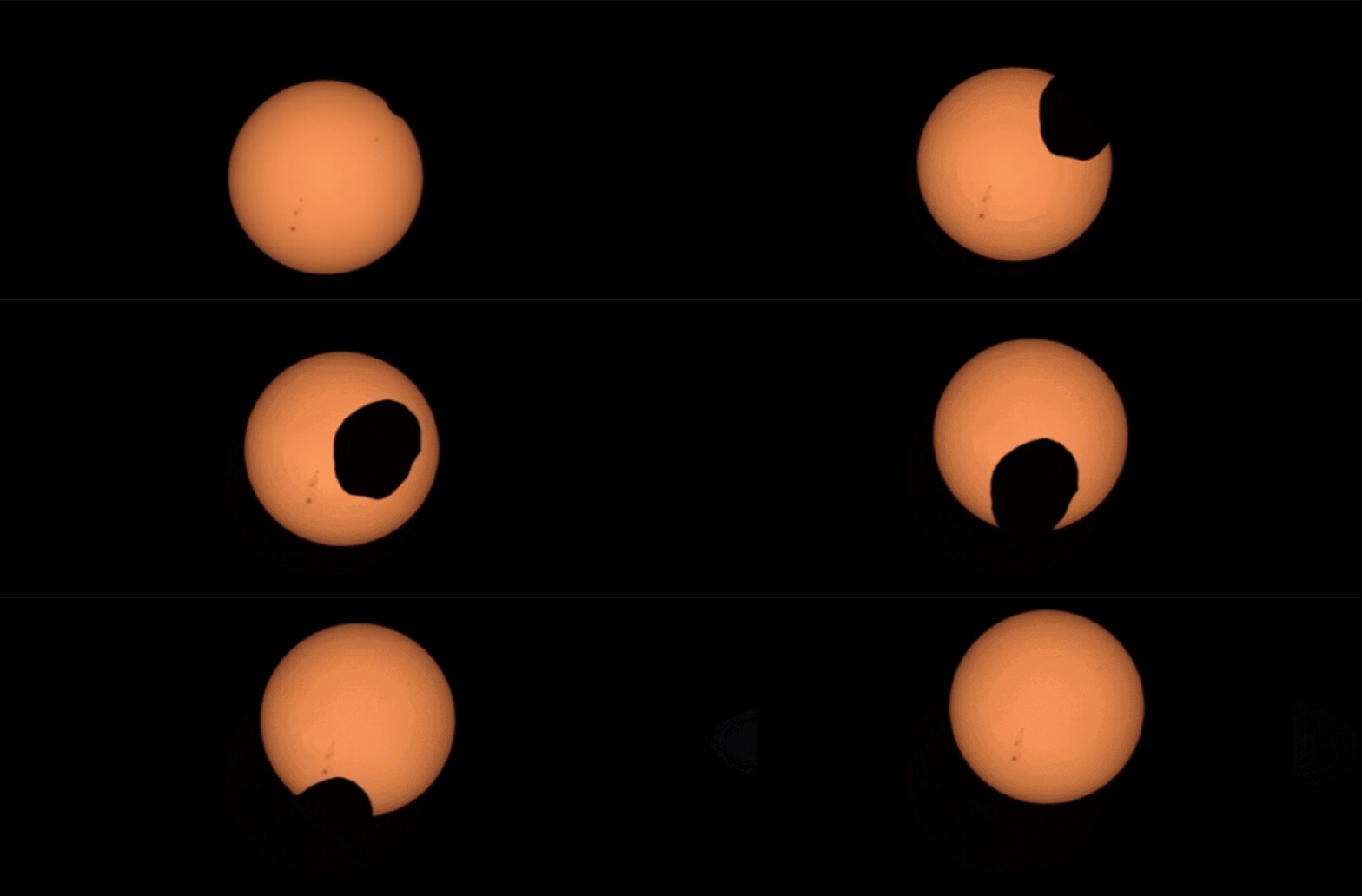
Mars has two moons, a pair of spudlike rocks called Deimos and Phobos. Both are small, less than 25 kilometers wide, and even though the sun is smaller in Mars’s sky because of the planet’s greater distance from it, neither moon can fully block it as seen from the surface. In fact, rovers on the surface of Mars have observed both moons pass in front of the sun, and at best, Phobos (which is larger than Deimos and closer to the planet) covers only a fraction of the solar disk. We could technically call such events annular eclipses—which occur when a moon’s apparent size is smaller than that of the sun, leaving a ring of sun around the moon’s silhouette—but more accurately, these would be called transits. Also, a Phobos eclipse lasts less than a minute! While it would be amazing to witness, a Martian eclipse would be a pale shadow of what we can see from Earth.
Moving on (and outward), Jupiter is about five times as far from the sun as Earth is, so our star appears only one fifth as large in its sky. The planet has four large moons, each of which can create a total eclipse—but Io is five to six times the sun’s apparent size, while Europa and Ganymede are both about three times bigger. That means they’d also block much of the inner part of the corona, lessening the effect. Callisto would be about half again as big as the sun in the sky, so more of the corona would be visible, but still not as much as we see from Earth. Jupiter’s other moons are too small or too distant to create a total eclipse. Earth wins this one.
Next up is Saturn, about 10 times as far from the sun than Earth is, with a dizzying array of moons. As with Jupiter, nearly all of Saturn’s major moons would appear at least twice the size of the sun, rendering the inner corona invisible. Most other Saturnian moons would be too small to generate a total eclipse.
There’s an exception, however: Epimetheus, an irregular icy body 130 × 116 × 107 km in size. Its orbit is slightly elliptical, averaging 151,450 km in radius. When it’s directly overhead, as viewed from Saturn’s equator, it would appear to be only slightly larger than the sun. But when it’s on the horizon, it’s farther away (by approximately Saturn’s radius of 60,000 km), so it would appear smaller than the sun. That means that somewhere between the two, it would appear exactly the same size as the sun! Even accounting for its irregular shape, this must still be true.
And this means the claim of Earth’s uniqueness is incorrect. There is at least one other place in the solar system where it’s technically possible to see a well-aligned total solar eclipse!
To be fair, it wouldn’t be as amazing a view as we get on Earth. For one, the sun would be tiny, so you’d need a telescope to see any details during the eclipse. For another, Epimetheus moves so swiftly in its orbit that the eclipse would last less than 10 seconds. Also, like Earth, Saturn’s rotational axis is tipped relative to its orbit. This means eclipses could only occur at the equinoxes, twice each Saturnian year of 29.5 Earth years. That’s a long time to wait to see such a teeny, short-lived eclipse.
I may be biased, but I think Earth wins here, too.
I did poke further out in the solar system and found another case: Perdita, a tiny 30-km-wide moon of Uranus that, like Epimetheus, can potentially be the exact size of the sun in the Uranian sky. The trouble is, this moon’s diameter isn’t perfectly known, and it’s possible Perdita may be too small (or irregularly shaped) to ever create a total eclipse. Even if it did, the eclipse would only be at most a few seconds long—plus, given the length of the Uranian year, it would be 42 years between eclipses as well.
Earth’s eclipses win yet again.
So, in the end, the claim that we are the only planet to enjoy such “perfect” solar eclipses isn’t technically true, but they wouldn’t be nearly as spectacular from these other worlds. (I have to note that I’ve left out various additional possibilities: for instance, many asteroids have moons, too, but at this point I leave those calculations to a reader far more dedicated—and patient—than I.)
Knowing there are other places in our solar system to witness total eclipses of our star does nothing to reduce the awe and majesty of this amazing sight. If we share it with other worlds, the more the merrier! Perhaps future astronauts will enjoy that view, but for me, right now Earth is still the best place to be an umbraphile.
