

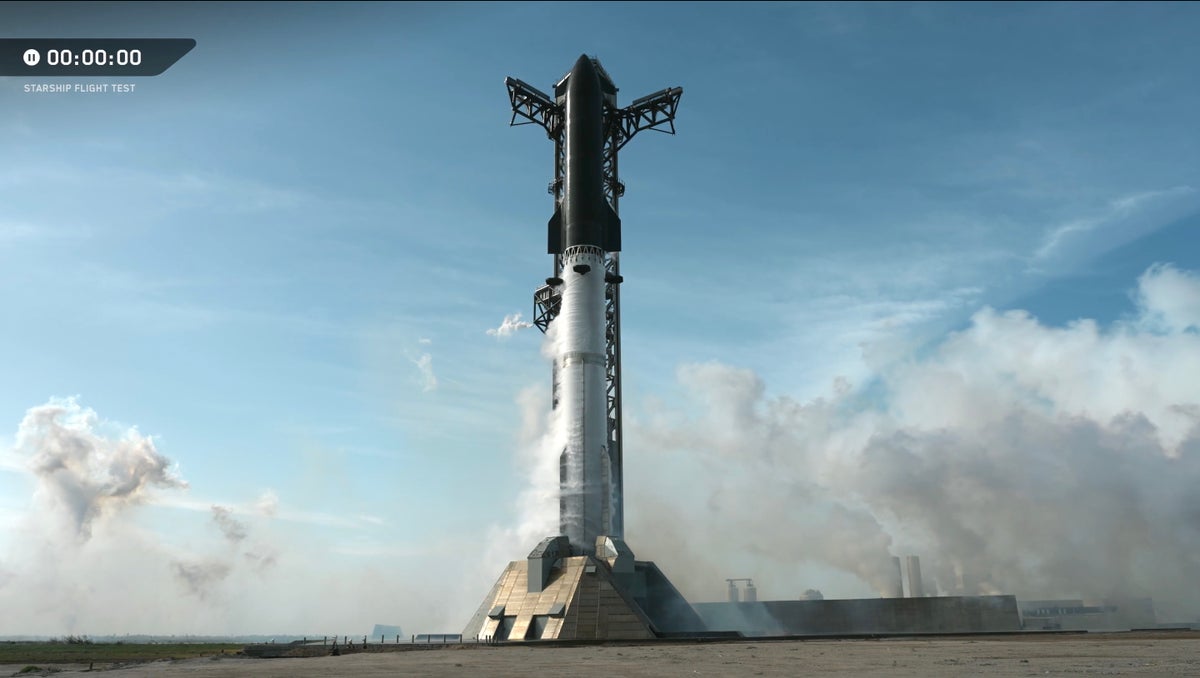
The first launch attempt for SpaceX’s thirteenth flight of its Starship megarocket has ended before it truly began. Automated safety features suspended the launch at T-minus 0, about 6:45pm Eastern time, just as Starship’s first-stage Super Heavy V3 booster began to fire its Raptor engines. The abort left Starship upright and intact on Pad 2 of SpaceX’s Starbase launch complex in Boca Chica, Texas as SpaceX personnel began the process of off-loading propellant from the vehicle.
“We got all the way down to startup, triggered a hold on the booster, and that shut down the engines right as they were starting to ignite,” said SpaceX spokesperson Dan Hewitt during the company’s livestream of the launch attempt. “No Starship launch today. We’ll dig in with the teams and figure out when our next attempt is going to be.”
In a subsequent social media post, SpaceX’s CEO Elon Musk said two Raptor engines would be removed and replaced “to be confident of a good flight,” with the next launch attempt most likely occurring early next week.
On supporting science journalism
If you’re enjoying this article, consider supporting our award-winning journalism by subscribing. By purchasing a subscription you are helping to ensure the future of impactful stories about the discoveries and ideas shaping our world today.
This flight was meant to follow much the same profile as its predecessor Flight 12, sending Starship into space but not into orbit. (Flight 12 also started with an initial scrub.) For Flight 13, after separating from Starship high above the Earth, the Super Heavy V3 would fly back to perform a pinpoint splashdown in the Gulf of Mexico—a landing that the booster failed to stick during Flight 12.
Meanwhile, Starship would continue on its suborbital trajectory, deploying a payload of 20 Starlink V3 satellites once in space. The satellites would only survive about 20 minutes before ultimately plunging to their fiery doom reentering Earth’s atmosphere. That would be enough time, however, for some of them to capture images of Starship’s heat shield, then transmit them to mission controllers on the ground via SpaceX’s Starlink network.
This flight’s Starship itself is also a “V3,” featuring a host of design improvements over its two previous iterations; Flight 12 was the first for Starship V3. After deploying its Starlink satellites, the Starship would then attempt something originally intended for that earlier flight: reigniting one of its six Raptor engines for a brief burn. That feat was called off for Flight 12 due to a premature shutdown of one of the Raptor engines.
Whenever it actually launches, Flight 13 is planned to end about an hour after lift-off, with Starship splashing down in a remote stretch of the Indian Ocean north of Australia.
Ultimately, SpaceX wants to use Starship as its mainstay rocket, replacing the company’s current workhorse, Falcon 9. Starship, able to carry 100 metric tons of cargo to orbit, will be able to loft many more Starlinks at a time than the Falcon 9. Others are counting on Starship’s success, too—NASA chief among them. As part of its Artemis program, the space agency hopes to use a lunar-lander variant of the vehicle to send astronauts to the surface of the moon as soon as 2028.
Provided, that is, Starship can not only get off the ground but also reach orbit and then return safely to Earth. And not only once, but multiple times in rapid succession. The Artemis IV mission that would put American bootprints on the moon for the first time in more than 50 years would require several Starship launches to transport sufficient propellant into orbit to allow the round-trip lunar voyage to take place.
A watchdog report published in March found SpaceX is lagging behind NASA’s aggressive lunar timeline, and the space agency is also funding development of a Blue Origin lunar lander for Artemis missions.
The clock is ticking for both companies: NASA’s Artemis III, a crewed mission to test key capabilities for both vehicles in low-Earth orbit, is targeted for launch before the end of next year. SpaceX’s part of that current plan involves docking Starship with NASA’s crew capsule, Orion—but the company still needs to show its crown jewel vehicle can get to orbit at all.
That means many more test flights, if nothing else.
It’s Time to Stand Up for Science
If you enjoyed this article, I’d like to ask for your support. Scientific American has served as an advocate for science and industry for 180 years, and right now may be the most critical moment in that two-century history.
I’ve been a Scientific American subscriber since I was 12 years old, and it helped shape the way I look at the world. SciAm always educates and delights me, and inspires a sense of awe for our vast, beautiful universe. I hope it does that for you, too.
If you subscribe to Scientific American, you help ensure that our coverage is centered on meaningful research and discovery; that we have the resources to report on the decisions that threaten labs across the U.S.; and that we support both budding and working scientists at a time when the value of science itself too often goes unrecognized.
In return, you get essential news, captivating podcasts, brilliant infographics, can’t-miss newsletters, must-watch videos, challenging games, and the science world’s best writing and reporting. You can even gift someone a subscription.
There has never been a more important time for us to stand up and show why science matters. I hope you’ll support us in that mission.
