

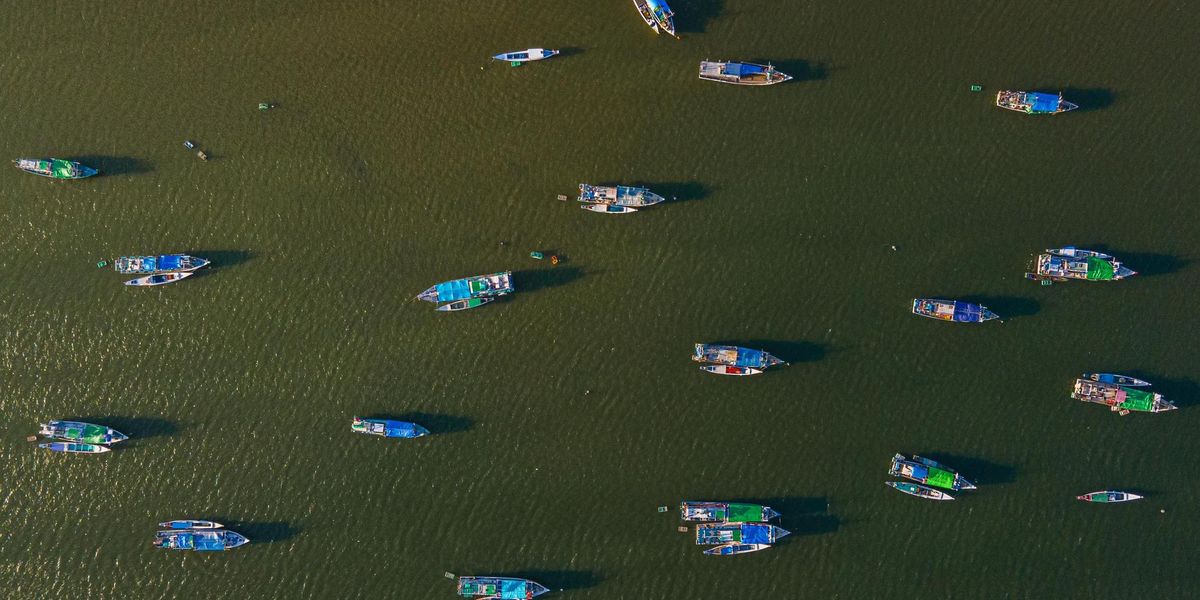
In the eastern Indian Ocean, south of Java in the vast sea stretching toward Australia, a fishing vessel slightly alters its course while operating near the boundary of its authorized fishing ground. Nothing appears unusual on deck. Nets remain in the water. Engines maintain a steady speed. To the crew, it is an ordinary day at sea.
Yet hundreds of kilometers above, satellites continuously record the vessel’s position. At Indonesia’s Marine and Fisheries Resources Surveillance Station in Cilacap, where I work, a monitoring platform receives the signal and automatically compares it against fishing permits, designated fishing grounds, vessel characteristics, and historical movement patterns. Within minutes, the system identifies a potential violation. Before any patrol vessel leaves port, before any inspector boards a vessel, and before any warning is issued, we have begun enforcement.
This transformation reflects a profound shift in maritime governance. The ocean has historically been opaque to regulators. States could only enforce laws where patrol vessels happened to be present. Today, however, integrated systems combining data from Vessel Monitoring Systems (VMS), satellite remote sensing, geospatial analytics, and increasingly sophisticated data-processing tools are making marine activity visible at an unprecedented scale. Global Fishing Watch alone tracks hundreds of thousands of vessels worldwide, generating a near real-time picture of fishing activity across the world’s oceans.
Indonesia has emerged as one of the most ambitious examples of this transition. As the world’s largest archipelagic state, managing more than six million square kilometers of maritime space, Indonesia faces a challenge familiar to many coastal nations: there are never enough patrol vessels. Digital surveillance is a practical necessity that makes my job possible, even as it creates new challenges.
The Law of the Sea Meets Digital Reality
The international legal framework governing the oceans was designed in an era when maritime enforcement depended almost entirely on physical presence. The United Nations Convention on the Law of the Sea (UNCLOS), adopted in 1982, assumes that states exercise authority through patrols, inspections, vessel boardings, and direct observation.
For countries with extensive coastlines and limited enforcement resources, this model has always faced practical constraints. Indonesia’s Fisheries Management Areas (WPP-NRI) span waters ranging from the Indian Ocean to the Pacific and from the Strait of Malacca to the maritime boundaries adjacent to Australia and Papua New Guinea. Monitoring such a vast domain solely through patrol operations is both expensive and operationally impossible.
Beginning in the late 2010s, Indonesia accelerated the integration of satellite-based monitoring into fisheries enforcement. Vessel Monitoring Systems became a cornerstone of this strategy. By early 2026, a total of 9,394 Indonesian fishing vessels were actively transmitting through the national Vessel Monitoring System (VMS), representing an increase of 2,880 vessels during the 2021–2025 period. As part of Indonesia’s broader maritime surveillance architecture, VMS data are complemented by satellite remote sensing and other monitoring tools to help identify suspicious activities involving vessels operating without active transponders or outside the national VMS network.
Indonesian fisheries officials plan fishery patrols using data from tracking devices, satellites, and their understanding of the patterns of illegal fishing.Indonesian Ministry of Marine Affairs and Fisheries
The implications extend far beyond vessel tracking. Continuous digital monitoring enables authorities to reconstruct vessel movements, identify suspicious behavioral patterns, detect unauthorized fishing activity, and verify compliance with licensing conditions. Rather than waiting to discover violations during patrol operations, regulators can increasingly prioritize inspections based on data-derived risk assessments.
Maritime governance is shifting from reactive enforcement toward predictive oversight.
The Surprising Geography of Digital Enforcement
The expansion of surveillance infrastructure has already generated measurable enforcement outcomes.
The Ministry of Marine and Fisheries Affairs Indonesia imposed 2,550 administrative sanctions during 2025, many involving violations detected through the Vessel Monitoring System, including fishing outside authorized fishing grounds and deliberate deactivation of monitoring transmitters.
This statistic is significant because many of these violations would have been extremely difficult to detect under traditional patrol-based enforcement. A vessel that briefly crosses into a prohibited fishing zone may never encounter an enforcement vessel. Likewise, a captain who temporarily disables a transmitter may escape detection if oversight depends solely on physical inspections.
Digital monitoring fundamentally changes this equation. Every vessel movement creates a data trail. Authorities can reconstruct routes, identify anomalous behavior, and compare activities against permit conditions long after the event itself has occurred.
The first quarter of 2026 demonstrates the scale of this surveillance capability. During just three months, Indonesia’s fisheries monitoring system tracked 14,571 fishing vessels, 182 fishing gear units, and 208 registered home ports while identifying 491 suspected violations across the country’s fisheries management areas. These violations included unauthorized fishing grounds, illegal high-seas operations, transshipment-related offenses, port-base discrepancies, licensing irregularities, and indications of poaching.
Such numbers reveal a fundamental transformation. Enforcement is no longer limited by the number of patrol vessels available at sea. Instead, surveillance capacity increasingly depends on the ability to collect, process, and interpret big data.
Illegal Operators Are Learning Too
Yet greater visibility does not eliminate illegal fishing. But it does change how poachers operate.
Indonesia’s expanding digital surveillance network, and a 2023 requirement that even small vessels use VMS when 12 nautical miles offshore, appears to have improved compliance among licensed fishing vessels. However, as enforcement capabilities become more sophisticated, some actors engaged in illegal fishing have also become more adept at exploiting technological and operational gaps.
Deliberately disabling VMS transmitters remains one of the most common enforcement concerns. While temporary signal losses, whether intentional or caused by technical failures—can complicate the reconstruction of vessel movements, they do not necessarily prevent authorities from detecting potentially illegal activity. Indonesia increasingly combines VMS with satellite-based observations, other maritime surveillance systems, intelligence-led analysis, and reports from community-based surveillance groups (Pokmaswas) to corroborate suspicious behavior and direct patrol resources where they are most needed. This layered approach—integrating digital technologies with local knowledge from coastal communities—helps reduce opportunities for illegal, unreported, and unregulated (IUU) fishing even when a single monitoring system is compromised.
A compromised surveillance network could potentially disrupt enforcement operations just as effectively as a vessel evading patrol detection.
As digital surveillance expands, one lesson from Indonesia’s experience is that stronger monitoring does not eliminate illegal fishing—it changes how illegal operators behave. Improved compliance across much of the fishing fleet has been accompanied by increasingly sophisticated attempts by a smaller group of offenders to avoid detection. This reflects a broader reality of technology-enabled enforcement: as monitoring capabilities evolve, so do the strategies used to circumvent them.
The result is a technological arms race. Every improvement in surveillance capability encourages new methods of avoidance, whether through disabling tracking devices, manipulating vessel identities, or exploiting gaps between different monitoring systems. Enforcement agencies must therefore continuously refine their analytical methods, integrate multiple sources of maritime information, and adapt their operational strategies to keep pace with evolving behavior at sea. Effective digital fisheries governance is not defined by a single technology, but by the ability to combine data, human expertise, and operational intelligence into a resilient and adaptive enforcement system.
The Next Battle May Be Over Data Integrity
The future of fisheries enforcement may ultimately depend less on detecting vessels and more on ensuring confidence in the digital systems that generate enforcement decisions.
As surveillance networks become increasingly integrated, questions surrounding cybersecurity, algorithmic accountability, and data integrity become more important. What happens if vessel tracking data are manipulated? How should authorities verify automated risk assessments? What safeguards exist when enforcement actions increasingly originate from algorithmic analysis rather than direct human observation?
These questions are no longer theoretical.
Modern fisheries governance increasingly depends on interconnected networks of satellites, communication systems, databases, cloud infrastructure, and analytical platforms. While these technologies dramatically improve visibility, they also create new vulnerabilities. A compromised surveillance network could potentially disrupt enforcement operations just as effectively as a vessel evading patrol detection.
For Indonesia, this means that investment in digital surveillance must be accompanied by investment in digital resilience. The effectiveness of a monitoring system ultimately depends not only on the volume of data collected but also on the credibility, security, and reliability of the information produced.
Governing Oceans Through Data
Indonesia’s experience illustrates a broader global transformation in maritime governance. The ocean is becoming increasingly transparent to regulators. Activities that once occurred beyond the reach of enforcement agencies can now be observed, analyzed, and investigated through interconnected digital systems.
The benefits are substantial. Expanded VMS adoption, improved monitoring coverage, and thousands of administrative enforcement actions demonstrate that digital surveillance can significantly enhance fisheries governance. Yet the transition also introduces new challenges involving data quality, cybersecurity, algorithmic accountability, and adaptive criminal behavior.
The central question facing maritime regulators is how governments can ensure that increasingly powerful monitoring systems remain transparent, secure, and accountable while preserving public trust and legal legitimacy. The most important lesson may be that digital surveillance does not replace traditional enforcement. It changes where enforcement begins. For generations, maritime law enforcement started when a patrol vessel encountered a suspected violator. Today, it often starts when an algorithm detects a pattern.
That shift may prove as significant for ocean governance as the invention of radar was for maritime navigation.
From Your Site Articles
Related Articles Around the Web
