

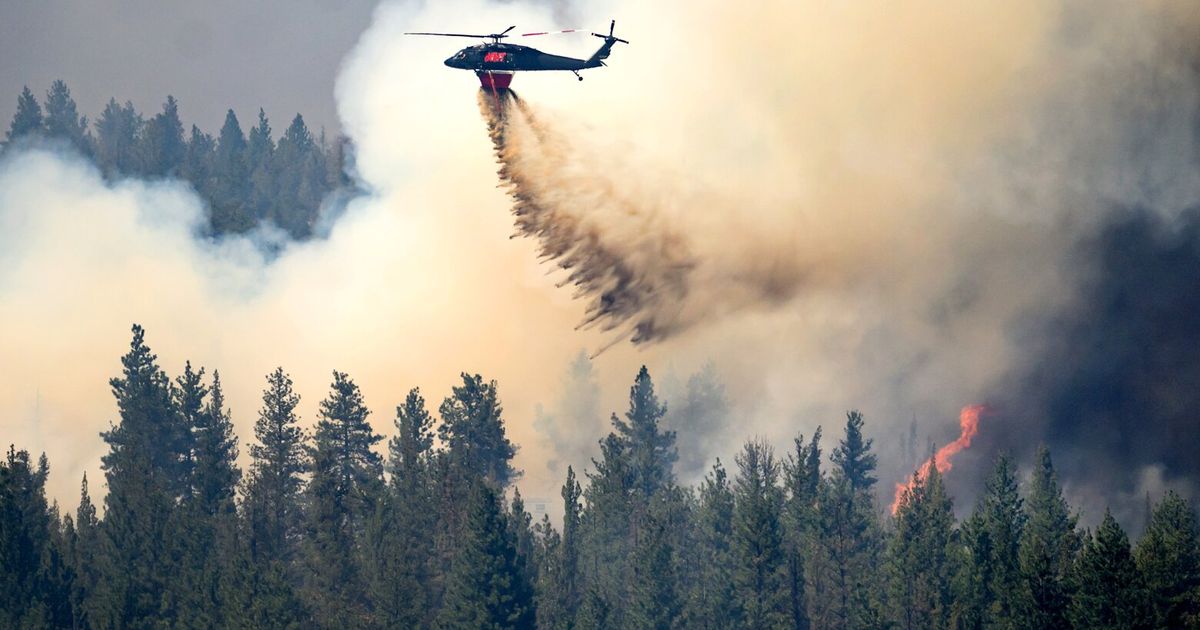
With roughly 50 large wildfires burning across the bone-dry Pacific Northwest — 2.1 million acres, already more than double the region’s 10-year average for an entire season — my wife and I activated annual apocalypse mode this week: windows sealed shut until further notice, air filters humming in every room, our ductless heat pump holding steady against record heat without pulling smoke-filled air inside.
After a winter in which Oregon’s mountains recorded their lowest snowpack in modern history, we’ve joined the millions of people across Washington and Oregon whose daily lives now bend to the air quality index. The outdoor air sensor on our shed now decides whether our children can play outside, and my wife, an urgent care provider, braces for an annual surge in respiratory illnesses.
I am a climate scientist and 22-year Coast Guard veteran who has led communities through hundreds of disasters. In May, the 210,000 residents of Deschutes County, Ore., elected me commissioner on a promise to guide our community through our rapidly worsening wildfire and insurance crisis.
This month, for the second year in a row, thousands of people outside Sisters, Ore., evacuated earlier this month ahead of a wildfire so intense it created its own weather. That the 27,000-acre Akawa Butte Fire — which earned the unenviable distinction for over a week as the nation’s highest firefighting priority — destroyed just two homes is a testament to the 1,600-plus firefighters holding the line. But that protection carries a steep price: more than $26.5 million in two weeks.
Washington is living the same story. The state hit its most dangerous fire period a month ahead of normal, and the Kaiser Canyon Fire continues to burn over an area twice the size of Seattle.
This week brought a personal reminder this crisis is continental: Friends in Washington, D.C., and New York called to ask what to do about wildfire smoke that had drifted east. After coaching these friends through hurricanes and earthquakes, I never expected to recommend an air purifier for a toddler’s room 3,000 miles away.
Wildfire smoke already causes more than 41,000 excess American deaths each year. And the climate-risk firm First Street projects that climate change — acting largely through insurance costs — will erase nearly $1.5 trillion in American home values by 2055. With the federal government spending more than $7 billion a year overwhelmingly on suppression rather than prevention, no fix that strikes at the root cause of this crisis is coming from the other Washington.
Our states must act first, stabilizing insurance markets and blunting the immediate harm to families. We know how to do this: In 2025, the Oregon Legislature created Oregon’s first durable, dedicated source of wildfire funding — $117 million in new prevention money and a tripled disaster fund. Yet legislators in both Olympia and Salem flinched this year on insurance. Washington’s SB 5928, requiring insurers to disclose wildfire risk scores and letting homeowners appeal after mitigation work, passed the Senate 48-1 but died in a House committee. Oregon’s SB 1540, requiring insurers to credit homeowners’ mitigation when setting rates, cleared committee unanimously, then died after industry pushback. Next session, Olympia and Salem should finish the job and fund hazard reduction at real scale.
Counties like mine, meanwhile, control where and how we build. The Seattle-based think tank Sightline notes that, in the Northwest, our fire-prone areas are growing faster than anywhere else in the Northwest. In Deschutes County, I documented two decades of new development inside our designated wildfire hazard zone by a County Commission apparently unconcerned with the risk they were creating. I will end that practice when I take office in January.
But the decisive action must be federal. Our predicament is the product of two underlying forces: more than a century of policy that treated every fire as an enemy to be extinguished by 10 o’clock the next morning, in landscapes that evolved with regular, low-intensity fire; and climate change, which research shows has roughly doubled the forest area burned in the Western United States. The solutions must match that scale: an acknowledgment of the fundamental science, including on climate change; a federal jobs program to build the West’s hazard-reduction workforce — work that returns nearly $4 for every dollar invested — and pay, benefits and protections for federal wildland firefighters that finally match what we ask of them.
After a career in disaster response, I know the communities that come through are not the luckiest. They have the best plans, and leaders willing to tackle hard problems before they become catastrophes. I ran for office so my son does not grow up in this world. We should take this summer as the warning it is, and get to work.
