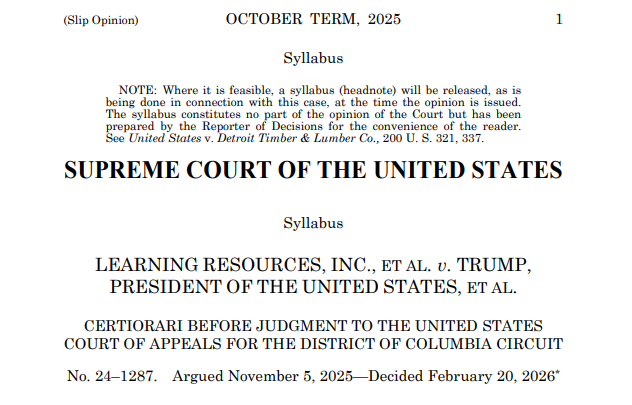
Download the Decision: Trump Tariffs 2-20-26 24-1287_4gcj
The Supreme Court has ruled as I expected. I have said on Podcasts that the power over tariffs lies with Congress, not the president. I also suggested that I did not expect the Supreme Court to overrule the statue as unconstitutional. To me, the plain language was very clear: IEEPA authorizes the President to:
“investigate, block during the pendency of an investigation, regulate, direct and compel,
nullify, void, prevent or prohibit . . . importation or exportation.”
§1702(a)(1)(B).
Nowhere does it authorize the power of tariffs. IEEPA does not authorize the President to impose tariffs plain and simple. I believe those in the Administration knew this would be the outcome. The judgment was vacated, and the case was remanded with instructions to dismiss for lack of jurisdiction; the judgment in No. 25–250 is affirmed. The Order states:
The judgment of the United States Court of Appeals for the Federal Circuit in case No. 25–250 is affirmed. The
judgment of the United States District Court for the District of Columbia in case No. 24–1287 is vacated, and the
case is remanded with instructions to dismiss for lack of jurisdiction.
We also had a renegade anti-Trump judge in the mix. The Government moved to transfer the Learning Resources case to the Court of International Trade (CIT). It argued that the District Court lacked jurisdiction under 28 U. S. C. §1581(i)(1), which gives the CIT “exclusive jurisdiction of any civil action commenced against” the Government “that arises out of any law of the United States providing for . . . tariffs” or their“administration and enforcement.” The District Court denied that motion illegally seizing jurisdiction since it was anti-Trump and granted the plaintiffs’ motion for a preliminary injunction, concluding that IEEPA did not grant the President the power to impose tariffs. 784 F. Supp. 3d 209 (DC 2025). That judge clearly had NO JURISDICTION whatsoever to make such a ruling. This is a continuing problem in our legal system. This judge should be penalized if not dismissed for an equally unconstitutional ruling our ot personal animosity.
Tariffs have helped the United States collect nearly $99 billion so far this fiscal year, which started on Oct. 1, 2025, according to the Daily Treasury Statement published on Jan. 7. To me, the law allows presidents to regulate imports during times of emergency, but it was questionable whether that regulation included tariffs, and, in particular, Trump’s large-scale tariffs.
The Trump administration argued that a 1977 law allowing the president to regulate importation during emergencies also allows him to set tariffs. Other presidents have used the law dozens of times, often to impose sanctions, but Trump was the first president to invoke it for import taxes. He classified them as “reciprocal” tariffs on most countries in April 2025 to address trade deficits that he declared a national emergency. Those came after he imposed duties on Canada, China and Mexico, ostensibly to address a drug trafficking emergency.
Multiple federal courts had ruled that Trump’s tariffs exceeded what was allowed under the law. Days after oral argument, Trump indicated in a Nov. 11 post on Truth Social that a negative decision by the Supreme Court could implicate trillions of dollars.
“The ‘unwind’ in the event of a negative decision on Tariffs, would be, including investments made, to be made, and return of funds, in excess of 3 Trillion Dollars.”
He added that the situation “would truly become an insurmountable National Security Event, and devastating to the future of our Country – Possibly non-sustainable!”
I looked at the tariffs and the only grey area was that Trump was imposing a tariff ON TOP OF what Congress authorized, he was not actually altering the Congressional tariff. The tariffs decision doesn’t stop Trump from imposing duties under other laws. While those have more limitations on the speed and severity of Trump’s actions, top administration officials have said they expect to keep the tariff framework in place under other authorities.
Can Trump still impose tariffs? The answer to that question is Yes!.