

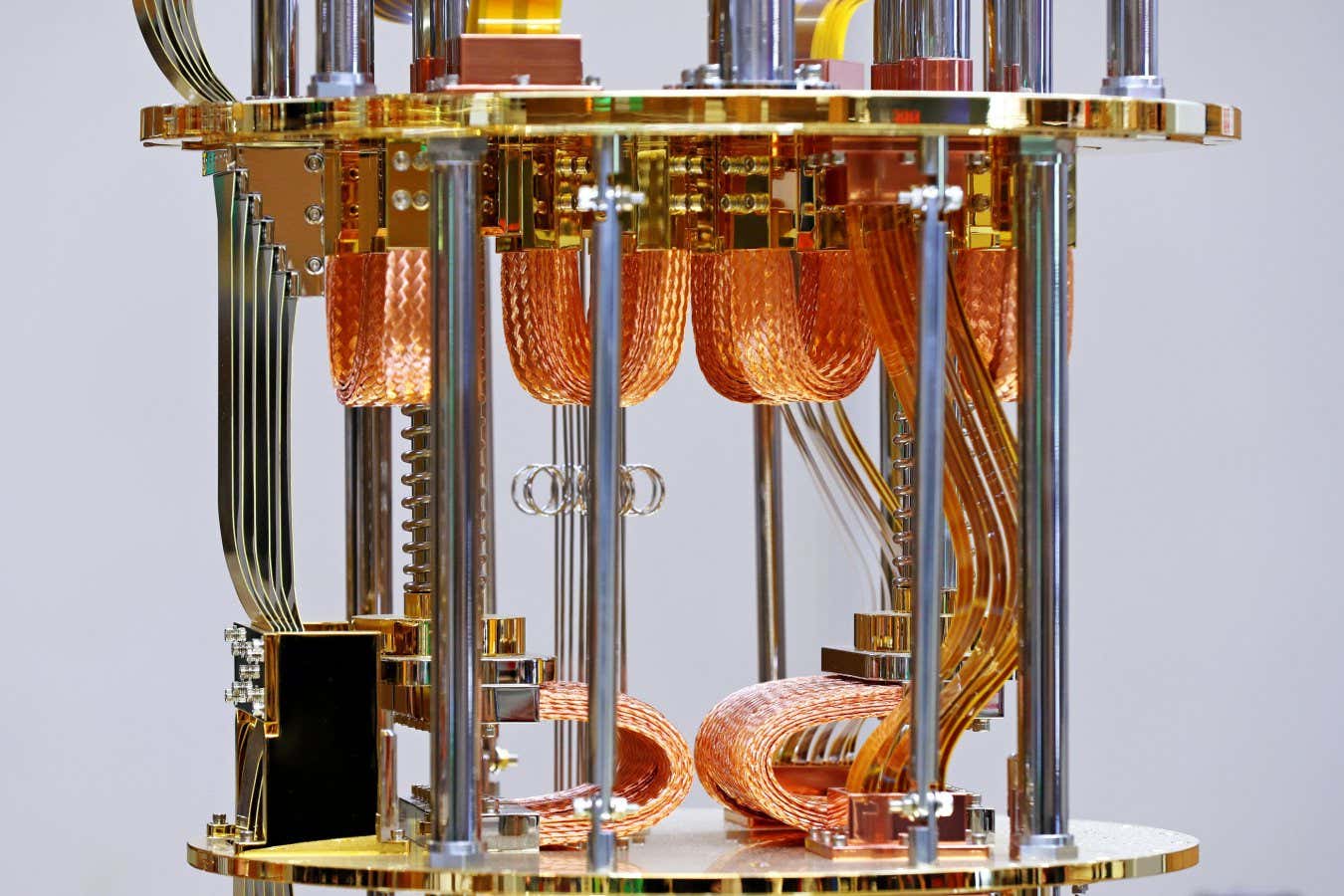
Quantum computers are strange-looking machines
ROBERT GHEMENT/EPA/Shutterstock
Picture a quantum computer. Are you imagining an ordinary computer, but somehow just better? If so, that would be a mistake, because quantum computers are fundamentally different. They rely on exotic quantum phenomena occurring between their constituent parts, known as qubits, but their strange nature often invites myths and misconceptions. Quantum computing expert Shayan Majidy at Harvard University, the lead author of Building Quantum Computers, is here to get you up to speed.
1. Quantum computers already exist
I was just on a flight and another passenger asked me: “When we will we actually have quantum computers?” But they do exist and we use them daily! Scientists all over the world are using them, and some companies have even made them publicly available so people sitting in their homes can get access to quantum computers and use them.
Having said that, quantum computers are not yet similar to something like large language models, where you just open your laptop and use it all the time. They are still more specialized devices and there is a spectrum in how people use them. Experimentalists who are working on bettering quantum computers are working on them every day. In fact, many researchers are using quantum computers to construct the building blocks for future large-scale quantum computers. Or we’re using them to probe very fundamental science questions.
We are at the crest of a wave of demonstrating how to use quantum computers for things that conventional computers can’t do. I wouldn’t be surprised if within five, 10 years, I mentor students who are just routinely accessing quantum computers through the cloud, always running some experiment like that.
2. Quantum computers will not make every computation easier
The misconception here is that quantum computers are just simply going to be better, faster computers, and they will make classical computers obsolete. But quantum computers are not generically faster – I like to describe them as differently capable instead. This means that they offer meaningful speed-ups only for very specific problems.
Two famous examples of such problems are factoring large numbers faster than any known classical algorithm, which is important for breaking encryption, and also faster searching through unstructured data. Additionally, there are problems like simulating quantum systems, sampling tasks, certain optimization problems, and some linear algebra problems under very specific assumptions.
So, the advantage of quantum computers doesn’t come from raw speed, but it comes from very surgically designed quantum algorithms. These algorithms exploit superposition, interference, entanglement, all these inherently quantum effects, and using them happens to suit a very narrow class of problems.
But outside of these cases, pretty much for anything like browsing the web, sending text messages, playing games, a quantum computer doesn’t offer any advantage beyond what the laptop can do. There’s a class of problems that we think are quantumly easy and classically hard, and these are the problems that we’d want to solve with a quantum computer. The ones that are classically easy, they’re already classically easy, so let’s not use our quantum computers on them, it would just be a huge waste of time and resources.
3. A quantum computer is not equivalent to lots of classical computers working simultaneously
I find that people often have this picture in mind that quantum computers try every calculation at once, because their qubits can be put into special superposition states, and that’s why they’re generically more powerful. A superposition state does mean that a qubit exists in a combination of zero and one at once. And it is also true that if you have n qubits, their quantum state will be described by exponentially many, or 2n options. But the myth of infinite parallelism breaks down because you can’t actually read that information out. You can’t actually read out exponentially many answers. The moment you go and measure the qubits’ state, it collapses into a single, ordinary, classical value.
So, the real story is much more subtle. The quantum computer can give many answers, and we engineer algorithms to amplify the correct ones, and suppress the wrong ones. The really good algorithms take all these superposed options and make it so that when the final measurement occurs, the right answer is the one that emerges.
Topics:
