

When you’re looking for exoplanets, stars are irritating.
Now, I have nothing against stars! I live near one and have deep appreciation for the light it provides. Stars are interesting scientifically and also happen to be very pretty.
And, certainly, they’re necessary. Planets form around stars, and those stars anchor them, heat them, shape and change them. Stars also make it easier to know where to look for them.
On supporting science journalism
If you’re enjoying this article, consider supporting our award-winning journalism by subscribing. By purchasing a subscription you are helping to ensure the future of impactful stories about the discoveries and ideas shaping our world today.
But from a distance, they can be billionsof times brighter than planets they host. We very much want to learn about these exoplanets, especially ones that might be like Earth, but that kind of glare makes it extraordinarily difficult to directly observe them. So we usually have to rely on less straightforward methods, such as finding exoplanets by how they gravitationally tug on their stars or by the mini eclipses they make when they pass in front of their stars.
Other discovery techniques abound, but astronomers have spotted precious few alien worlds in direct images in which a planet is seen as a point of light next to its star.
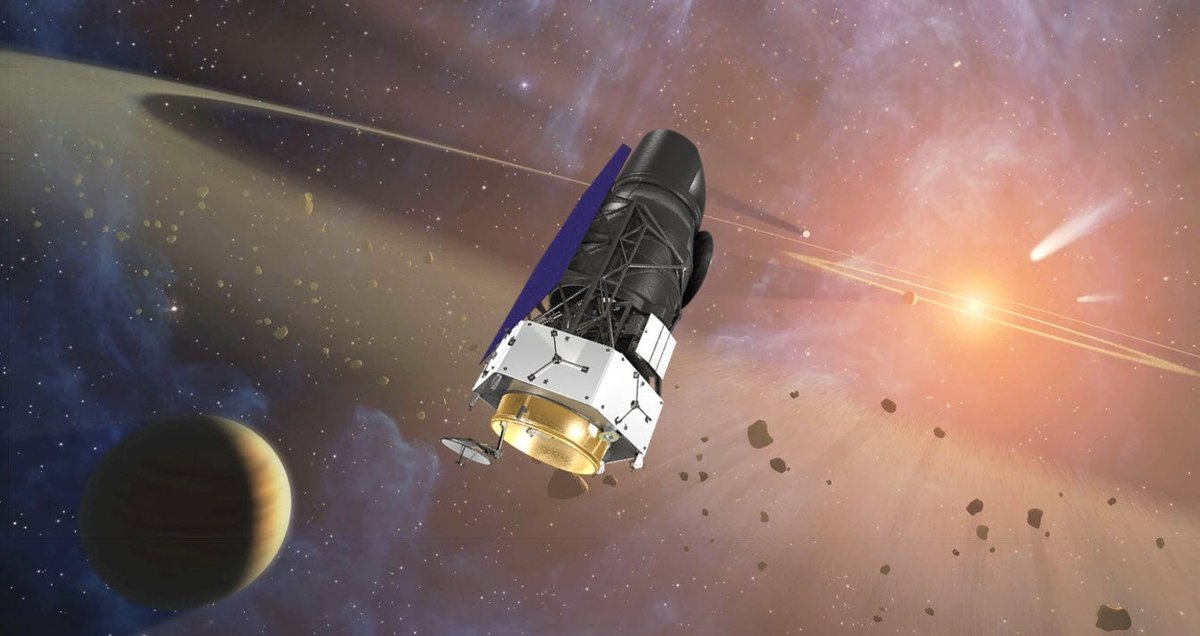
Now that’s about to change. On August 30, 2026, NASA is set to launch the Nancy Grace Roman Space Telescope (Roman for short). A spy satellite turned astronomical observatory, Roman will give humanity an unprecedented view of the universe.
It’s actually similar to the Hubble Space Telescope, with the same size mirror (a key consideration for just how powerful a telescope can be). Roman’s mirror is sculpted to a different shape, however; it’s curved slightly more than Hubble’s, which greatly enlarges its field of view, giving the Wide Field Instrument—its workhorse camera—a footprint on the sky quite literally 100 times larger than Hubble’s! Paired with Roman’s more sensitive detectors, this means astronomical targets that would take days of Hubble’s time can instead be done in one fell swoop. That will allow Roman to achieve one of its main goals: mapping the positions and motions of galaxies by the billions so that astronomers can probe dark energy, the still-mysterious force that is causing the universe’s expansion to accelerate.
But Roman carries another camera, too: the Coronagraphic Instrument (or CGI), which will produce potentially even more intriguing data. Its purpose is to directly observe planets orbiting bright, nearby stars.
Contrast is the crucial factor here: an exoplanet is very close to its host star in our sky yet is millions to billions of times fainter. A coronagraph has to knock down as much of the starlight as possible while letting the light from an exoplanet through to the detector. It does this with an opaque mask that covers the target star—the astronomical equivalent of holding your hand over the sun to blot out its glare. The first coronagraphs were simple metal disks astronomers used to see the sun’s faint outer atmosphere—the corona—hence the name.
We’ve learned a lot since then, and Roman’s CGI is much more sophisticated than those earlier devices. It incorporates multiple masks of varying shapes, for one thing, which can be switched out on the fly for different imaging modes. It also automatically corrects for the troublesome fact that light passing through a telescope’s optics isn’t perfectly steady. Changes in temperature, slight variations in pointing, and other effects all add tiny fluctuations, or jitter, to the starlight as it moves through an instrument, which allows more than you’d like to leak through to your detector. The CGI combats this using a sensor that detects and maps the incoming starlight, feeding that information to a pair of thin, flexible mirrors just downstream that are each linked to an array of 2,304 tiny pistons. The pistons change the shape of the mirrors very rapidly with an accuracy of better than 10 nanometers (about one-ten-thousandth the width of a human hair) to precisely counteract the jitter, helping to keep the light focused and reduce any that strays.
The CGI won’t be the first coronagraph to ever fly in space, but it is by far the most advanced yet. In the end, its goal is to allow Roman to see an exoplanet when the host star is hundreds of millions of times brighter—something no other space-flown coronagraph has managed before!
And we’re still not done. Seeing an exoplanet is one thing, but being able to analyze it is another. For example, different molecules in an exoplanet’s atmosphere will absorb or emit very specific wavelengths, or colors, of light. Taking a spectrum—breaking that light up into hundreds or even thousands of colors—allows astronomers to identify some of those constituent atmospheric molecules. Roman’s CGI is equipped with a low-resolution spectroscopic capability, enough to identify some of what’s floating around in the alien air.
All this machinery is very light-hungry, however: CGI needs as many photons as possible to do its job of detecting the faint exoplanets. That in turn means Roman’s coronagraph can only be used on bright stars, those of about magnitude 5 or brighter—that limit is only about twice as bright as the dimmest star you can see by eye. Still, there are well more than 1,000 such stars in the sky—plenty of targets for the coronagraph to work its magic and far more than Roman could ever observe individually during its nominal five-year mission.
We already know of well more than 6,000 exoplanets. Roman’s CGI won’t increase that number by a lot, but in this case, it’s quality over quantity. Roman may manage to take snapshots and spectra for a number of alien Jupiters and Saturns, but as powerful as its CGI is, it’s not quite sufficient for spotting alien Earths. It’s a deliberate pathfinder for that audacious task, however, which NASA is planning to tackle in decades to come with yet another next-generation space telescope, the Habitable Worlds Observatory. Along the way, Roman’s CGI will study more than exoplanets, too; it will also see the leftover planetary building material surrounding young stars, increasing our knowledge of how planets form in the first place.
Roman has been called “Hubble on steroids,” and the metaphor is apt. But its innovation will be more than the huge amount of celestial light it will gulp down in one bite. It’s also in the delicate sips it will take of the faint, faint glimmer from far-off worlds that hide in the riotous glow of their hosts—telling us how they taste.
