

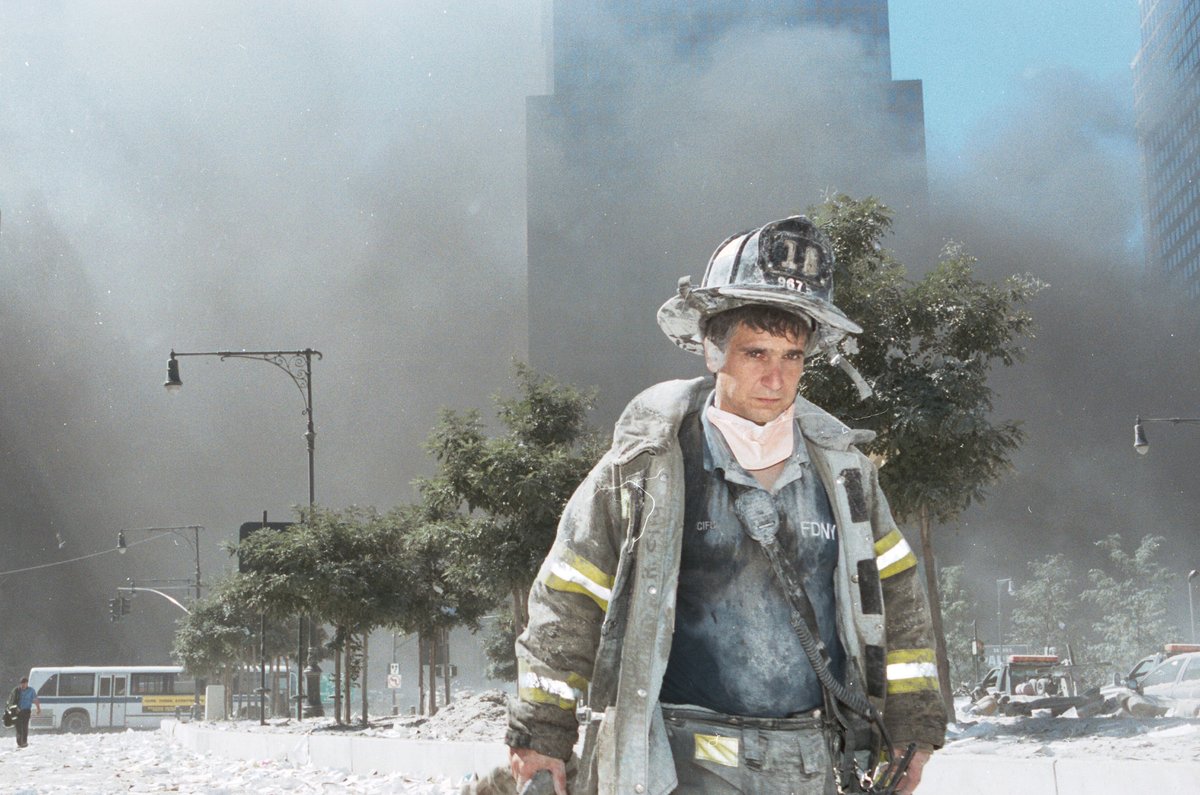
Twenty-five years on, Matthew McCauley still remembers the dust. On September 11, 2001, he was working as a law clerk just blocks away from the World Trade Center in lower Manhattan when terrorists flew a pair of planes into its Twin Towers, causing them to collapse in a cloud of debris, ash and fire.
The dust plume—which contained concrete, asbestos, glass, and more—reached more than a kilometer above New York City’s financial district. McCauley, a former police officer in his early 30s, stepped up to help sift through the rubble at the site, which we now know as Ground Zero. At least two feet’s (more than half a meter’s) worth of dirt and dust covered the ground, he recalls. Sediment hung in the air. Fires burned at the site for more than a month.
“Lower Manhattan just smelled,” he says.
On supporting science journalism
If you’re enjoying this article, consider supporting our award-winning journalism by subscribing. By purchasing a subscription you are helping to ensure the future of impactful stories about the discoveries and ideas shaping our world today.
Locals reported dust in their homes weeks after the attacks. In McCauley’s office building, the dust kept reappearing on desks and inside windowsills. “Every single day there was dust to be cleaned,” he says, “every day.”
Now, a quarter-century later, McCauley is plagued by a persistent cough and sinus issues. “I wake up every morning, and you’d think that I smoked. I don’t smoke,” he says. “It’s the gift that keeps giving from Ground Zero.”
Still, McCauley says he is one of the lucky ones: He’s lost several close friends to 9/11-related illnesses. And McCauley, now working as a lawyer for the advocacy organization 9/11 Health Watch, says he’s known hundreds who have died in the aftermath of the attacks.
The true health impact of the attacks is impossible to measure, but an estimated 400,000 people were exposed to “toxic contaminants, risk of physical injury, and physically and emotionally stressful conditions” in the days and weeks after 9/11, according to the U.S. Centers for Disease Control and Prevention.
Aside from respiratory issues, 9/11 survivors and first responders have developed health conditions such as cancers, gastroesophageal reflux disease (GERD), post-traumatic stress disorder (PTSD), substance abuse, anxiety, depression, sleep apnea, and more. As of June 30, 2026, the World Trade Center (WTC) Health Program, a research effort that spans multiple clinics, health agencies and universities, has documented more than 139,000 health conditions—and counting—in more than 150,000 survivors and first responders.
Thanks to years of lobbying by 9/11 health advocates, treatment for McCauley’s cough, as well as for dozens of conditions associated with the attacks, is covered for survivors and first responders under the James Zadroga 9/11 Health and Compensation Act, which was signed into law in 2011. But many survivors and their families contend that is still not enough to account for the risks they have faced.
Back at Ground Zero all those years ago, McCauley recalls the dangers posed by burning rubble and dust crossing his mind. But, he says, “the focus was to get things done.”
Wearing a paper mask was unwieldy. “It was hot. It was sweaty. You were just constantly moving,” he recalls. Still, he feels that government agencies could have done more to protect first responders and civilians from the dangers posed by hazardous dust.
“The World Trade Center was basically made of every single carcinogen known to man, as most buildings are, and then [it] was micronized in seconds and became airborne,” McCauley says.
Indeed, researchers are still documenting new health conditions—particularly cancers—among survivors and first responders. As of June 30, cancer made up about 71 percent of the conditions in these groups recorded by the WTC Health Program in the past 12 months. Most people who were present during the attacks and their aftermath and are living with cancer today have nonmelanoma skin cancer, followed by prostate cancer and breast cancer, according to the WTC Health Program. But many also have rarer forms of the disease, such as brain cancer, testicular cancer, leukemia, and more.

From a view east of the Hudson River, smoke rises from the World Trade Center in the wake of the September 11, 2001, terrorist attacks in New York City.
Rodney G. JeanBaptiste/Getty Images
“We still see new patients, and a lot of our patients that are coming in now are coming in with a diagnosis of cancer or other latent conditions like interstitial lung disease,” says Denise Harrison, clinical director of the New York University Grossman School of Medicine’s WTC Health Program and an associate professor at the school. That’s because many of these conditions take years to develop, she says.
Alongside the rise in long-term illnesses, researchers have also seen an increase in “adjustment disorders”—that is, anxiety, depression and other mental health issues related to other medical conditions, such as a cancer diagnosis, says Peter Haugen, director of mental health for the NYU Grossman School of Medicine’s WTC Health Program.
“You can imagine, people who come in with cancer that’s progressed or newly diagnosed, it, of course, would make sense that they might be experiencing some of those symptoms,” he says. And treatments such as chemotherapy can also take a mental toll, he adds.
Directly linking an environmental exposure to a complex medical condition such as cancer can be fraught. It’s hard to know who was exposed to which pollutants, where and for how long. Survivors and responders haven’t lived in a vacuum for the past 25 years, Harrison says. They’ve experienced wildfire pollution, COVID, daily allergies, and more—this “complicates the picture,” she says. But under the WTC Health Program, covered illnesses only must be associated with 9/11 exposures; causal proof isn’t necessary.
As time goes on, cases are likely to keep climbing.
Just this week, in response to a lawsuit from 9/11 Health Watch, the New York City mayor’s office agreed to release a trove of documents suggesting the city may have downplayed air quality issues in Manhattan in the months after the attacks. That means health issues may be more widespread than previously documented. McCauley hopes the documents could support new research into illnesses that are not currently covered by the WTC Health Program, as well as the effect of 9/11 exposure on pregnancy and fetuses.
McCauley, now age 56, doesn’t plan to “live in fear” of getting sick. But witnessing the death of many close friends over the years has tested his resolve.
One of his closest friends, Brian Payne, was a volunteer firefighter at Ground Zero. He was a “bigger than life” guy who loved the New York Rangers and the Mets, McCauley recalls. “One day, Brian was healthy and playing hockey and being a fireman and going fishing, and next thing you know, he had cancer.”
Payne died in 2022, leaving a wife and four kids.
More than anything else, McCauley worries about how the deaths in his community have affected his own three college-age kids. They have seen some of their friends’ parents lost to 9/11-related illnesses, too. “My kids kind of look at me, and they’re like, ‘Well, what about you, Dad?’” he says.
“We’re surrounded by it,” McCauley adds.
