

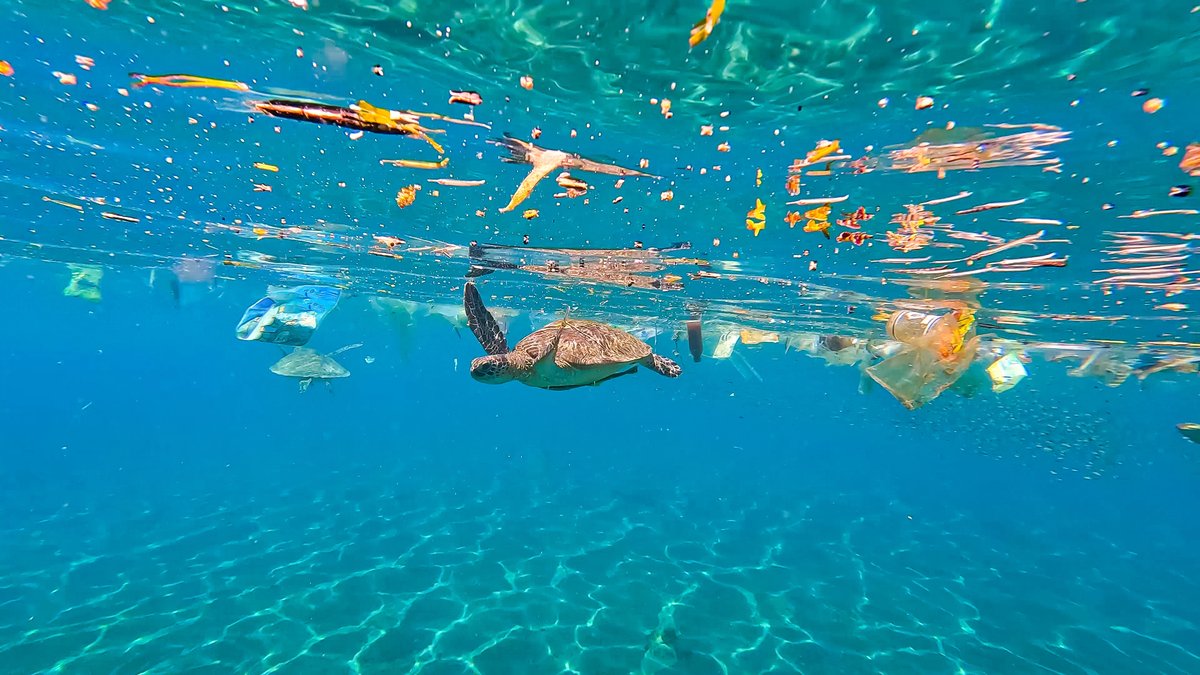
The Great Pacific Garbage Patch, an area in the Pacific Ocean where debris naturally accumulates, is full of tiny bits of plastic—so full, in fact, that it seems to be changing the color of the ocean.
The ocean is, of course, famously blue. That’s because of the wavelength of light it reflects. Water scatters shorter wavelengths, which we see as blue—while absorbing longer wavelengths, such as red or orange. Additives in the ocean, including phytoplankton, algae and sediment, can affect its color.
Microplastics, too, can affect the color of the ocean. They can be made of all sorts of materials, including polystyrene, polypropylene, polyester, and more, explains Daniel Koestner, a postdoctoral fellow at the University of Bergen in Norway, and tend to scatter more light than organic material in the ocean.
On supporting science journalism
If you’re enjoying this article, consider supporting our award-winning journalism by subscribing. By purchasing a subscription you are helping to ensure the future of impactful stories about the discoveries and ideas shaping our world today.
To better understand how microplastics may have influenced the ocean’s color, Koestner and his colleagues looked at 20 years of satellite data from the spot in the ocean with perhaps the most of plastic—the Great Pacific Garbage Patch, a zone between Hawaii and California where trash trapped by ocean currents accumulates.
Between 2002 and 2022, the researchers found, waters near the garbage patch have gotten brighter in both blue and green wavelengths compared with surrounding areas. The results, published in the journal Communications Earth & Environment on Thursday, don’t yet prove that microplastics have directly brightened the ocean, the researchers emphasize, though their findings are backed up by lab experiments with microplastics. But without taking direct ocean samples, it’s hard to know for sure what’s causing the ocean’s color to change.
“We’re still one step away from proving definitively that microplastics are causing the shift in color that that we’re seeing,” adds study co-author Shea Cheatham, a Ph.D. student also at the University of Bergen. “We just have to get in there [to the garbage patch] to verify.”
Still, the findings underscore just how omnipresent these pollutants are.
Previous research has shown that microplastics can harm microbes in the ocean, for instance, and can change the behavior of fish. They also accumulate in seafood we eat.
If the researchers’ approach can be verified, Koestner hopes it can be used to identify other areas across the world where microplastics have accumulated.
“That would mean that we have a target area for cleaning up,” he says.
Subscribe to Support Independent Journalism
Great science journalism requires human expertise, time, effort and creativity. And it costs money. That’s why I and the journalists here at Scientific American hope you’ll join our community.
When you subscribe, you are supporting staff and freelance journalists who are passionate about telling science stories that are true, important and compelling. Our editors and reporters are often experts in their fields, which means they understand the nuances of big discoveries and can untangle the breakthroughs from the hype. With a subscription, you are also supporting rigorous fact-checking to ensure the words we publish are precise and accurate. And you’re supporting original illustrations, graphics and photos that bring you closer to an advanced laboratory, an ice sheet in Antarctica or a space mission in orbit. You’re helping us craft other types of high-quality journalism as well: Our newsletters are carefully written, edited and curated by staffers you have or will come to know and love. Our Science Quickly podcast is based on original reporting, collaboration with editors and scientists and exacting production.
Subscriptions keep this engine running so we can continue to deliver thoughtful, rigorous and independent science journalism to you. In an era of viral misinformation, this work is crucial. If you value what we do, I hope you’ll consider joining us as a subscriber
