

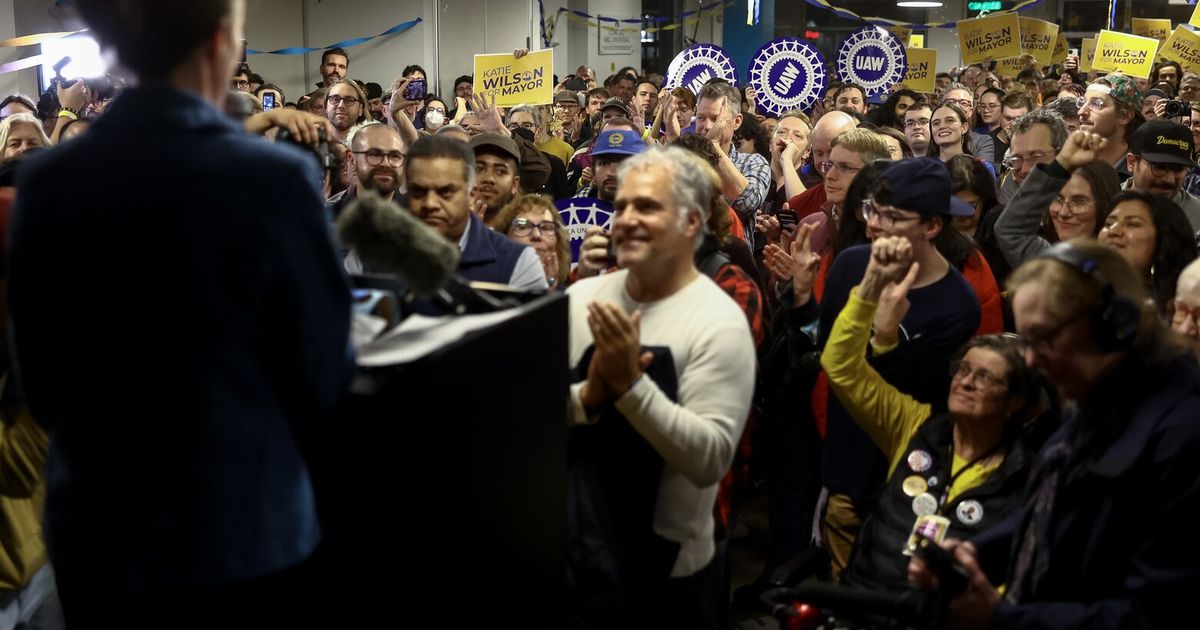
Seattle recently elected a democratic socialist mayor. Katie Wilson, a transit organizer who’d never held office, beat three-term City Hall fixture Bruce Harrell by fewer than 2,000 votes — one of the tightest mayoral races in the city’s modern history.
Pundits keep asking the wrong question about races like hers: Why are voters warming to democratic socialism? Critics call it radicalism. Supporters call it a moral awakening. Both dodge the real story: Voters aren’t drifting left on theory. They’re reacting to a system that quietly resold political power to the highest bidder. A 2025 Gallup poll found 66% of Democrats now view socialism favorably, up from 53% a decade ago, while capitalism’s favorability among Democrats has collapsed to 42%. That isn’t a mood swing. That’s a verdict — and Seattle just delivered one.
Start with the history most Americans have forgotten. The nation’s founders restricted voting to property-owning men, insisting the propertyless couldn’t be trusted with political judgment. It took two centuries of organizing and amendments to tear that doctrine out by the root and establish one person, one vote — a right belonging to citizens, not net worth.
Then, in 2010, the Supreme Court handed it back. Citizens United v. FEC gave corporations First Amendment rights to spend unlimited money on elections. Critics call the ruling a property qualification in modern dress: Elections get bought long before anyone votes, as cash floods in through Super PACs and dark-money groups. We didn’t repeal the property test. We just stopped calling it one.
Both parties own this. For decades, Democrats and Republicans alike built their machines on corporate megadonors, chasing money from Wall Street, real estate and lobbyists. When leadership on both sides treats capital as the client and voters as the audience, the message is clear: These institutions serve property first, people second.
To be fair, this isn’t only about campaign finance. Younger Americans are furious about housing costs, crushing student debt and stagnant wages — grievances distinct from, but compounded by, the corruption story. Most voters embracing the “socialism” label aren’t calling for nationalized industry; they want universal healthcare, affordable housing, real labor power. Skeptics will call this generational impatience, not a verdict on money in politics. Fair challenge — but it doesn’t explain why the shift tracks so tightly with collapsing trust in both parties’ fundraising machines, not just with age. Housing, debt and wages are the symptoms. Money in politics is why nobody in power has fixed them.
Washington is ground zero. This city once ran on Boeing, canneries, the port and rail — jobs that built a working- and middle-class city. Now tech runs it, and its wealth priced that city out of existence. A 2024 DHM Research poll found two-thirds of Washington voters no longer believe building more housing would even bring costs down — a quiet admission that people have stopped trusting the market to fix what the market broke. That’s the exhaustion Wilson ran on. But this state has also proven the rot isn’t inevitable: Seattle’s Democracy Vouchers program and Washington’s disclosure laws show grassroots policy can still outmuscle concentrated money — when we build it.
So build it, everywhere. Congress must pass the Freedom to Vote Act and push measures like the Democracy For All Amendment, declaring plainly that money isn’t speech and corporations aren’t people. Legislators must close the loopholes letting megadonors hide behind PACs and shell groups, and shut down the informal coordination that makes even strong disclosure laws toothless. Cities should adopt small-donor voucher and matching systems now, not after the next election, so candidates stop needing corporate bundlers to compete. Washington voters should keep the pressure on: expand what already works here, and hand the rest of the country a blueprint instead of an excuse.
Katie Wilson’s win isn’t proof Seattle has given up on markets. It’s a warning shot to a political establishment that allowed concentrated wealth to overshadow civic participation. The promise of American democracy was never meant to be owned by the few — it was meant to belong to us all.
