

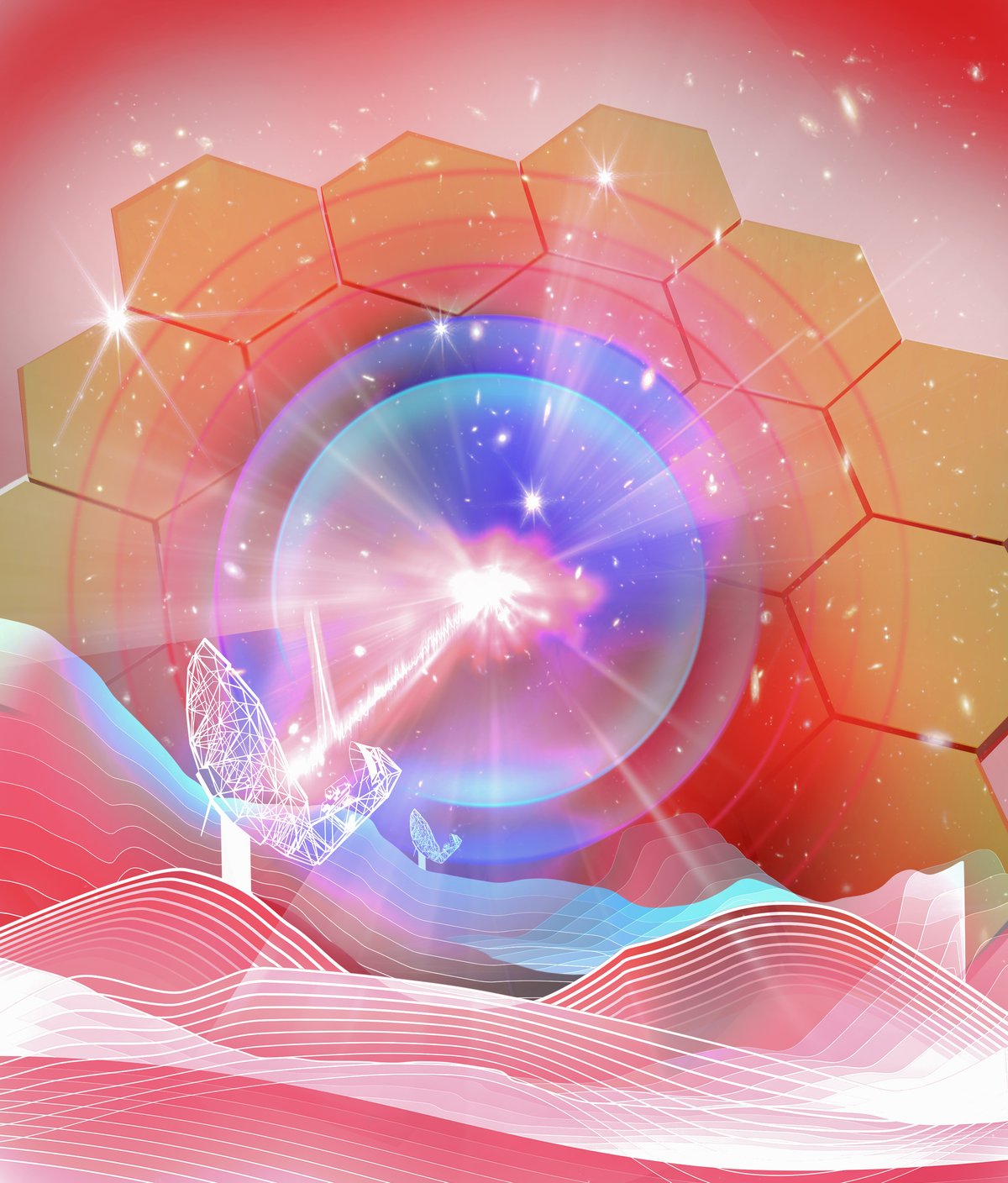
At some point around three billion years after the big bang, some celestial object in a faraway galaxy suddenly went pop and shot out a brief-but-powerful blast of radio waves, lasting just a fraction of a second. That blast kept traveling across the intergalactic vastness of space and time until, in March 2024, it breezed by Earth, with a small fraction of its energy trickling into the dishes of the MeerKAT radio telescope array in South Africa.
For Themiya Nanayakkara, an astronomer at Australia’s University of Sydney, MeerKAT’s detection was a moment of peak excitement. Fast radio bursts (FRBs), as these types of emissions are called, are common, occurring roughly 5,000 to 10,000 times per day across Earth’s sky. But this one’s sheer faintness signaled it was very old, originating long, long ago from somewhere far, far away.
But just how old was it, and where did it come from? Looking at the power of the burst and the amount of its light that had been stretched, or “redshifted,” by the expansion of the universe around it as it traveled, Nanayakkara and his colleagues were able to find out. As they describe in a new paper in Science, this FRB occurred in a far-distant galaxy some 10 billion years ago. That esteemed cosmic vintage makes this the oldest FRB ever detected by far. This event, in fact, is twice as old as the previous record holder.
On supporting science journalism
If you’re enjoying this article, consider supporting our award-winning journalism by subscribing. By purchasing a subscription you are helping to ensure the future of impactful stories about the discoveries and ideas shaping our world today.
Despite intensive scrutiny in the quarter-century since their discovery, FRBs remain rather mysterious. For starters, astronomers still don’t know their astrophysical origins. One leading idea posits they’re produced by magnetars, small remnants left behind by massive stars that detonate as supernovae, but many details are murky, and not all FRBs seem to fit the “magnetar” mold. Detecting and measuring FRBs and their host galaxies can help solve the puzzle, Nanayakkara says. In this case, he and his colleagues traced this one back to a galaxy that appears relatively primitive compared with others from its early cosmic epoch: this galaxy has a lower mass and less heavy elements than its contemporaries but higher amounts of star formation.
None of that is necessarily unexpected for the formation of an FRB-birthing magnetar. But this record-setting FRB still significantly pushes back the baseline for when these bursts can occur in cosmic history. And according to Nanayakkara, this in turn raises the possibility that even older (and fainter) FRBs have passed by Earth unnoticed.
“Our telescopes need to be extremely sensitive to detect them,” he says. Thankfully, MeerKAT exists to help. “The same thing applies when trying to find their host galaxies. Since these galaxies are also very far away, they can be extremely faint, making it challenging to follow them up and study their properties.”
The clamor to find and study increasingly distant FRBs isn’t just a matter of curiosity, either: These short, sharp bursts can also serve as potent probes of otherwise-invisible matter spread between galaxies. As an FRB travels, its radio waves interact with the dilute, dark plasma that astronomers call the intergalactic medium; the FRB’s shorter waves interact more with the plasma, slowing their propagation so that they arrive at Earth later than their longer-wavelength counterparts. Measuring this dispersion allows astronomers to learn just how much of this material any given FRB has traversed on its long journey to our planet.
“Our discovery is particularly important because we have shown that we can do this across approximately 80 percent of cosmic history,” Nanayakkara says. “The further back we push FRB detections, the further we can map this otherwise unseen matter.”
To accomplish this, Nanayakkara recently secured time on NASA’s James Webb Space Telescope (JWST). Once a year for the next three years, his team will be able to focus JWST onto the faraway astrophysical source of some especially ancient FRB, seeking to break the cosmic distance record yet again.
“We are currently waiting for our radio telescopes in Australia and South Africa to detect such a burst. As soon as we find one, we can trigger JWST observations to study its host galaxy and hopefully push the boundary even further,” he says. “The more distant FRBs we find, the stronger the constraints we can place on the objects and emission mechanisms that produce them, the environments in which they occur and the distribution of matter across the universe.”
