

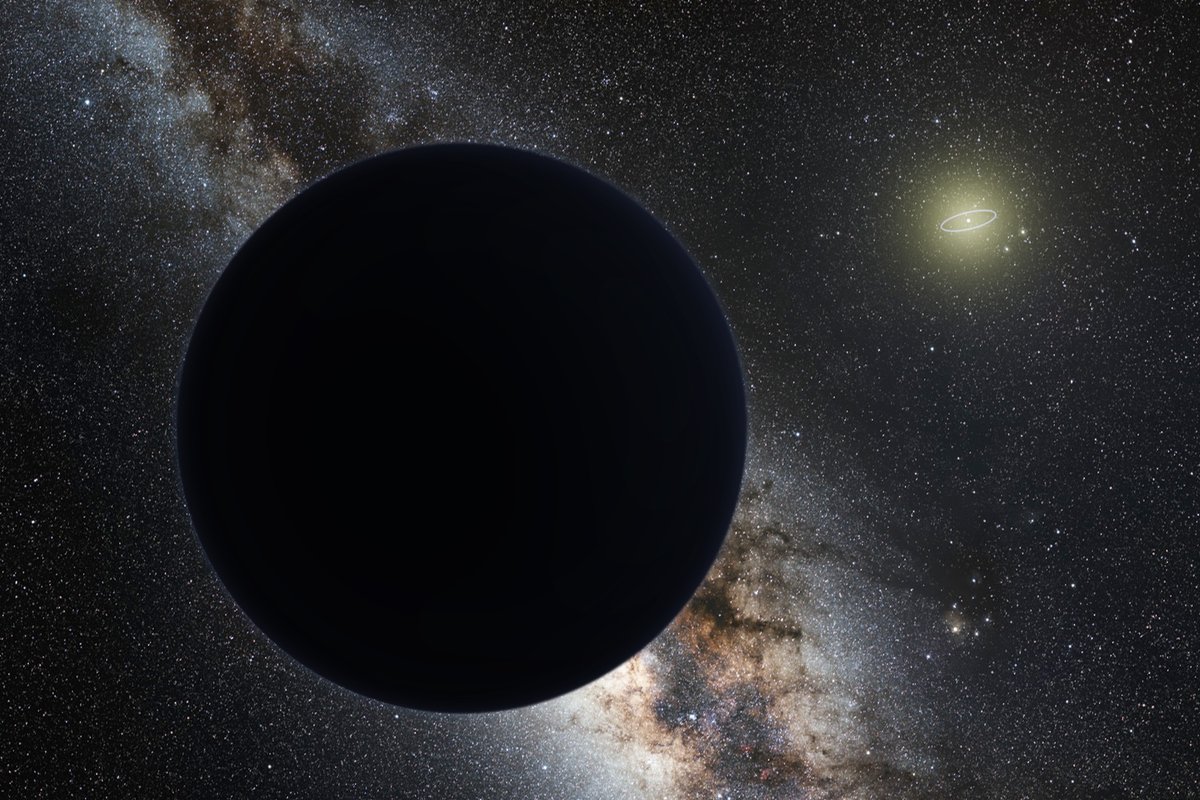
The outer solar system is getting crowded with theoretical planets.
Well, it’s not crowded, exactly. Billions of small rocky, icy bodies orbit the Sun out past Neptune. But space is so vast that they rarely pass within a million kilometers of one another. There’s lots of room out there.
In fact, that’s part of the problem for planet hunters right now: this volume of space is so unimaginably huge and so far away that searching it for even relatively large objects is tricky.
On supporting science journalism
If you’re enjoying this article, consider supporting our award-winning journalism by subscribing. By purchasing a subscription you are helping to ensure the future of impactful stories about the discoveries and ideas shaping our world today.
That hasn’t stopped astronomers from trying—because it’s entirely possible the outer solar system still harbors a world big enough to measurably alter its surroundings but small enough to have avoided direct detection. Often called Planet Nine—poking fun at professional astronomers’ 2006 demotion of Pluto from being the solar system’s ninth planet—this hypothetical body’s existence has been hotly debated, though that hasn’t slowed the search.
In 2025 an international team of astronomers published a paper in the Publications of the Astronomical Society of Australia reporting a candidate for Planet Nine in the deep trans-Neptunian darkness. The scientists’ claim made a minor splash last year and has enjoyed something of a renaissance recently, thanks to an article in BBC Sky at Night Magazine and social media. Their research is under fire from others, however, including, ironically, a pair of astronomers who were largely responsible for the Planet Nine search in the first place.
What the international team did hearkens back to the days of old, when American astronomer Clyde Tombaugh discovered Pluto in 1930. Others had predicted the existence of a ninth planet (somewhat confusingly referred to as Planet X at the time, with the “X” standing for “mysterious and unknown” rather than the Roman numeral for 10). And using the mathematics of orbital mechanics, those others had predicted where in the sky it might be.
Tombaugh methodically photographed a large area of the sky surrounding that position, night after night, and then compared the images to look for any blip of light that moved against the background stars as such a distant planet should. After months of searching, he found Pluto. As it happens, though, this whole endeavor was a happy accident: the predictions of its position were based on faulty assumptions, so Pluto was, in fact, found by coincidence.
But Tombaugh’s search method is still valid, and we now have much more sophisticated techniques with which to perform it: many modern ground- and space-based telescopes are undertaking wide-area surveys that are stored digitally, making their data much easier to sift through for signs of any slow-moving, distant planet.
Not that it’s easy. For one thing, a planet that far out will be incredibly faint in reflected light because the meager amount that reaches it from the Sun will attenuate even more as that light bounces back from the world into our telescopes on and around Earth. This means the brightness drops as the fourth power of the planet’s distance from us, a seriously steep decline. Even a large planet will be a difficult target.
The math gets better, however, for searches in infrared light: if the otherwise chilly Planet Nine exists, it would still emit such light, making it appear brighter at those wavelengths. So the international team took advantage of that, using data from the Infrared Astronomical Satellite (IRAS), which surveyed the sky in the early 1980s, and the Japanese, space-based AKARI infrared observatory, which operated for about 18 months in 2006 and 2007.
The two-decade gap between the two missions is a key factor. That’s a long enough baseline for a far-out world to exhibit significant orbital motion. In a nutshell, the researchers looked for objects that only appeared (as blobs of light) at one spot in the IRAS data and at another spot in the AKARI data, possibly indicating motion of the same object across the intervening decades. Moreover, each object in the apparent pairs of detections had to be about the right brightness and move the correct amount for a planet orbiting the Sun several hundred times farther out than Earth.
After cross-checking between hundreds of thousands of potential objects in the images, they were able, astonishingly, to narrow their search down to a single candidate. It checked all the right boxes, including the expected motion and brightness. Could this be Planet Nine?!
Well, probably not.
One problem is that two points do not a planet a make. In this case, that’s enough for calculating a crude orbit, but at least one more spatially separate point is mathematically necessary to estimate anything about that orbit’s shape.
Also, there’s no guarantee these two detections, one in each dataset, come from the same (or any) moving object: these points of light in the data could be false positives. Very faint variable stars changing their brightness and then fading back into obscurity, for example, might also explain either or both points. Supermassive black holes in distant galaxies can flare powerfully, appearing and then disappearing from view as well. While the astronomers did look for potential galaxies in those positions, not finding them doesn’t preclude their existence.
Perhaps the biggest problem, though, is the orbit that is implied by the two points. While its shape cannot be determined, its orientation in space can be: a line connecting the two points is a pretty good indicator of how tilted the orbit is with respect to Earth’s (what astronomers call inclination).
This is critical because the search for Planet Nine is motivated primarily by that world’s predicted effects on the orbits of other, smaller objects in the outer solar system. Several large, icy bodies, called trans-Neptunian objects (TNOs), have been found in oddly aligned orbits at large distances from the Sun, when those orbits should instead be randomly oriented in space. One way to explain this peculiar comportment is the existence of a massive planet gravitationally influencing these bodies, coaxing their orbits into a roughly systematic arrangement.
This is what led American astronomers Mike Brown and Konstantin Batygin to concoct their Planet Nine hypothesis in 2016. They’ve been the champions of this hunt ever since and have worked through the math to determine the characteristics of this possible planet, including its physical properties and orbital shape.
They have found that, for Planet Nine to explain the TNOs, its inclination would have to be 15 to 20 degrees from Earth’s orbital plane. As described in an article in Science, Brown looked at the infrared data and measured the inclination of the international team’s candidate planet: 120 degrees, a wildly divergent angle. That pretty well precludes it from being Planet Nine, even if it’s genuine.
He and Batygin haven’t necessarily discounted the possibility that this candidate is real, but they have pointed out that if it does exist, it isn’t their proposed Planet Nine. Batygin has called it “Planet 8.5.”
What’s really needed here, of course, is more observations. In the 2025 paper, the authors pointed out that the Dark Energy Camera (DECam) can get images that could spot a potential planet, and of course, the Vera C. Rubin Observatory is taking broad and deep images of the sky even now and could possibly reveal the candidate planet’s presence. Rubin’s observations have already, in fact, revealed one possible new world beyond Neptune: a candidate “dwarf planet” announced in October and dubbed 2026 ED138 that is at least 600 km wide and in an approximately 280-Earth-year orbit around the Sun.
But Rubin can take away just as easily as it gives: the telescope’s unique observations could also end up refuting the 2025 claim of a Planet 8.5—and, for that matter, Batygin and Brown’s original proposal for Planet Nine.
The bottom line is: we don’t know if either of these planets exists, yea or nay. All we can do is keep watching the skies—and keep crunching the numbers.
