

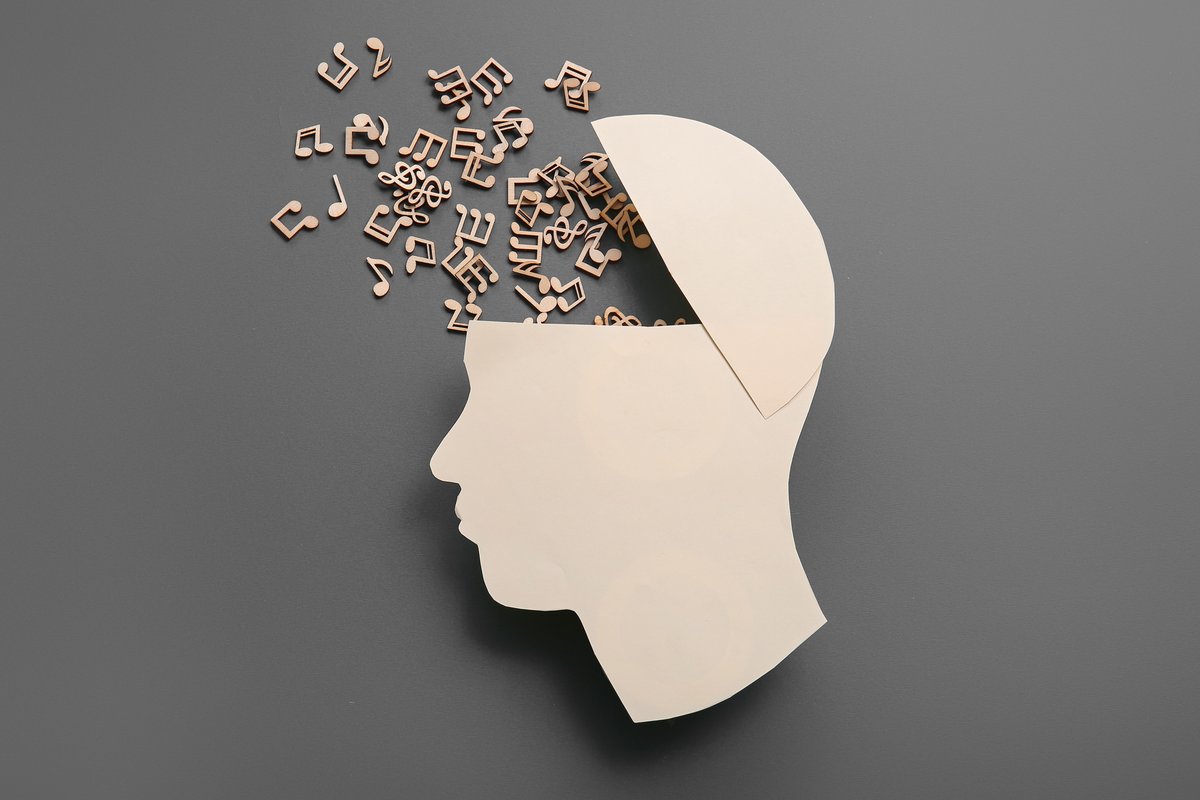
People who have lived most of their lives blind often have extraordinary hearing abilities. In new research published in the Journal of Neuroscience, my colleagues and I discovered that this ability arises from how their auditory systems are able to more consistently and reliably process sounds compared with people who aren’t blind. And interestingly, sighted musicians seem to enhance their hearing through a similar mechanism.
Hearing is a complicated process. It involves many stages, starting from how the ears detect sounds and going all the way up to how the brain extracts meaningful information from those sounds.
Different mechanisms are involved, too. You can get better at hearing by being more selective or more consistent. Think of writing the letter “A.” You can practice to make your “A” either more distinguishable from “B” or look more similar to other “A’s” every time you write it. The latter is called internal noise—how consistently your auditory system responds to the same sound over time. The less internal noise you have, the more reliably you can tell similar sounds apart.
On supporting science journalism
If you’re enjoying this article, consider supporting our award-winning journalism by subscribing. By purchasing a subscription you are helping to ensure the future of impactful stories about the discoveries and ideas shaping our world today.
We recruited nine individuals who became blind before the age of 2 and 18 sighted individuals. Participants in both groups had varying levels of musical training, giving us an opportunity to examine how musical experience can also affect hearing abilities.
Participants completed two simple hearing tasks. In one task, they detected a tone presented in background noise, which allowed us to assess how the cochlea in the inner ear processes different sound frequencies. In the other task, they judged which of the two tones had a higher pitch, a task that also relies on how the brain interprets sound information.
We found that people with early-life blindness were better than sighted people only in the pitch discrimination task. This means that their improved hearing abilities may selectively originate from changes in how their brains process auditory information and not from how their ears detect sounds.
Importantly, we used a mathematical model to better understand what drives differences in pitch discrimination. The model showed that the enhanced ability to tell pitches apart in people with early-life blindness happens by reducing internal noise: more consistent and reliable processing of sounds rather than greater selectivity for different sound frequencies.
Surprisingly, we found that musical training seems to similarly reduce internal noise. Sighted musicians also responded to sounds more consistently compared with people who neither experienced early-life blindness nor received extensive musical training.
Why it matters
Because your brain doesn’t know what kind of sensory environment it’ll encounter when you’re born, it’s equipped with a special ability: to tune its responses to parts of the world that matter to it.
This ability helps people see, hear and master new skills as their experiences change, like when children learn to read and when adults learn to identify different bird species. Words and birds have become a meaningful part of their experiences, so their brains are tuned to the new information.
Our study identifies internal noise as an important factor that facilitates this brain plasticity. There are many ways a person can come to have reduced levels of internal noise, and one is by building a more accurate template for perceiving the world.
It is possible that sensory experience, whether it be being blind or being a musician, might help create and fine-tune the perceptual template relevant for hearing.
What still isn’t known
If sensory experiences and training can tap into the brain’s ability to adapt, researchers may be able to use them to improve perceptual abilities. For example, targeted training to hear sound locations could help people who are beginning to lose vision learn to rely on other senses to navigate.
However, researchers still don’t know how much training is needed and what aspects of the auditory experience are key to drive behaviorally meaningful changes in the brain.
Another important question is whether and how this brain plasticity varies depending on when someone loses their vision or begins musical training. The brain might have greater plasticity early in development, and how sensory experiences shape the brain may differ in adulthood.
What’s next
How far can people push their ability to learn? Can everyone become super listeners with training? If the brain’s plasticity is limited in adulthood, are there ways to reopen the door? And what role does internal noise play in this learning?
Moving forward, our team is interested in understanding whether the enhanced pitch discrimination we saw in people with early-life blindness and sighted musicians extends to more complex, everyday listening.
This article was first published by The Conversation. Read the original article here.
Subscribe to Support Independent Journalism
Great science journalism requires human expertise, time, effort and creativity. And it costs money. That’s why I and the journalists here at Scientific American hope you’ll join our community.
When you subscribe, you are supporting staff and freelance journalists who are passionate about telling science stories that are true, important and compelling. Our editors and reporters are often experts in their fields, which means they understand the nuances of big discoveries and can untangle the breakthroughs from the hype. With a subscription, you are also supporting rigorous fact-checking to ensure the words we publish are precise and accurate. And you’re supporting original illustrations, graphics and photos that bring you closer to an advanced laboratory, an ice sheet in Antarctica or a space mission in orbit. You’re helping us craft other types of high-quality journalism as well: Our newsletters are carefully written, edited and curated by staffers you have or will come to know and love. Our Science Quickly podcast is based on original reporting, collaboration with editors and scientists and exacting production.
Subscriptions keep this engine running so we can continue to deliver thoughtful, rigorous and independent science journalism to you. In an era of viral misinformation, this work is crucial. If you value what we do, I hope you’ll consider joining us as a subscriber
