

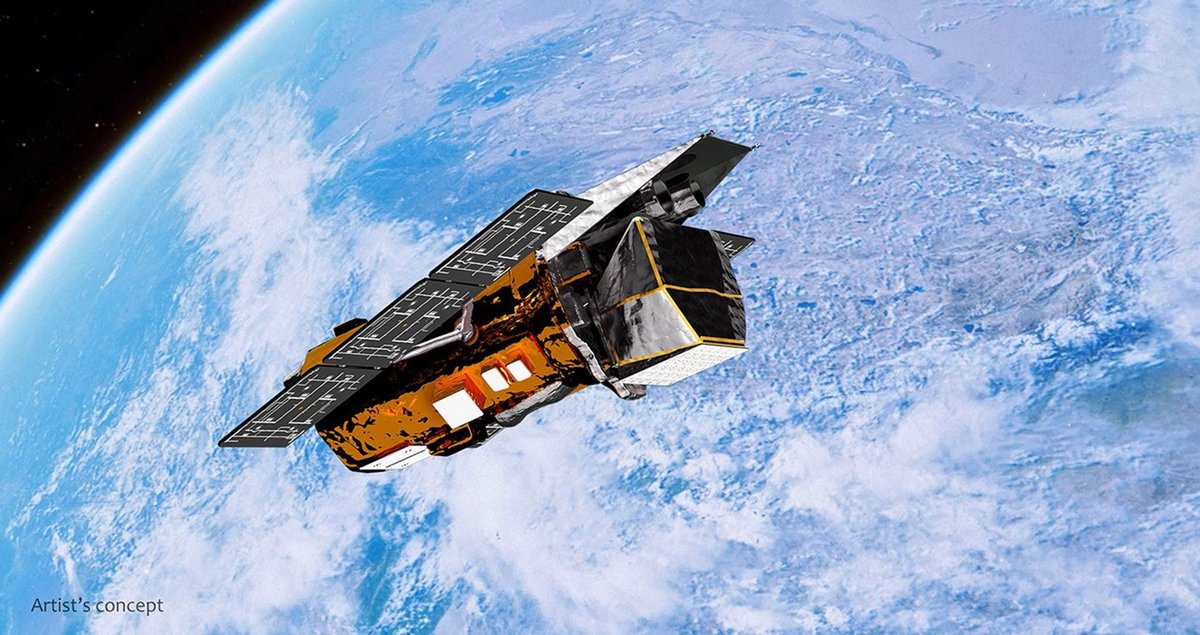
After more than two decades of observing some of the universe’s most powerful explosions, NASA’s Neil Gehrels Swift Observatory has ended its mission with some fireworks of its own.
The 3,200-pound (1.5-metric-ton) space telescope, which gathered data on gamma-ray bursts (GRBs), was projected to enter Earth’s atmosphere in the early-morning hours of November 4. Most of Swift should have burned up, although experts expected that a small fraction of its most durable components would survive the plunge and reach the planet’s surface. NASA officials estimated an approximately one-in-2,100 chance that Swift’s falling debris would harm anyone. The observatory’s fiery swan song leaves a hole in NASA’s space science fleet that is unlikely to be filled anytime soon.
Swift made its last observation on October 20, after which its orbit descended to just below 171 miles (275 kilometers) above Earth, making continued operations impossible.
On supporting science journalism
If you’re enjoying this article, consider supporting our award-winning journalism by subscribing. By purchasing a subscription you are helping to ensure the future of impactful stories about the discoveries and ideas shaping our world today.
Initially named for swifts, birds in the family Apodidae, because of its capability to swiftly slew in the heavens to focus on faraway GRBs, the observatory’s title was amended in 2018 to include the name of astrophysicist Neil Gehrels—who was the mission’s principal investigator—after he died in 2017.
Swift was loaded with three instruments designed to pick up gamma rays, x-rays, and ultraviolet and optical wavelength light. Together, these tools offered astronomers extraordinary insights into GRBs—extremely luminous eruptions that occur in distant galaxies when massive stars explode or collide, sometimes leaving behind neutron stars or black holes.
Since its launch in 2004, the observatory had been able to gather data on nearly 2,000 of these events. It also acted as an important sentinel for scientists, alerting astronomers within seconds of detecting incoming cosmic blasts so that terrestrial telescopes could follow-up with their own observations.
While there are numerous other Earth and space-based observatories and telescopes, none currently in operation are able to compete with the Swift for capturing details of some of the most exciting events in distant space. That it was able to do so for over two decades, far longer than its initial mission length of two years, is a credit to both the technology aboard, and the hardworking astronomers and support staff who kept it running, says Jamie Kennea, the former lead of science operations for the observatory.
“Throughout the mission the Swift team never rested on its laurels and reinvented the operations model yearly, keeping things fresh and, importantly, scientifically vital,” he says. “Swift was a one-of-a-kind mission that the community will hugely miss, and a huge testimony to the memory of Neil Gehrels, its original leader, who laid the foundations of this success by his sheer excitement about the new possibilities this little mission could explore.”
Like all satellites in low-Earth orbit that aren’t actively maintaining altitude through engine firings or other measures, Swift was gradually falling to Earth, slowly losing speed as it dragged through our planet’s tenuous upper atmosphere. Starting some two years ago, high-energy particles from heavier-than-usual solar activity puffed up this part of Earth’s atmosphere, hastening Swift’s demise. NASA launched a last-ditch rescue mission to try and boost its orbit with another spacecraft, but that effort failed in July 2026 when the rescue craft suffered several malfunctions.
According to NASA’s projections, Swift’s reentry and resulting debris shower should’ve occurred in a broad swath stretching nearly 1,500 miles in latitude above and below the equator. That put much of South and Central America, as well as parts of Africa, Southeast Asia and Australia, in its potential path, but most of the spacecraft’s likely reentry profile was over remote stretches of open ocean.
The sparsity of suitable sensors in those regions likely contributed to the delayed confirmation of Swift’s demise, which was attributed to the U.S. Space Force on Wednesday afternoon. According to an X post by astrophysicist and space activity tracker Jonathan McDowell, Space Force tracking pinpointed the telescope’s reentry as occurring at 7:39 A.M. EST off the coast of northern Sumatra, an island in Indonesia.
Editor’s Note (11/4/26): This story has been updated to include the reentry time and location of the Swift spacecraft.
