

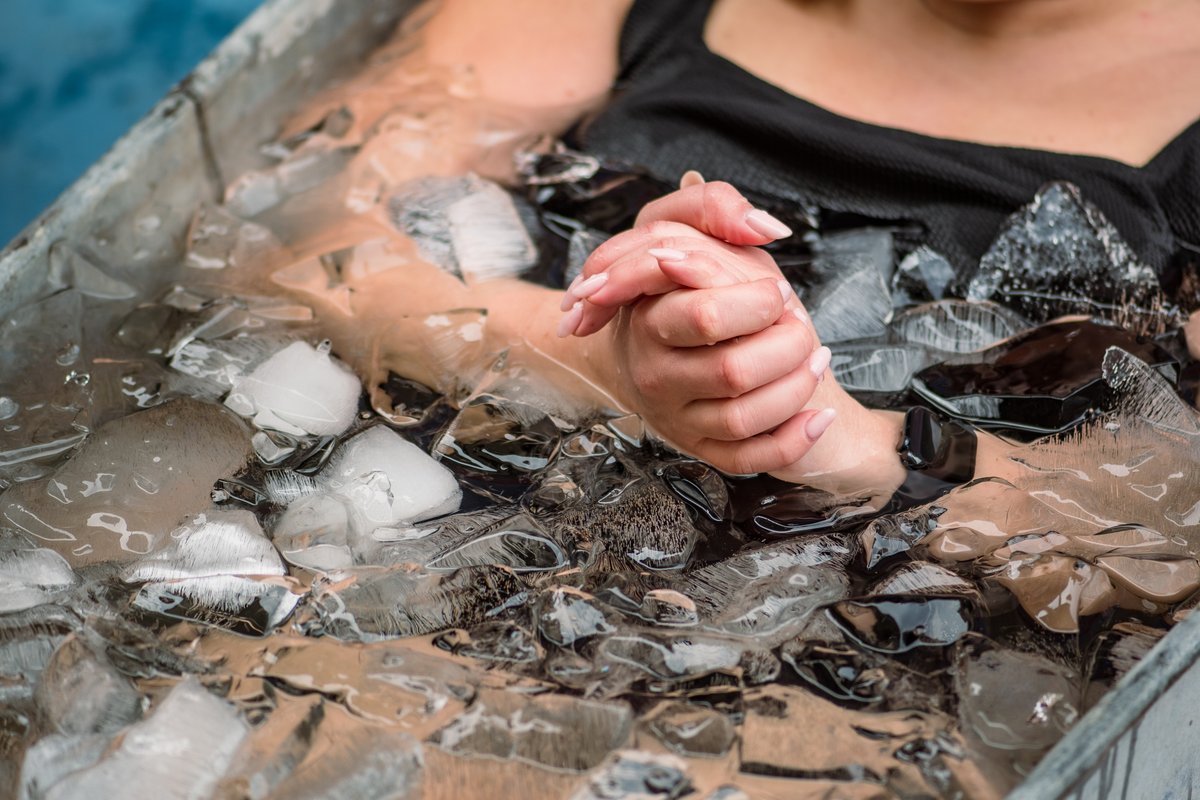
Ice baths have become one of the most popular recovery strategies in sport. They are used by elite athletes and recreational gym-goers to reduce soreness and recuperate more quickly after exercising.
It has often been claimed that ice baths help to reduce pain and repair the muscle damage that intense exercise can cause. Yet when we look at the evidence, it isn’t clear that ice baths really are the best way to recover post exercise.
In a recent study, my colleagues and I compared ice baths against heat-based recovery methods. What we found suggests recovery is far more complex than simply cooling things down.
On supporting science journalism
If you’re enjoying this article, consider supporting our award-winning journalism by subscribing. By purchasing a subscription you are helping to ensure the future of impactful stories about the discoveries and ideas shaping our world today.
Muscle repair
Strenuous or unfamiliar exercise can cause damage to our muscle fibers. This is particularly the case after doing “eccentric exercises”, where muscles lengthen while generating force. Activities such as downhill running, descending the stairs or lowering a weight under control (while doing a barbell squat for instance) are all examples of eccentric exercise.
This exercise-induced muscle damage can leave your muscles feeling sore and weak. To repair the damage, the body triggers what’s known as an “inflammatory repair response”, where immune cells move into the muscle tissue to clear away damaged cellular material and stimulate regeneration.
Other molecules are also released to help coordinate repair. However, these molecules can also increase the sensitivity of pain receptors, which may further contribute to the muscle soreness that people experience up to 72 hours after an intense workout.
These responses are an important part of how the body repairs itself and becomes stronger.
We wanted to better understand what effect different recovery methods had on this repair process after a strenuous workout. So we recruited 40 healthy, physically active adults (31 men and nine women) and asked them to complete a specific exercise.
This involved repeatedly targeting the quadriceps—the large muscles at the front of the thigh – using a specialized machine that allowed us to carefully control the movement and measure muscle strength. This particular movement is known to cause temporary muscle damage and soreness—making it useful for studying how different recovery methods influence the body’s repair process.
Participants were then randomly assigned to one of four recovery methods: cold-water immersion (in water that was 10 C), hot-water immersion (in water that was 42 C), hot air exposure (60 C, similar to a sauna) and “passive recovery” which involved sitting and doing nothing for 30 minutes. Each method was carried out immediately after the workout.
Over the following 72 hours, we monitored recovery by looking at several measures—including muscle strength, pain and soreness, alongside various biological markers linked to muscle damage, inflammation and cellular stress.
All participants showed the expected signs of exercise-induced muscle damage. Strength declined immediately after exercise and soreness increased.
But when we looked at the effects of the recovery techniques, we were surprised to find that none of them restored muscle strength significantly faster than the others.
If strength had been the only outcome measured, we might have concluded the recovery methods made little difference. But the physiological data told a different story.
Participants who completed hot-water immersion were shown to have higher levels of a substance called “heat shock protein 72” (HSP72) which acts as a cellular maintenance and protection system, supporting repair processes and protecting cells during periods of physiological stress. It’s widely believed that HSP72 plays an important role in recovery and adaptation following exercise.
The heat-based recovery methods were also associated with more favorable changes in biological markers linked to muscle damage and inflammation.
So our findings suggest that exposure to heat may be better at stimulating the biological processes involved in recovery.
Cold-water immersion was not shown to improve any of the recovery markers measured in the study. It also showed the slowest recovery, with strength returning to around 82% of pre-exercise levels after 72 hours, compared with 88-89 percent in the other groups.
But cold-water immersion appeared more effective at reducing perceptions of muscle soreness. This highlights how feeling recovered and actually being physiologically recovered are not always the same thing.
These findings should be interpreted with some caution, however. The study involved 40 healthy, physically active adults—with just ten participants in each intervention group. While the study was adjusted to detect moderate effects, the sample size wasn’t large enough to explore potential differences between men and women.
The best way to recover
One of the most important lessons from our study is that recovery cannot be measured using a single outcome.
A person may feel less sore but may still have reduced muscle function. Also, important repair processes may be occurring inside the body without producing immediate improvements in performance.
This distinction may help explain why recovery research has produced mixed findings over the years. Different interventions may influence different aspects of recovery.
If your priority is reducing how sore you feel after a workout, cold-water immersion may be the most beneficial. But if your goal is to influence the biological processes that help your muscles to repair and adapt, heat-based recovery may be a better choice.
Our findings don’t suggest that ice baths are completely ineffective. Ice baths were still found to help people feel better.
What our study shows is that recovery is about far more than how you feel the next day. Sometimes the most important changes are happening beneath the surface.
This article was first published by The Conversation. Read the original article here.
