

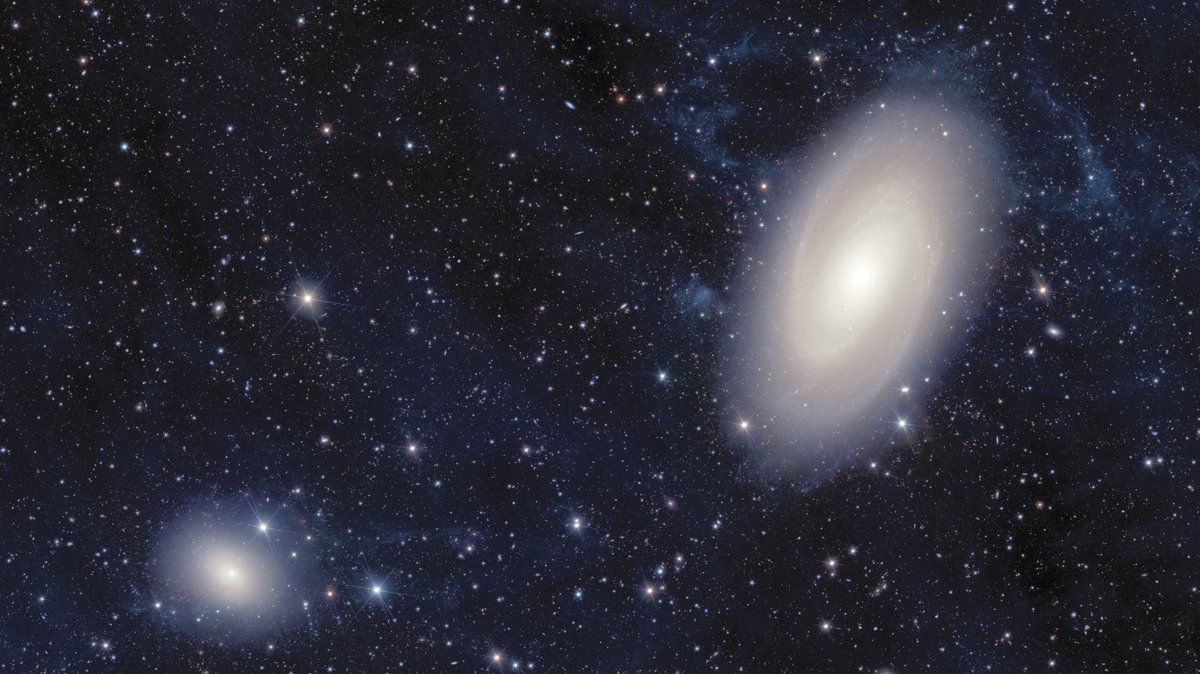
Astronomers took a major step toward navigating the universe, thanks to the European Space Agency’s (ESA’s) Euclid space telescope, which just released its first major batch of observations.
Since its launch in July 2023, Euclid has been using its approximately 600-megapixel visible-light camera to capture images of the cosmos, near and far. All told, it has already managed to document nearly a billion objects, including more than 900 million galaxies and 60 million possible quasars, the ultrabright nuclei of galaxies where ultrahot gas is being sucked into a supermassive black hole.
Previous releases of images by Euclid had been focused on a far narrower band of sky. Now the huge amount of data collected—more than 1.7 million gigabytes—makes the new release the “largest space-based survey of its kind, laying the foundation of future discovery in a new regime for astronomy,” said ESA’s director of science Carole Mundell in a statement.
On supporting science journalism
If you’re enjoying this article, consider supporting our award-winning journalism by subscribing. By purchasing a subscription you are helping to ensure the future of impactful stories about the discoveries and ideas shaping our world today.
Euclid is aided in its observations by a cosmic phenomenon known as gravitational lensing. As light emitted from galaxies and other celestial objects travels through space, it interacts with the gravitational forces of other large objects. That gravity bends and magnifies the light, making it brighter and easier to detect for telescopes such as Euclid; it can even allow astronomers to determine the mass of the source. But the objects must line up just right for the lensing to occur, making them extremely rare.
According to ESA, Euclid has identified around 15,000 strong candidates for gravitational lensing, a trove that Scott Gaudi, an astronomer at the Ohio State University, calls “bonkers.”
“Gravitational lenses are one of nature’s toolboxes for us measuring dark matter mass by looking for these distortions of background quasars and galaxies due to foreground structures,” says Gaudi, who is not involved in the Euclid program. “But you can’t do it from the ground. You just need the high-resolution imaging to do it.”
The Nancy Grace Roman Space Telescope, which relies on instruments that examine infrared light, as opposed to the optical light Euclid is designed for, will also harness gravitational lensing to see far-off cosmic objects. The two approaches are “very complementary,” Gaudi says, particularly when it comes to searching for elusive things such as dark energy and dark matter.
“Euclid is going for as much area as possible, whereas Roman is focusing in the infrared, and it’s focusing on repeating observations of the same area of the sky with different roll angles and different filters,” Gaudi says. “I think the joint approach of those two missions is very powerful because you can vet the big statistics you get with Euclid with a very careful controlled system with Roman.”
Euclid’s latest release also includes a large amount of data on galaxy clusters. Examining how galaxies are bunched together can offer insights into how the first matter formed and organized shortly after the big bang. And Euclid can help astronomers begin to figure out where individual galaxies are located in relation to one another, leading to what could be the most comprehensive three-dimensional map of the universe ever made.
“Euclid doesn’t just look far back in time—it does so across huge areas of sky,” said Barbara Sartoris, an astrophysicist at France’s Joseph-Louis Lagrange Laboratory, in the ESA statement. “This gives us an unprecedented view of large samples of ancient galaxy clusters that were previously out of reach. We will explore these in the coming months to learn how these giants grew, and decipher what they reveal about the dark Universe.”
Subscribe to Support Independent Journalism
Great science journalism requires human expertise, time, effort and creativity. And it costs money. That’s why I and the journalists here at Scientific American hope you’ll join our community.
When you subscribe, you are supporting staff and freelance journalists who are passionate about telling science stories that are true, important and compelling. Our editors and reporters are often experts in their fields, which means they understand the nuances of big discoveries and can untangle the breakthroughs from the hype. With a subscription, you are also supporting rigorous fact-checking to ensure the words we publish are precise and accurate. And you’re supporting original illustrations, graphics and photos that bring you closer to an advanced laboratory, an ice sheet in Antarctica or a space mission in orbit. You’re helping us craft other types of high-quality journalism as well: Our newsletters are carefully written, edited and curated by staffers you have or will come to know and love. Our Science Quickly podcast is based on original reporting, collaboration with editors and scientists and exacting production.
Subscriptions keep this engine running so we can continue to deliver thoughtful, rigorous and independent science journalism to you. In an era of viral misinformation, this work is crucial. If you value what we do, I hope you’ll consider joining us as a subscriber
