

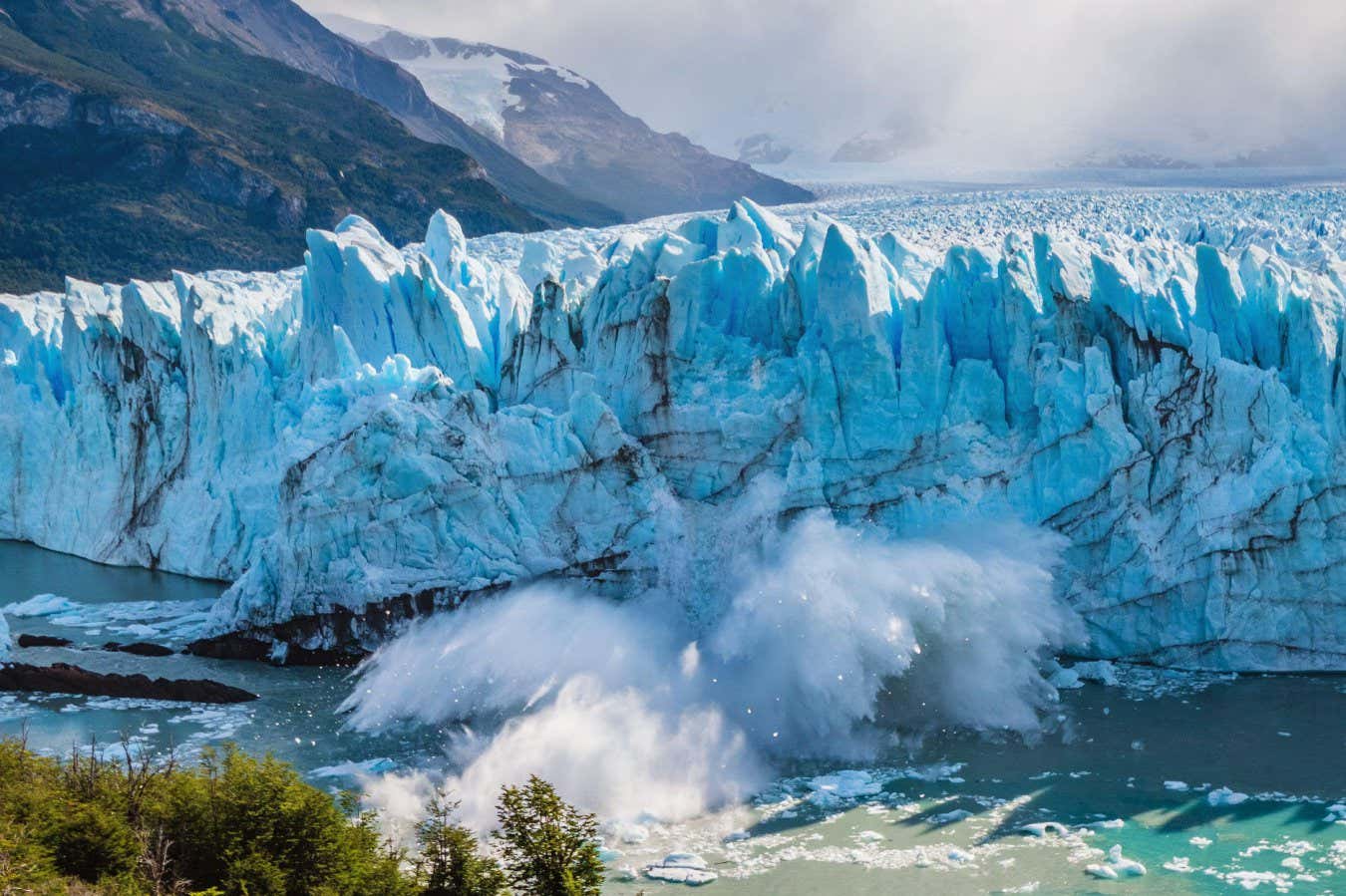
Ice collapsing into the water at Perito Moreno Glacier in Los Glaciares National Park, Argentina
R.M. Nunes/Alamy
Even a few years’ delay in reaching net-zero emissions will have repercussions for hundreds or even thousands of years, leading to warmer oceans, more extensive ice loss in Antarctica and higher temperatures around the world.
Nations around the world have collectively promised to prevent more than 2°C of global warming, a goal that can only be achieved by reaching net-zero emissions – effectively ending almost all human-caused greenhouse gas emissions – before the end of the century. But once that hugely challenging goal is achieved, the planet will keep warming.
“Even if we do reach net-zero emissions – and that has to be a goal – we still have lots of aspects of the climate that are going to evolve for a very long time,” says Andrew King at the University of Melbourne.
Climate modellers are using a new generation of models that capture the way carbon is absorbed and released by land and the ocean to simulate how Earth’s systems might respond to a stable net-zero emissions world.
Most of these experiments simulate a net-zero world for around 100 years, but King and his colleagues have gone further, simulating 1000 years of net-zero emissions.
The team modelled scenarios in which emissions continue to rise rapidly before reaching net zero at five-year intervals from 2030 to 2060. This resulted in seven simulations of net zero under different levels of warming. They found that although warming over land stabilises once net zero is achieved, the deep ocean continues to warm for centuries to come, as heat from surface waters descends, pushing up global mean temperatures.
“The unfortunate thing is that we have changed the climate, and in some aspects it is going to keep going further and further away from its pre-industrial state for quite a long time, even under net zero,” says King.
Certain parts of the world will experience more ongoing change than others. In the northern hemisphere, most land regions reach peak warming within a few centuries of net-zero emissions being reached.
By contrast, the Southern Ocean continues to warm for 800 to 900 years. This leads to a long-term decline in Antarctic sea ice over the centuries, and more warming in Australia than elsewhere.
The later we achieve net zero, the larger these changes will be, suggest the simulations. Delaying net zero by just five years results in a warmer ocean, lower levels of sea ice and higher average temperatures around the world. For example, if net-zero emissions are reached in 2060, under a high-emissions scenario, the city of Melbourne will warm by a further 1°C after that point.
“If we equivocate or delay in reaching net zero, it will take a long time for that delay to be washed out,” says King. “The faster we get to net zero, the better.”
While some aspects of the climate system will keep changing after net zero, others appear to return to a pre-industrial “normal” in the simulations. In some areas, such as the Mediterranean, rainfall patterns return quickly to 19th-century levels. The El Niño and La Niña weather patterns, which have seen their heating and cooling effects strengthened by climate change, will also damp down again once we reach net zero.
Much more research is needed into these kinds of regional change under net zero, says King, who cautions that the results are based on just one Earth system model. Plus, the findings may not factor in every relevant climate “tipping point” that could trigger sudden, irreversible changes to regional climate systems at a certain level of warming.
Nevertheless, Paulo Ceppi at Imperial College London says the results may enhance our understanding of how net-zero emissions will change regional climates. “I am sure there are some aspects here that would be robust across models,” he says.
An important thing to keep in mind is that the simulations aren’t direct predictions of a net-zero emissions future. For one, the model simulated emissions being cut from high levels down to zero overnight, rather than a more realistic tapering down over decades. “It’s completely unrealistic to go to net zero overnight,” says Ceppi.
Meanwhile, the simulations assume the world stays at net-zero emissions. Climate campaigners hope that once humanity achieves net zero, there will be an effort to remove even more carbon dioxide from the atmosphere to start reversing some climate impacts.
Topics:
