
Close Menu
    National News Brief
    Sunday, September 27
    • Home
    • Business
    • Lifestyle
    • Science
    • Technology
    • International
    • Arts & Entertainment
    • Sports
    National News Brief
    Home » How to see all the solar system’s planets in the night sky at once

    How to see all the solar system’s planets in the night sky at once

    Team_NationalNewsBriefBy Team_NationalNewsBriefJanuary 21, 2025 Science No Comments3 Mins Read
    Share
    Facebook Twitter LinkedIn Pinterest Email


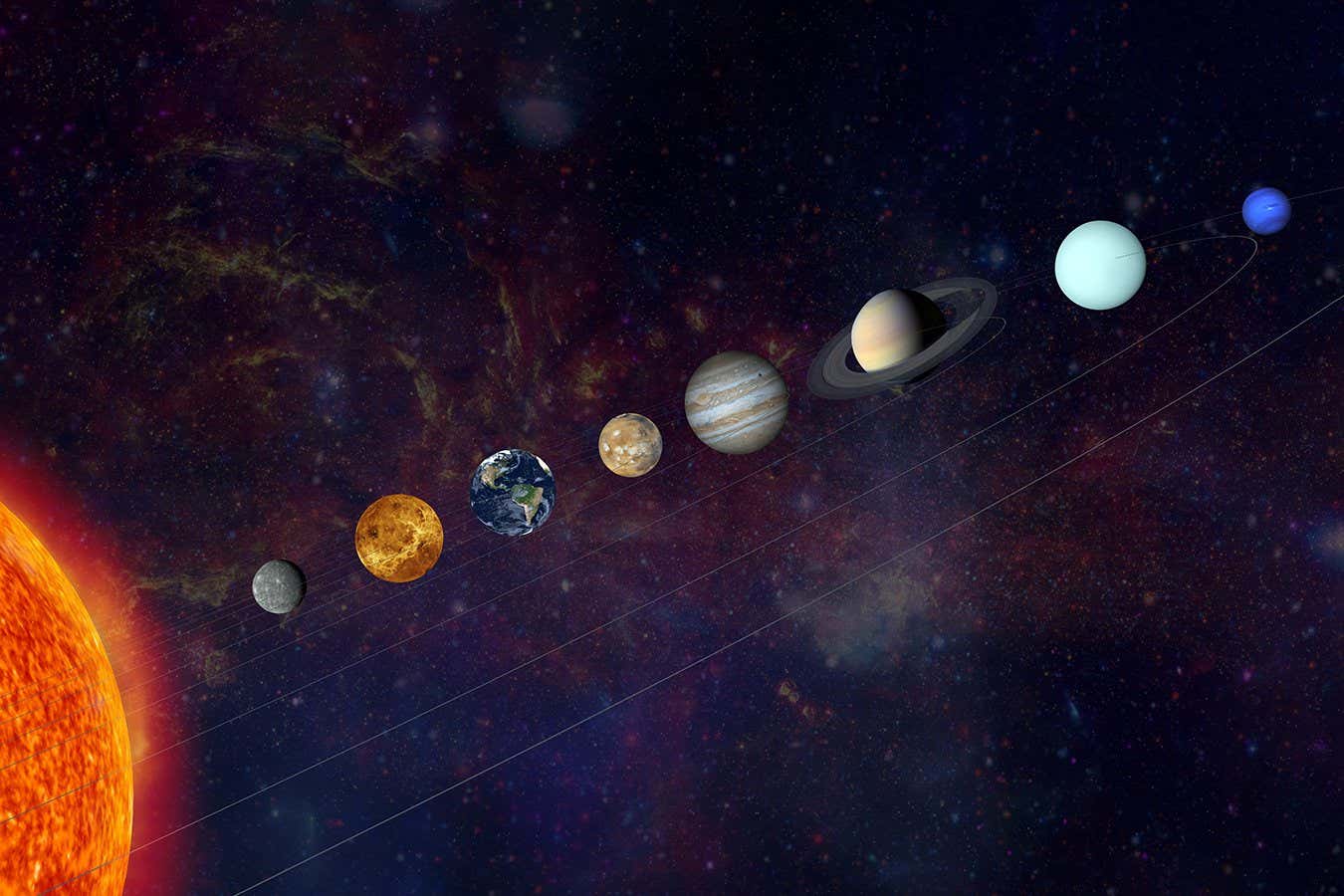
    All the planets will appear to line up across the sky towards the end of February

    alxpin/Getty Images

    All of our solar system’s planets are lining up to parade through the night sky at once. This extraordinary celestial event will see the sky scattered with seven visible planets in what is known as a great planetary alignment.

    The eight planets in our solar system orbit the sun in roughly the same plane, because they all originally formed from the same disc of debris around the sun. The line the sun traces across the daytime sky, called the ecliptic, aligns with this plane, so when the planets appear in the sky, they all appear roughly along the ecliptic. It isn’t a perfect line of planets, because their orbits are tilted slightly, but it is fairly close.

    Never is this more apparent than during a planetary alignment. An alignment including all of the planets except Mercury is taking place in mid-January. Uranus and Neptune, being the most distant planets, will only be visible through a telescope, but you may be able to spot the others with the naked eye.

    The great alignment, including Mercury, will only happen for a few evenings around 28 February, depending on your location. All seven planets will be visible briefly right after sunset, stretching in an arc across the sky.

    By the time the sky is completely dark, Mercury and Saturn will have sunk below the horizon, with Neptune and Venus following shortly after. The best time to spot the planets will be in the hour after sunset, when all of them except Mars, Jupiter and Uranus will be close to the horizon. Those three will continue to hang around for most of the night, but spotting three planets in the sky isn’t nearly as rare as finding all seven.

    The main thing preventing such alignments from being visible all of the time – aside from weather – is the difference in orbital periods between the planets. Mercury, which is closest to the sun, takes about 88 Earth days to complete an orbit, while Neptune, which is most distant, takes nearly 165 Earth years.

    A great alignment is only possible when the planets are all relatively far from the sun, so they are visible at night, and all in roughly the same half of the sky, so they can be seen at the same time. It is a remarkable orbital coincidence – sometimes there are multiple great alignments in a year, and sometimes several years pass without a single one.

    In some ways, a planetary alignment is simply an optical illusion: the planets are still separated by millions or billions of kilometres, and if you could look down on our solar system from outside of it, you would never see them arrayed in a perfect line emanating from the sun. But for stargazers around the world, it’s an excellent chance to see all of the planets at once, neatly arrayed across the sky.

    Topics:


    Source link

    Team_NationalNewsBrief
    • Website

    Keep Reading

    What’s the point of the interstellar Fermi Explorer mission?

    How the body’s own immune system can attack the brain

    How a horse flu crisis fueled animals rights advocacy in the U.S.

    Jupiter-bound spacecraft Juice to fly by Earth Monday

    Why Hawaii is facing an unprecedented hurricane season

    2026 could be the turning point on climate action, Al Gore says

    Add A Comment

    Comments are closed.

    Editors Picks

    Iranian nuclear programme degraded by up to two years: Pentagon

    July 3, 2025

    Zelenskyy seeks diplomatic end to Russia’s war, floats role for foreign troops

    December 10, 2024

    The essential guide to proving we’ve found alien life

    December 23, 2025

    US axes mRNA vaccine contracts, casting safety doubts

    August 6, 2025

    Gabbard comes in from the cold

    February 15, 2025
    Categories
    • Arts & Entertainment
    • Business
    • International
    • Latest News
    • Lifestyle
    • Opinions
    • Politics
    • Science
    • Sports
    • Technology
    • Top Stories
    • Trending News
    • World Economy
    About us

    Welcome to National News Brief, your one-stop destination for staying informed on the latest developments from around the globe. Our mission is to provide readers with up-to-the-minute coverage across a wide range of topics, ensuring you never miss out on the stories that matter most.

    At National News Brief, we cover World News, delivering accurate and insightful reports on global events and issues shaping the future. Our Tech News section keeps you informed about cutting-edge technologies, trends in AI, and innovations transforming industries. Stay ahead of the curve with updates on the World Economy, including financial markets, economic policies, and international trade.

    Editors Picks

    Barbara Mazzolai Is Cultivating Sustainability Robotics

    September 27, 2026

    Week 4’s Best Big Dawg Plays Light Up High School Football

    September 27, 2026

    Jon Watts Reportedly Set To Direct Next ‘Star Wars’ Film

    September 27, 2026

    Boeing flags 737 MAX software glitch affecting landing navigation feature: Report

    September 27, 2026
    Categories
    • Arts & Entertainment
    • Business
    • International
    • Latest News
    • Lifestyle
    • Opinions
    • Politics
    • Science
    • Sports
    • Technology
    • Top Stories
    • Trending News
    • World Economy
    • Privacy Policy
    • Disclaimer
    • Terms and Conditions
    • About us
    • Contact us
    Copyright © 2024 Nationalnewsbrief.com All Rights Reserved.

    Type above and press Enter to search. Press Esc to cancel.