

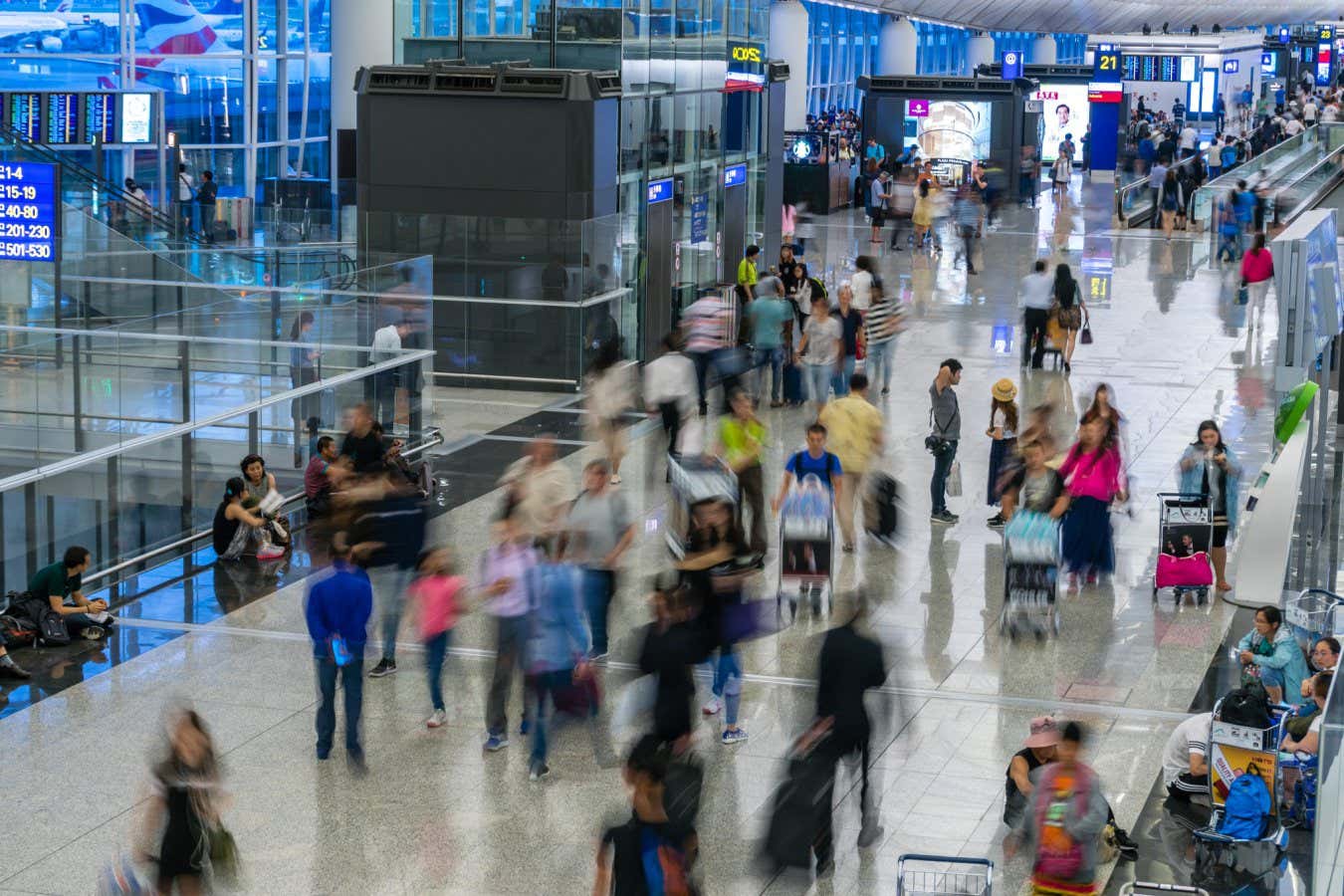
A network of airports like Hong Kong International Airport could effectively detect disease outbreaks
Yuen Man Cheung / Alamy
A global early-warning system for disease outbreaks and even future pandemics is possible with minimal monitoring: testing the waste water from a fraction of international flight arrivals at just 20 airports around the world.
When passengers fly while infected with bacteria or viruses, they can leave traces of these pathogens in their waste, which airports collect from a plane after the flight lands. “If you’re going to the bathroom on an aircraft, and if you blow your nose and put that in the toilet – or if you do whatever you have to do – there’s some chance that some of the genetic material from the pathogen is going into the waste water,” says Guillaume St-Onge at Northeastern University in Massachusetts.
St-Onge and his colleagues used a simulator called the Global Epidemic and Mobility model to analyse how airport waste-water surveillance networks could detect emerging variants of a virus like the one that causes covid-19. By testing the model using different numbers and locations of airports, they showed that 20 strategically placed “sentinel airports” worldwide could detect outbreaks nearly as quickly and efficiently as a network involving thousands of airports. The larger network was just 20 per cent faster but cost much more.
To detect emerging threats from anywhere in the world, the network should include major international airports in cities such as London, Paris, Dubai and Singapore. But the team also showed how networks involving a different set of airports could provide more targeted detection of disease outbreaks that were likely to originate in certain continents.
“This modelling study is the first to provide the actual number of sentinel airports required to support effective global surveillance while optimising resource use,” says Jiaying Li at the University of Sydney in Australia.
Airport-based networks could also provide useful information about disease outbreaks early on during an epidemic, including estimates of how quickly the disease can spread from person to person and how many people are likely to be infected from exposure to a single case, says St-Onge.
Such waste-water surveillance could provide early warning for known diseases and possibly track new emerging threats too – if the bacterium’s or virus’s genomic data is available. “I don’t think we’d be able to look in the waste water and say: ‘There is a new pathogen that’s out there,’” says Temi Ibitoye at Brown University in Rhode Island. “But when a new pathogen is announced, you can very quickly look at that previous waste-water data and say: ‘Is this present in our sample?’”

A map of sentinel airports, with colours indicating how quickly this network would detect a novel disease outbreak originating at various sites around the world
Northeastern University
There are still some nuances to work out, such as how often to take waste-water samples to track different pathogens. Other challenges include figuring out the most efficient ways to sample waste water from aircraft and evaluating the system’s real-world effectiveness, says Li.
A long-term monitoring programme would also require cooperation from airlines and airports, along with a consistent source of funding, she says.
Individual airports could hesitate to participate because of perceived risk to their operations if infectious disease statistics are made widely available – unless data-handling agreements could assuage such concerns, says Trevor Charles at the University of Waterloo in Canada. He emphasised the importance of coordinated international funding to offset “local political considerations”.
But even coordination through an international body like the World Health Organization carries its own political complications, given that President Donald Trump has initiated the US’s withdrawal from the organisation, says Ibitoye. Still, research such as this “contributes towards making [the monitoring network] a reality sooner rather than later”, she says.
Topics:
