

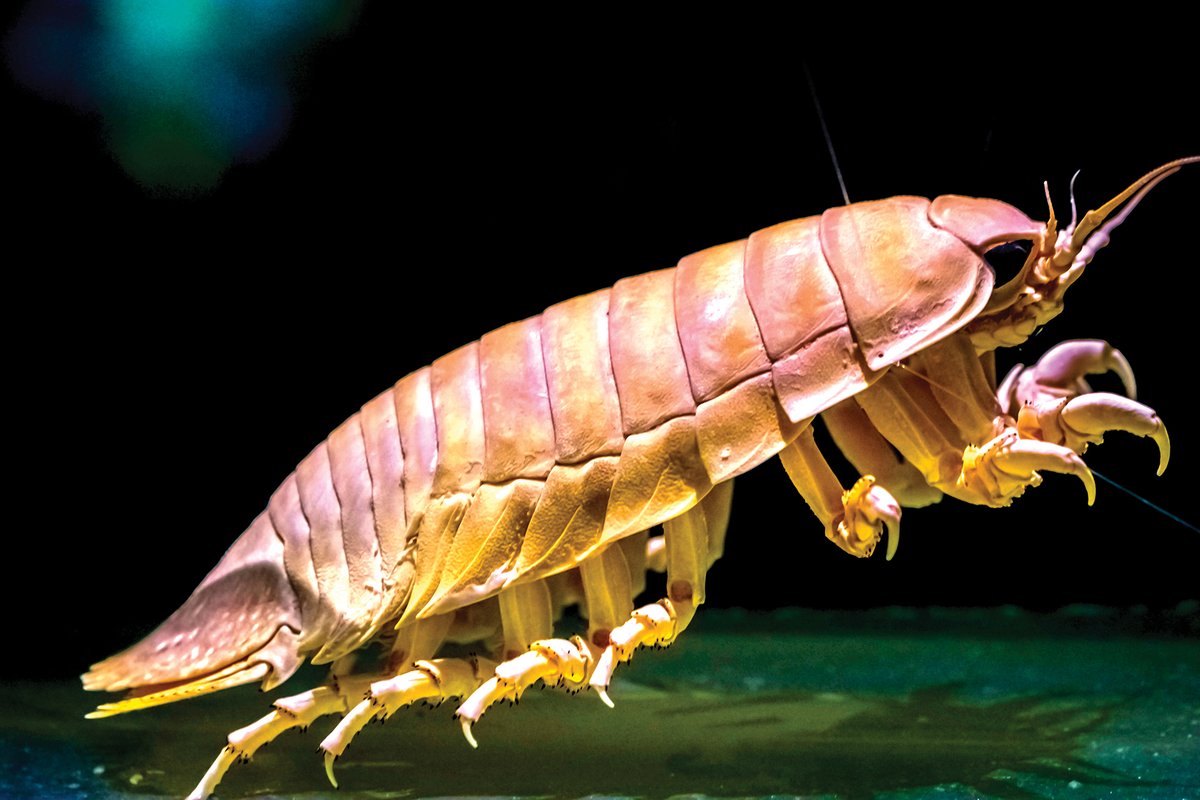
When scientists refer to the deep sea as Earth’s most alien environment, they’re not exaggerating. Among the cast of bizarre characters are enormous armor-covered crustaceans with large triangular compound eyes and long antennae. Researchers have long wondered how these strange creatures pull off one extreme feat: surviving more than five years without food.
It turns out that millions of years ago these deep-sea isopods most likely co-opted a gene from bacteria that—paired with a large stomach—lets them gorge on rare meals and slow their metabolism to endure long-term starvation in the ocean depths. “This is surprising because bacteria and animals are very different, and such [gene] transfers are rare,” says Jianbo Yuan, a marine biologist at the Chinese Academy of Sciences’ Institute of Oceanology and co-author on the new research published in Cell.
Giant marine isopods, which are related to garden pill bugs, live across a wide range of ocean depths, from a comparatively shallow 170 meters to the deep, dark sea around 2,100 meters down, where food and light are scarce. Some deep-sea isopods are supergiant, reaching up to half a meter in length. To understand what separates the deep-sea species from their shallower cousins, the researchers sequenced full genomes from specimens found at 300 and 800 meters and compared their energy demands, enzyme activity and oxygen use.
On supporting science journalism
If you’re enjoying this article, consider supporting our award-winning journalism by subscribing. By purchasing a subscription you are helping to ensure the future of impactful stories about the discoveries and ideas shaping our world today.
They found a key gene called ND1 expressed much more strongly in the deep-sea isopods that looked more like a gene found in bacteria than in an animal: it lacked filler genetic segments called introns and produced very tiny proteins, both signs of a bacterial gene. The researchers theorize that more than 16 million years ago genes from bacteria living in an isopod’s stomach may have been incorporated into its genome in a way that was then passed along to future generations.
The many copies now in deep-sea isopods’ genomes seem to slow down energy production when the creatures are in cold conditions. Inserting the gene into zebra fish, nematode worms and human cells, the researchers found, lowered those organisms’ metabolic rates, too.
The finding “opens a completely new window to study the evolution of deep-sea gigantism and the role of microbiome in deep-sea adaptation,” says Torben Riehl, a marine biologist at the Senckenberg Ocean Species Alliance in Frankfurt, Germany, who was not involved in the study. Deep-sea ecosystems cover more than 50 percent of Earth’s surface and are vital to the planet—so every little bit we learn, Riehl adds, may help us understand the benefits these ecosystems provide and how to preserve them.
Subscribe to Support Independent Journalism
Great science journalism requires human expertise, time, effort and creativity. And it costs money. That’s why I and the journalists here at Scientific American hope you’ll join our community.
When you subscribe, you are supporting staff and freelance journalists who are passionate about telling science stories that are true, important and compelling. Our editors and reporters are often experts in their fields, which means they understand the nuances of big discoveries and can untangle the breakthroughs from the hype. With a subscription, you are also supporting rigorous fact-checking to ensure the words we publish are precise and accurate. And you’re supporting original illustrations, graphics and photos that bring you closer to an advanced laboratory, an ice sheet in Antarctica or a space mission in orbit. You’re helping us craft other types of high-quality journalism as well: Our newsletters are carefully written, edited and curated by staffers you have or will come to know and love. Our Science Quickly podcast is based on original reporting, collaboration with editors and scientists and exacting production.
Subscriptions keep this engine running so we can continue to deliver thoughtful, rigorous and independent science journalism to you. In an era of viral misinformation, this work is crucial. If you value what we do, I hope you’ll consider joining us as a subscriber
