

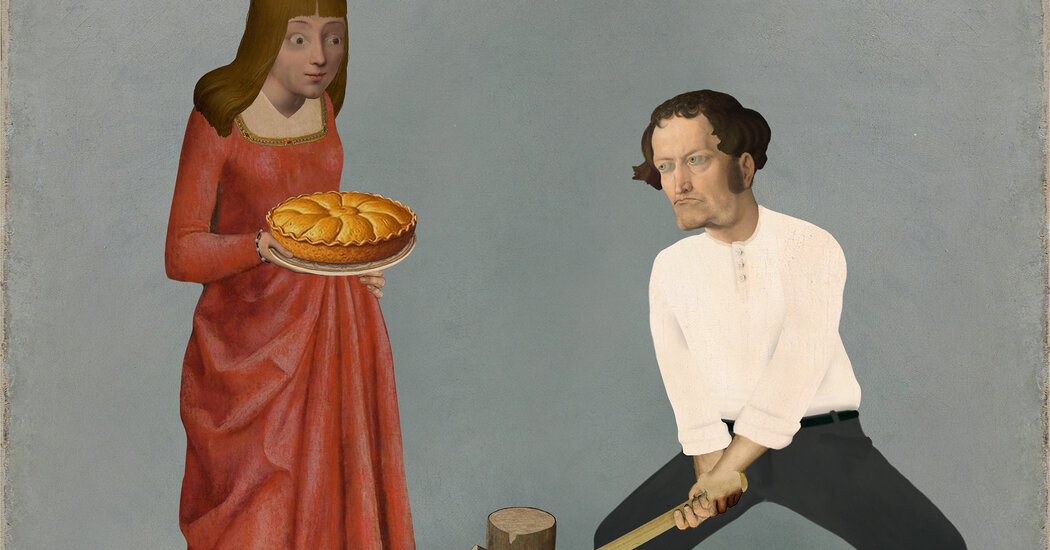
The 2024 election felt like more than just a victory for President Trump. It felt like a victory for a traditional view of gender roles.
Mr. Trump certainly shares that view. During the campaign, he declared that women liked him because he was their “protector.” He called the satellite radio host Howard Stern a “BETA MALE” after Mr. Stern criticized him. In a 2021 interview, Mr. Trump’s running mate, JD Vance, disparaged women without children as “childless cat ladies.”
It appeared that what Mark Zuckerberg lauded as “masculine energy” was on the rise — fueled by a “manosphere” of podcasters and a subculture of women, the so-called tradwives, who have embraced homemaking and domesticity.
But in a way, all that was just anecdotes and impressions. Now we have the data to match. Surveys from 2024 show that support for traditional gender roles is increasing. Perhaps unsurprisingly, this is happening primarily among Republicans. Perhaps more surprisingly, it is happening among Republican women as well as among Republican men.
Put another way, the rise in gender traditionalism derives more from politics than it is does from gender.
It’s important to note just how new this trend is. For decades, gender traditionalism was in decline. In American National Election Studies surveys, the percentage of Americans saying that “women’s place is in the home” decreased steadily — from almost 30 percent in 1972 to 6 percent in 2008. Instead, more people embraced the view that “women should have an equal role with men in running business, industry and government.” This question was actually dropped from these surveys after 2008.
Pew Research Center surveys documented a similar trend. From 1987 to 2012, fewer people endorsed the idea that “women should return to their traditional role in society.” As of 2012, there were no significant differences between Democrats and Republicans. Pew also stopped asking that particular question. Its last graphical display of the decline in gender traditionalism was called “No Turning Back for Women.”
More recent data, however, show increasing support for traditional gender roles among both Republican men and Republican women. For example, in the Views of the Electorate Research Survey, the percentage of Republican men who agree that women should return to their traditional roles increased from 28 percent in May 2022 to 48 percent in November 2024. Among Republican women, there was an increase from 23 percent to 37 percent. The views of Democrats, on the other hand, did not change much.
There has also been an increase in Republicans’ support for traditional notions of masculinity. In the Views of the Electorate Research Survey, Republicans have become more likely to agree that “what it means to be a man has changed and I don’t think that has been good for society.” About three-fourths of both Republican men and Republican women endorse this view.
Similarly, in surveys done by the Public Religion Research Institute, an increasing percentage of Republican men and women agree that “society as a whole has become too soft and feminine.” The percentage of Republican men who endorse this idea has increased from 68 percent in 2011 to 79 percent in 2024. The increase among Republican women is even larger — from 41 percent to 67 percent. Democrats, especially Democratic men, have become less likely to agree with this.
Note that this trend has developed over several years, with the earliest changes visible in 2016 compared with 2011. Not all the credit or blame can be laid at the feet of podcasters, tech moguls or the tradwives of TikTok.
One last data point shows this increasing Republican support for traditional gender roles. In Pew Research Center surveys, the percentage of Republicans who agree that “society is too accepting of men who take on roles typically associated with women” has increased from 18 percent in 2017 to 28 percent in 2024.
There are at least two plausible explanations for these changes. One is that some Republicans are changing their minds in response to new information from opinion leaders and media sources. Another is that some of them had traditional views all along and now feel more comfortable expressing them.
We think that changing minds is the more likely explanation. One reason is that we are not seeing similar changes in other types of attitudes about gender. For example, the Views of the Electorate Research Survey asks several questions that measure perceptions of discrimination against women. Respondents are asked to agree or disagree with statements like “Women often miss out on good jobs because of discrimination” and “Women who complain about harassment often cause more problems than they solve.”
Although there are predictable partisan differences in the responses to these questions, those differences did not increase very much from 2016 to 2024. If it were simply becoming more socially acceptable to express conservative views about gender, we would expect a variety of views to change. But the changes seem limited to questions about gender roles, not about gender discrimination.
While these changes in public opinion are notable, there are reasons to be cautious about what they mean going forward.
First, other facets of public opinion do not suggest an embrace of masculine energy. Majorities of Americans, including many Republicans, still say that Americans don’t place enough value on men who display stereotypically feminine qualities, like being affectionate or caring. Large majorities of Americans, including majorities of both parties, reject stereotypically masculine behaviors like fighting, getting drunk, sleeping around and talking about women in a sexual way. And most Americans reject Mr. Vance’s view of childlessness and say that it’s fine if a couple chooses not to have children.
Second, views expressed in surveys do not always translate into real-world behavior. Simply stating support for traditional gender roles may not mean that someone is living out those roles.
There is not much evidence, for example, that an overwhelming number of women are becoming tradwives. In fact, labor force participation among prime-age women has never been higher. Rates of marriage and childbirth are also down among women overall, especially women with less formal education.
Men aren’t adopting traditionally male roles, either. The U.S. government regularly conducts a “time-use survey” that asks respondents to construct detailed diaries of how they spend their time each day. Research based on that survey shows that married men and women are becoming more similar in the time they spend on things like housework and shopping (although women still spend more time on them). The researchers conclude that “men appear to have an increased proclivity for doing more traditionally feminine work.”
It is possible, then, that any growing gender traditionalism may be a reaction to societal trends and not a cause of these trends. If anything, the societal trends are in the opposite direction.
Nonetheless, the rise in Republican reverence for traditional gender roles marks a breakdown of the apparent consensus of a decade ago. It is yet one more manifestation of an underappreciated fact about gender and politics. Although there is a lot of focus on the longstanding gender gap between men and women in voting, the two parties are actually divided less by gender than by their attitudes about gender.
The more important difference between Democrats and Republicans isn’t whether they are men or women. It’s how they think men and women should behave.
Michael Tesler is a professor of political science at the University of California, Irvine. John Sides is a professor of political science and Colette Marcellin is a doctoral candidate in political science, both at Vanderbilt University.
Graphics by Aileen Clarke.
The Times is committed to publishing a diversity of letters to the editor. We’d like to hear what you think about this or any of our articles. Here are some tips. And here’s our email: letters@nytimes.com.
Follow the New York Times Opinion section on Facebook, Instagram, TikTok, Bluesky, WhatsApp and Threads.
