


In April, the red-hulled icebreaker Polar Star lumbered home to the Seattle waterfront, the conclusion of its 29th annual trek to the bottom of the world to crack open frozen Antarctic Sea routes. The U.S. Coast Guard cutter currently shares a home port with the nation’s two other icebreakers at Pier 36, part of a longstanding base that’s supported the country’s polar operations for decades.
With Congress finally funding an expansion of the nation’s meager icebreaker fleet, Seattle should be cementing its status as the nation’s strategic home port for a new geopolitical era in the global far north. U.S. Sen. Maria Cantwell calls it a “gateway to the Arctic.”
Instead, those plans have hit a snag.
Breaking the ice on a new fleet
The U.S. Coast Guard is building a new fleet of icebreakers for the increasingly competitive Arctic region. Here’s the how the current and future fleets stack up.
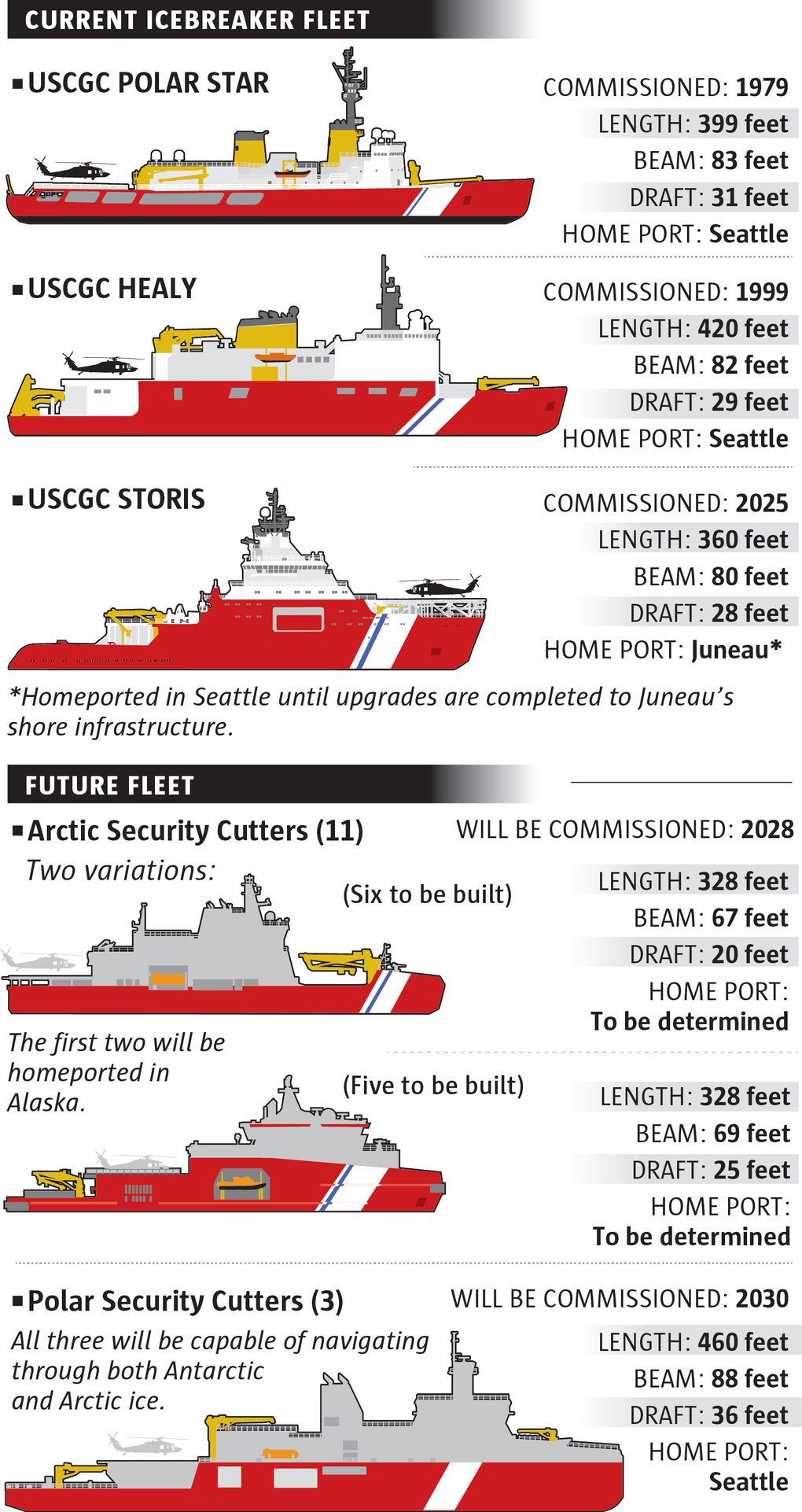
The Coast Guard announced last month that it was declining to pursue a larger planned icebreaker base expansion in Seattle and, in a separate announcement, said locations in Alaska will become the home ports for two new icebreaking vessels known as Arctic Security Cutters.
The Coast Guard’s retreat should alarm political leaders here, from local port commissioners to Gov. Bob Ferguson. The service’s robust multimission base in Seattle remains essential to Puget Sound’s broad maritime economy. Jobs, infrastructure and investment are on the line. Growing, not shrinking, the service’s footprint here should be in every local leader’s interest.
The Coast Guard’s backtracking follows the Northwest Seaport Alliance’s renewed search for a cargo tenant at nearby Terminal 46, which the service had eyed for base expansion. The alliance, comprising commissioners from the combined ports of Seattle and Tacoma, signed a contract with a Canadian firm in December to seek new cargo business there — a chilling signal to the Coast Guard and its expansion plans.
Port commissioners would be foolish not to consider all options when it comes to the limited supply of industrial lands available on the waterfront. But the alliance’s success in attracting new business there is far from certain; the terminal has mostly sat empty since 2019. Seattle Port Commissioner Fred Felleman told the Post Alley blog he’d rather have “red hulls” than “no hulls,” but moves that aim to shut out the Coast Guard from a future waterfront location risk the latter.
Granted, the Coast Guard is already pursuing a $323 million modernization at Base Seattle to host the country’s newest heavy icebreakers, known as the Polar Security Cutters. But local leaders should not be complacent about further investment. The Coast Guard’s scaled-back plan calls for only about 6 more acres to be purchased at Terminal 46, roughly a 10th of the service’s original proposal.
Melting sea ice in the far north requires a far more vigorous Coast Guard presence than the one today. New Arctic shipping lanes are opening in a warming world; some countries are contemplating risky oil, gas and mineral extraction in one of the globe’s most environmentally vulnerable regions. Seattle’s multifaceted base is best suited to meet new demands in the Arctic, building on the polar skill set it’s hosted here since 1976.
Seattle Mayor Katie Wilson noted through a spokesperson that she’s “closely monitoring the Coast Guard’s plans,” and backs the work of longtime U.S. Sens. Cantwell and Patty Murray, as well as Washington’s congressional delegation, “to support the maritime industrial base and grow the Coast Guard assets, including additional Arctic Security Cutters.”
That’s welcome news, as the buildout of a new icebreaker fleet begins. Congress earmarked more than $8.6 billion for these thick-hulled vessels to finally begin the march toward matching other countries’ ambitions, including a 40-plus- icebreaker Russian armada.
Where nine of the 11 Arctic Security Cutters will be homeported is still an open question. Alaska’s congressional delegation has proved persuasive; Sen. Dan Sullivan often remarks that his state is “actually where the ice is.” Adm. Kevin E. Lunday, the Coast Guard’s commandant, said up to four could go to the state, at Sullivan’s urging.
Local leaders have a great case of their own. The Puget Sound region’s advantages include a skilled maritime workforce of more than 62,000 that’s also home to the Navy’s third largest fleet concentration and the North Pacific Fishing Fleet, not to mention robust shipyard capacity. Just last month, Vigor Marine, owners of a nearby Harbor Island shipyard, won a $64 million contract to maintain the Polar Star.
Rather than a remote outpost, Seattle and the region offer a strategic node on the perch of the Pacific rim, where rapidly growing the ranks of Coast Guard personnel for Arctic competition is possible. The metropolis possesses the amenities necessary for Coast Guard families to thrive here.
Disappointingly, Ferguson didn’t respond to the editorial board’s repeated requests for comment about the Coast Guard’s expansion over the last two weeks.
Murray, for her part, told the editorial board that she remains committed to expanding the Seattle base’s capabilities.
“I’m going to keep working to ensure that Base Seattle has the resources it needs to grow, modernize and succeed,” she said.
Cantwell said she has a commitment from Lunday for up to four additional Coast Guard vessels to be homeported in Seattle.
“This effort will strengthen our Arctic presence and scientific leadership, make Puget Sound shipyards more competitive, and could support hundreds of shipbuilding and repair jobs,” she said in a statement.
Now, Seattle and its leaders need to show the Coast Guard that the Puget Sound region is the best place for more icebreakers — or they’ll end up elsewhere.
