

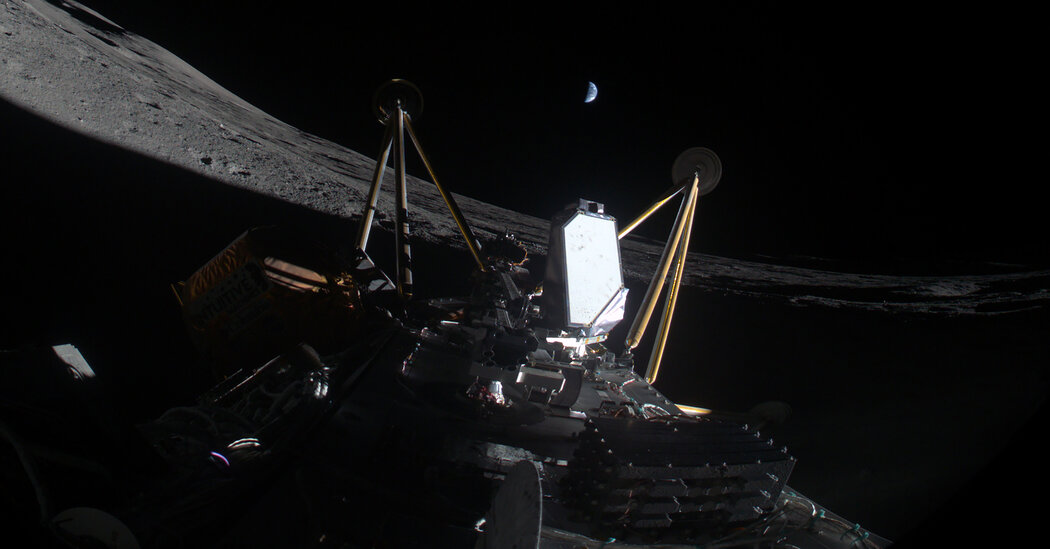
A day after landing on the moon, the robotic Athena spacecraft built by Intuitive Machines of Houston is dead.
In an update on its website on Friday, the company confirmed that Athena had tipped onto its side — the same fate that befell its first lunar lander, Odysseus, last year. With its solar panels unable to face the sun, the spacecraft’s batteries could not recharge.
The company said it did not expect the spacecraft to revive.
Before the spacecraft fell silent, it said “mission controllers were able to accelerate several program and payload milestones.”
On Friday afternoon, NASA reported that some of its payloads were able to turn on and send back data before the lander stopped working. The mission was supposed to last 10 days until the darkness of lunar night fell over that part of the moon.
The mission was part of a NASA program known as Commercial Lunar Payload Services, or CLPS, to contract private companies to carry science instruments and technology demonstrations to the moon at a lower cost. Another robotic spacecraft that is part of CLPS, the Blue Ghost lander by Firefly Aerospace of Cedar Park, Texas, touched down on Sunday and is conducting science experiments on another part of the moon.
Athena landed on Thursday on a flat-topped mountain named Mons Mouton, about 100 miles from the moon’s south pole. It was the southernmost landing site of any spacecraft.
The spacecraft ended up about 800 feet from the targeted landing site, the company said.
Athena was carrying payloads for NASA and commercial customers, including three rovers, a rocket-powered drone and a drill meant to poke into the lunar soil in search of water ice.
Soon after the landing, it became clear that the spacecraft was not working as expected.
At a post-landing news conference, Steve Altemus, the chief executive of Intuitive Machines, portrayed the tribulations in a positive light. “Any time that you ship a spacecraft to Florida for flight and end up a week later operating on the moon, I declare that a success,” he said.
Investors do not appear to agree. Shares of Intuitive Machines, a publicly traded company, fell 20 percent on Thursday and continued to decline at the start of trading on Friday. At noon on Friday, the company’s stock was trading under $9, down from more than $13 when the stock market opened on Thursday.
Nicola Fox, the associate administrator for NASA’s science mission directorate, also tried to put a positive spin on the discouraging results. “Our goal is to set American companies up to establish a lunar economy on the surface,” she said. “And that means that even if it doesn’t land perfectly, we always learn lessons that we can provide and use in the future.”
But the quick death of Athena again raises questions about the soundness of NASA’s strategy.
So far, four CLPS missions have been launched. Only Sunday’s landing of the Blue Ghost spacecraft by Firefly appears to be a complete success. The two landers sent by Intuitive Machines both landed in working condition but toppled over and failed to accomplish most of their science goals.
The fourth CLPS mission, by Astrobotic Technology of Pittsburgh, missed the moon entirely last year when the propulsion system of its Peregrine spacecraft malfunctioned soon after launch.
“You really hope that there’s at least two companies that are successful,” said Thomas Zurbuchen, who preceded Dr. Fox as the head of the science mission directorate and who set up CLPS in 2017. “I hope it’s more.”
But Dr. Zurbuchen has said from the start that perhaps half of the missions would fail as companies figured out how to take smart risks in building cheaper spacecraft.
The almost flawless success of Blue Ghost demonstrates that lunar missions with cheaper price tags are feasible. NASA paid $101 million to Firefly to deliver $44 million worth of science experiments.
For Athena, NASA agreed to pay Intuitive Machines $62.5 million for the delivery service to Mons Mouton. The intertwining of business relationships among Athena’s payloads suggest that the goal of spurring a profitable lunar economy is not entirely fantastical.
Nokia, for example, had won a NASA contract to deploy a 4G LTE cellphone network on the moon. Nokia then hired a company, Lunar Outpost of Golden, Colo., to build a rover that would move a cellphone antenna varying distances from the Athena lander as part of the tests of the technology, which would provide an upgrade from UHF radio for lunar communications.
Lunar Outpost then sold space on its rover to other commercial customers.
In a statement, Nokia said its system was successfully turned on after landing, and operated for about 25 minutes.
“Unfortunately, Nokia was unable to make the first cellular call on the moon due to factors beyond our control that resulted in extreme cold temperatures on our user device modules,” the statement said.
If the CLPS deliveries continue to fail, commercial companies and NASA might turn leery of sending more packages.
One of the key NASA instruments carried by Athena was a drill built by Honeybee Robotics, a subsidiary of Blue Origin. The drill was turned on and was able to demonstrate that it would have worked, NASA said.
An instrument for measuring water and other vapors of other chemical compounds in the lunar soil also worked, probably detecting elements in the exhaust plume from Athena’s propulsion system, NASA said.
Interest in the moon was rekindled a couple of decades ago after the discovery of frozen water in shadowed craters near the poles. By analyzing soil and rock up to three feet below the surface, NASA hoped to gain new insight into how much water is actually there and how easily it might be dug up and used by future astronauts.
But now NASA will have to decide whether to spend millions of dollars more for another drill to gather that information.
NASA already owns an identical drill that is installed on the Volatiles Investigating Polar Exploration Rover, or VIPER. The golf-cart-size rover was slated to also land on Mons Mouton on Astrobotic’s next CLPS mission. But the space agency announced last year that it wanted to cancel VIPER, even though it had already spent $450 million and the rover’s construction and testing were almost complete.
The space agency has since called companies for proposals to send the rover to the moon at no additional cost to NASA.
Danielle Kaye contributed reporting.
