

Across the spectrum of uses for artificial intelligence, one stands out.
The big, inspiring A.I. opportunity on the horizon, experts agree, lies in accelerating and transforming scientific discovery and development. Fed by vast troves of scientific data, A.I. promises to generate new drugs to combat disease, new agriculture to feed the world’s population and new materials to unlock green energy — all in a tiny fraction of the time of traditional research.
Technology companies like Microsoft and Google are making A.I. tools for science and collaborating with partners in fields like drug discovery. And the Nobel Prize in Chemistry last year went to scientists using A.I. to predict and create proteins.
This month, Lila Sciences went public with its own ambitions to revolutionize science through A.I. The start-up, which is based in Cambridge, Mass., had worked in secret for two years “to build scientific superintelligence to solve humankind’s greatest challenges.”
Relying on an experienced team of scientists and $200 million in initial funding, Lila has been developing an A.I. program trained on published and experimental data, as well as the scientific process and reasoning. The start-up then lets that A.I. software run experiments in automated, physical labs with a few scientists to assist.
Already, in projects demonstrating the technology, Lila’s A.I. has generated novel antibodies to fight disease and developed new materials for capturing carbon from the atmosphere. Lila turned those experiments into physical results in its lab within months, a process that most likely would take years with conventional research.
Experiments like Lila’s have convinced many scientists that A.I. will soon make the hypothesis-experiment-test cycle faster than ever before. In some cases, A.I. could even exceed the human imagination with inventions, turbocharging progress.
“A.I. will power the next revolution of this most valuable thing humans ever stumbled across — the scientific method,” said Geoffrey von Maltzahn, Lila’s chief executive, who has a Ph.D. in biomedical engineering and medical physics from the Massachusetts Institute of Technology.
The push to reinvent the scientific discovery process builds on the power of generative A.I., which burst into public awareness with the introduction of OpenAI’s ChatGPT just over two years ago. The new technology is trained on data across the internet and can answer questions, write reports and compose email with humanlike fluency.
The new breed of A.I. set off a commercial arms race and seemingly limitless spending by tech companies including OpenAI, Microsoft and Google.
(The New York Times has sued OpenAI and Microsoft, which formed a partnership, accusing them of copyright infringement regarding news content related to A.I. systems. OpenAI and Microsoft have denied those claims.)
Lila has taken a science-focused approach to training its generative A.I., feeding it research papers, documented experiments and data from its fast-growing life science and materials science lab. That, the Lila team believes, will give the technology both depth in science and wide-ranging abilities, mirroring the way chatbots can write poetry and computer code.
Still, Lila and any company working to crack “scientific superintelligence” will face major challenges, scientists say. While A.I. is already revolutionizing certain fields, including drug discovery, it’s unclear whether the technology is just a powerful tool or on a path to matching or surpassing all human abilities.
Since Lila has been operating in secret, outside scientists have not been able to evaluate its work and, they add, early progress in science does not guarantee success, as unforeseen obstacles often surface later.
“More power to them, if they can do it,” said David Baker, a biochemist and director of the Institute for Protein Design at the University of Washington. “It seems beyond anything I’m familiar with in scientific discovery.”
Dr. Baker, who shared the Nobel Prize in Chemistry last year, said he viewed A.I. more as a tool.
Lila was conceived inside Flagship Pioneering, an investor in and prolific creator of biotechnology companies, including the Covid-19 vaccine maker Moderna. Flagship conducts scientific research, focusing on where breakthroughs are likely within a few years and could prove commercially valuable, said Noubar Afeyan, Flagship’s founder and chief executive.
“So not only do we care about the idea, we care about the timeliness of the idea,” Dr. Afeyan said.
Lila resulted from the merger of two early A.I. company projects at Flagship, one focused on new materials and the other on biology. The two groups were trying to solve similar problems and recruit the same people, so they combined forces, said Molly Gibson, a computational biologist and a Lila co-founder.
The Lila team has completed five projects to demonstrate the abilities of its A.I., a powerful version of one of a growing number of sophisticated assistants known as agents. In each case, scientists — who typically had no specialty in the subject matter — typed in a request for what they wanted the A.I. program to accomplish. After refining the request, the scientists, working with A.I. as a partner, ran experiments and tested the results — again and again, steadily homing in on the desired target.
One of those projects found a new catalyst for green hydrogen production, which involves using electricity to split water into hydrogen and oxygen. The A.I. was instructed that the catalyst had to be abundant or easy to produce, unlike iridium, the current commercial standard. With A.I.’s help, the two scientists found a novel catalyst in four months — a process that more typically might take years.
That success helped persuade John Gregoire, a prominent researcher in new materials for clean energy, to leave the California Institute of Technology last year to join Lila as head of physical sciences research.
George Church, a Harvard geneticist known for his pioneering research in genome sequencing and DNA synthesis who has co-founded dozens of companies, also joined recently as Lila’s chief scientist.
“I think science is a really good topic for A.I.,” Dr. Church said. Science is focused on specific fields of knowledge, where truth and accuracy can be tested and measured, he added. That makes A.I. in science less prone to the errant and erroneous answers, known as hallucinations, sometimes created by chatbots.
The early projects are still a long way from market-ready products. Lila will now work with partners to commercialize the ideas emerging from its lab.
Lila is expanding its lab space in a six-floor Flagship building in Cambridge, alongside the Charles River. Over the next two years, Lila says, it plans to move into a separate building, add tens of thousands of square feet of lab space and open offices in San Francisco and London.
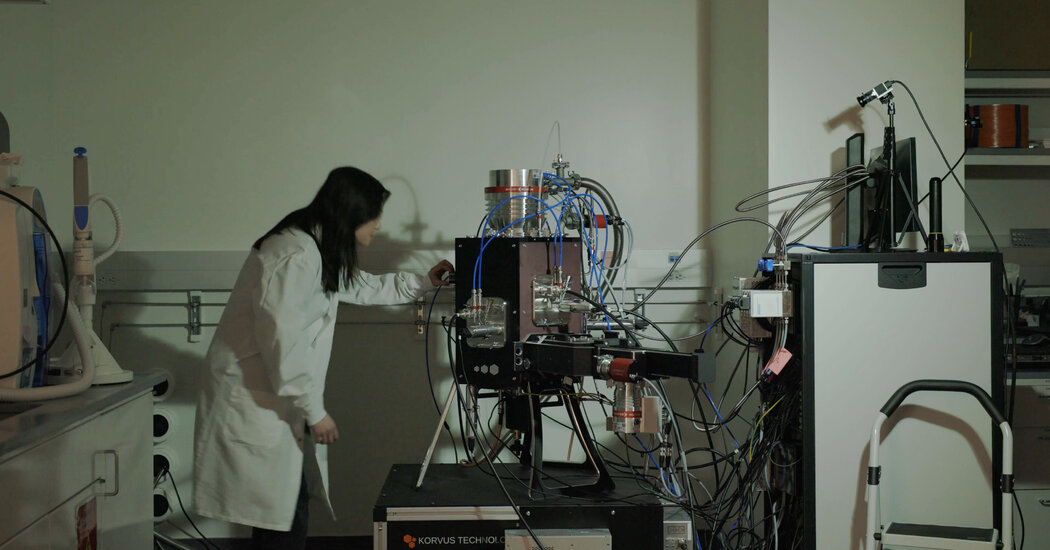
On a recent day, trays carrying 96 wells of DNA samples rode on magnetic tracks, shifting directions quickly for delivery to different lab stations, depending partly on what the A.I. suggested. The technology appeared to improvise as it executed experimental steps in pursuit of novel proteins, gene editors or metabolic pathways.
In another part of the lab, scientists monitored high-tech machines used to create, measure and analyze custom nanoparticles of new materials.
The activity on the lab floor was guided by a collaboration of white-coated scientists, automated equipment and unseen software. Every measurement, every experiment, every incremental success and failure was captured digitally and fed into Lila’s A.I. So it continuously learns, gets smarter and does more on its own.
“Our goal is really to give A.I. access to run the scientific method — to come up with new ideas and actually go into the lab and test those ideas,” Dr. Gibson said.
