

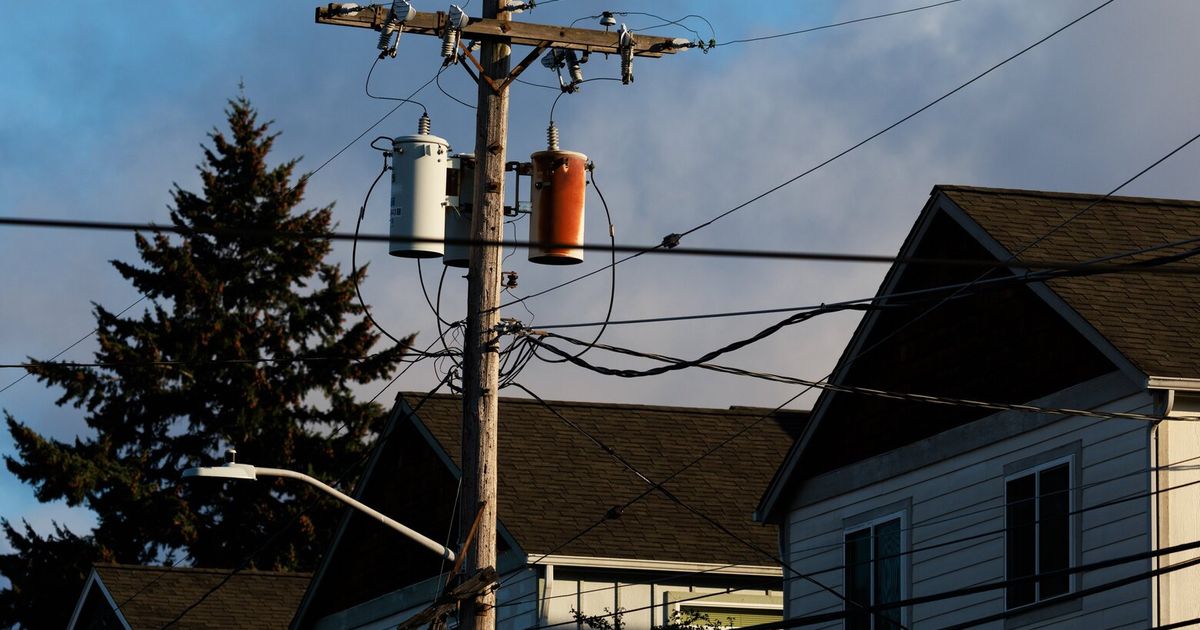
In an election year where Democrats may take back control of Congress and a statewide income tax is on the ballot, it’s a good bet many voters haven’t noticed Kitsap County residents are weighing a public takeover of their electricity service.
But it’s worth a look. What’s at stake — a vote to oust current electricity provider Puget Sound Energy from the peninsula — has ramifications for all of the private utility’s 1.2 million ratepayers across Western Washington. The decision could ultimately shrink PSE’s customer base, making it harder for the utility to continue its state-mandated build-out of clean energy projects.
Some Northwest energy experts worry the vote could even inspire other customers, from Bellingham to Olympia, to foment their own mutinies and pursue their own public option. If the state’s largest utility tips into that kind of death spiral, the greening of its grid could be at risk.
“If you send a utility into bankruptcy, forget about your clean energy goals,” Randy Hardy, a former superintendent of Seattle City Light and administrator of the Bonneville Power Administration, told me.
So why is PSE, as a utility, uniquely affected by those state-mandated goals? To understand that, think of a race whose runners are positioned at very different starting blocks. Some of the athletes have only a short distance to go and can probably skate by with only a little training. Others, meanwhile, will require a Rocky Balboa-like regimen to make it to the finish line.
This is what all utilities, public and private, are experiencing under the Clean Energy Transformation Act, or CETA, the state’s ambitious carbon-cutting law passed by the Legislature and signed by former Gov. Jay Inslee in 2019. Every utility must attain 80% of their electricity with carbon-free sources like wind and solar power by 2030. The finish line is drawing near.
Publicly owned utilities, including Seattle City Light, are already at the finisher’s podium. The state’s abundant hydropower, drawn from dams across the state, is considered clean. City Light already clocks in at 88%.
Puget Sound Energy, meanwhile, is running a much farther marathon. When CETA was passed, its energy sources were only 34% green, lacking access to abundant hydropower. To get to 80% by 2030, the Legislature granted the utility authority to invest heavily in wind farms, solar arrays and battery storage, while shedding all its coal by wire by the end of 2025. The transition will cost billions of dollars, and PSE has permission to pass those costs onto its ratepayers.
While cost pressures are mounting for every utility in the state, none are as extreme as PSE’s, whose rates have doubled this decade. And the utility is arguing before the state’s Utilities and Transportation Commission they must go up again by 30% over the next three years.
The average PSE customer’s bill could soon approach $90 more a month than that of a City Light customer.
Queue the Kitsap revolt. “Unplug PSE,” is the campaign on the peninsula to ditch the longtime provider and hand over the reins to the county’s public utilities district, which currently manages water systems and fiber optic cable for internet.
The ability to get power directly from the federal Bonneville Power Administration is a pathway that dates back to the dawn of hydropower in the Pacific Northwest. Specifically, the Bonneville Power Act, signed by President Franklin Roosevelt, included what’s known as the “preference clause” — a direct line to cheap hydropower for any public entity seeking it.
Trouble is, BPA’s network of 31 dams and its one nuclear power plant have only a limited amount of preference power left: a total of 200 megawatts that would be shared among any new public customers. Kitsap’s power demand, for example, averages 370 megawatts and can surge to more than 700 during winter cold snaps. When that low-cost preference power is spoken for, any new PUD would purchase electricity at a rate similar to other private and public utilities.
Should the Kitsap vote pass, the PUD will perform a feasibility study. If two of its three commissioners like the results, PSE’s 130,000 electricity customers will become the PUD’s customers.
Though I’m a peninsula resident myself, I think anyone who cares about this state’s energy future should also care about this vote. Here’s why.
1: Because it might just work — and inspire others to revolt
The push for a public option in Kitsap is the result of increasing customer bills. And those bills are increasing in large part due to CETA.
“We began getting more letters, comments, stopped in the grocery store, talked to by various community members, letting us know they were concerned with rising rates,” Kitsap PUD Commissioner Debra Lester told the Kitsap Sun earlier this year.
A customer mutiny within PSE is not unprecedented: Jefferson County residents in 2008 initiated the same law as Kitsap is considering.
But Jefferson is different in a few key respects. For one, customers rebelled because of reliability — what they said was a slow response to restoring power after storms. Secondly, Jefferson was able to access a low-interest federal loan, as a rural county with a tenth of the number of customers as Kitsap. Today’s interest rate environment is far less friendly.
Still, the price surge is dredging up some longtime criticisms customers have with the regulated monopoly, which guarantees a roughly 10% return for its investors. PUDs have no such obligation.
So the measure of success is this: Would a buyout of PSE’s infrastructure, the hiring of staff, access to BPA power and all the associated borrowing costs be cheaper than continuing the status quo?
2: If it works, it could lead to a death spiral at Puget Sound Energy
Shifting power from PSE’s energy mix and onto BPA’s portfolio comes at a time when power demands are surging around the Northwest for numerous reasons, not the least of which are proposals for energy-thirsty data centers. And despite Washington’s clean energy goals, the state lags far behind most others in its adoption of new renewable resources and transmission lines.
But for PSE, a diminishing customer base is an even bigger threat. Kitsap could be the canary in the coal mine. Fewer ratepayers doesn’t relieve the utility of its CETA 2030 goal. The costs of a wind farm, battery storage or other clean energy project doesn’t get any cheaper — only more expensive for what would become a smaller number of customers.
3: State lawmakers caused this situation — and now they must fix it.
Ultimately, it’s up to those in the state Legislature to recognize what is causing ratepayer frustration, and do something about it.
So let’s return to what might cause these potential dominoes to fall: CETA. Without the price pressure, it’s not likely the Kitsap revolt happens. And without the clean energy law, PSE’s bills would not have surged to record levels beyond their peer utilities.
What this means: When state lawmakers reconvene in Olympia in January, they must find a way to alleviate the near-term cost pressure on PSE.
Yes, CETA contained “offramps” that ostensibly allow utilities ways of complying without reaching the law’s targets. But judging by PSE’s application to the state regulator to raise rates, its leadership clearly doesn’t believe the utility will avoid steep fines that come in 2030 if they fail to hit CETA’s 80% target. The utility needs direction — a viable path — from the Legislature.
The current situation is untenable, and if PSE is picked apart, the 80% goal is certain to fail.
That doesn’t mean lawmakers must repeal or diminish CETA’s worthy goals. But what is necessary is a loosening of the law to account for the landscape of power in the Pacific Northwest. It is simply not sustainable for Puget Sound Energy’s ratepayers to suffocate under these soaring energy costs. And those costs could destroy the investor-owned utility, while driving customers to rely even more on the Northwest’s legacy hydropower, not new renewables.
For the good of the state’s electricity grid, as well as the pursuit of the green energy we know we need, the state Legislature must find a solution that both helps keep energy rates reasonable while keeping the course toward a cleaner future.
