

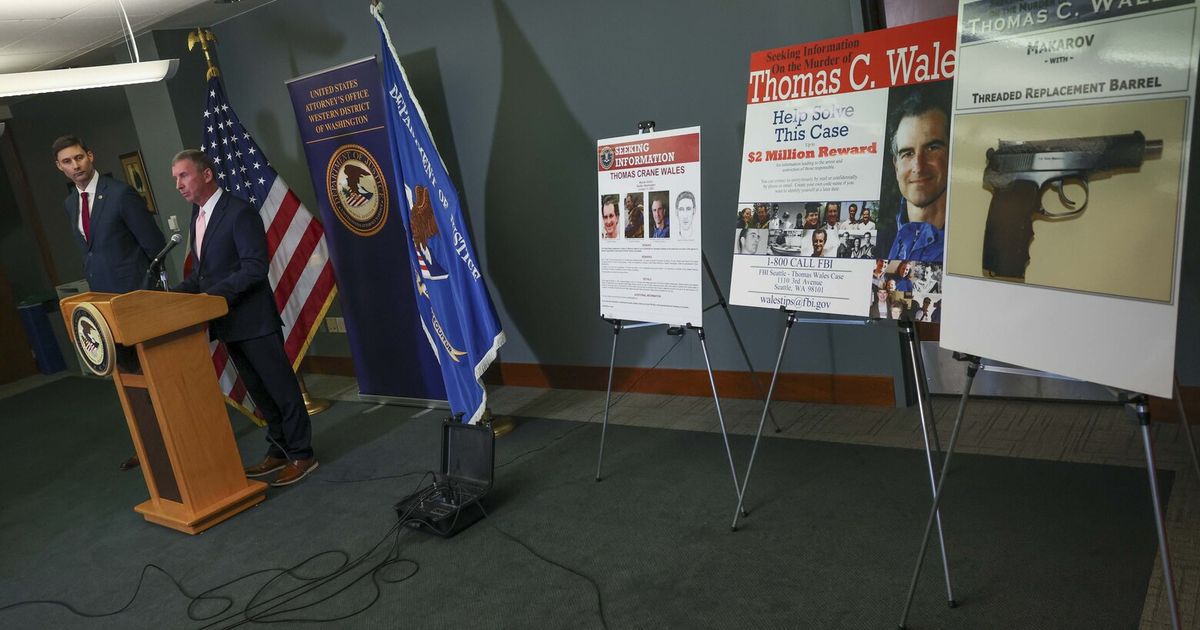
Twenty-five years ago, on a Thursday evening in October, a federal prosecutor named Tom Wales sat working at his desk in the basement of his Seattle home. At 10:40 p.m., a man crept into Wales’ backyard, avoided the motion-sensor lights and shot Wales through the window. He died the next day, at the age of 49.
Tom Wales is widely believed to be the only federal prosecutor in the 156-year history of the Department of Justice to be killed for doing his job.
There is a difference between being killed while doing your job and for doing your job. For 18 years, Wales served as an assistant U.S. attorney in Seattle, specializing in white-collar and fraud cases. The FBI never named a suspect, though it reportedly looked closely at a defendant in a fraud case that Wales prosecuted. In 2018, the FBI said it believed the killing was the work of a hired gunman. Wales’ death was an assassination, and his murder remains unsolved.
Wales’ case captures a problem every prosecutor lives with: There is no way to tell which resentments will fade and which will turn violent. Twenty-five years later, we still know little about that transformation.
I didn’t know about Wales when I became an assistant U.S. attorney. Instead, I learned about him from my husband’s family, who knew Tom and his family from living in the same Queen Anne neighborhood.
The more I learned about Wales, the more he reminded me of my colleagues: ordinary people performing an extraordinary public function. Prosecutors exercise immense governmental power without fear or favor. That independence is the point of the job, and it inevitably makes enemies.
During nearly 18 years at the Justice Department, I never believed I was in danger. But I received enough unsettling messages to know I couldn’t be sure. Some came from federal prison inmates with a bone to pick; a few kept writing or calling after their release. The hard part was deciphering intent. Was the writer or caller merely venting? Or was something more serious brewing? Usually, there was no way to know.
Every prosecutor lives somewhere on that spectrum: at one end, an unnerving letter you read and throw away; at the other, a man in your backyard at 10:40 on a Thursday night.
The government records threats against federal prosecutors, but it does not account for them consistently. Better tracking would not predict the next attack, but it would reveal which kinds of cases generate threats so resources follow actual risk instead of the last headline.
We already do this for judges. In 2020, a disgruntled litigant who found New Jersey Judge Esther Salas’ home address online went to her house and killed her 20-year-old son, Daniel Anderl. Two years later, Congress passed the Daniel Anderl Judicial Security and Privacy Act, which protects judges’ personally identifiable information from wide release as a way to minimize threats. That response was possible because threats against judges are tracked, reported and answered with resources. Prosecutors are counted too, but as an afterthought. In 2023, the U.S. Marshals Service reported 155 serious threats against federal prosecutors that required investigation, more than double the 72 recorded in 2020.
Yet the numbers are stripped of nearly everything useful. We don’t know the nature of those threats, how many prompted protective details, or which kinds of cases drew them. Are threats more common in drug and gun prosecutions or in white-collar cases? The public data doesn’t say.
That Wales’ murder remains singular is not a reason to wait for another. Congress should extend to federal prosecutors the same protections judges received after Anderl’s death, and require the Justice Department to track and publicly report threats against prosecutors as their own category, on a regular schedule, with enough detail to show where the danger lies.
The FBI continues to actively investigate Wales’ murder, and a $2.5 million reward stands. But even solving that case would not answer the larger question his death raises: how a grievance becomes a gunman.
Most prosecutors will never encounter what happened to Tom Wales. Nearly everyone who feels wronged moves on. Some announce first that they haven’t, in a letter or phone call. The least we owe federal prosecutors is to notice and keep track.
