

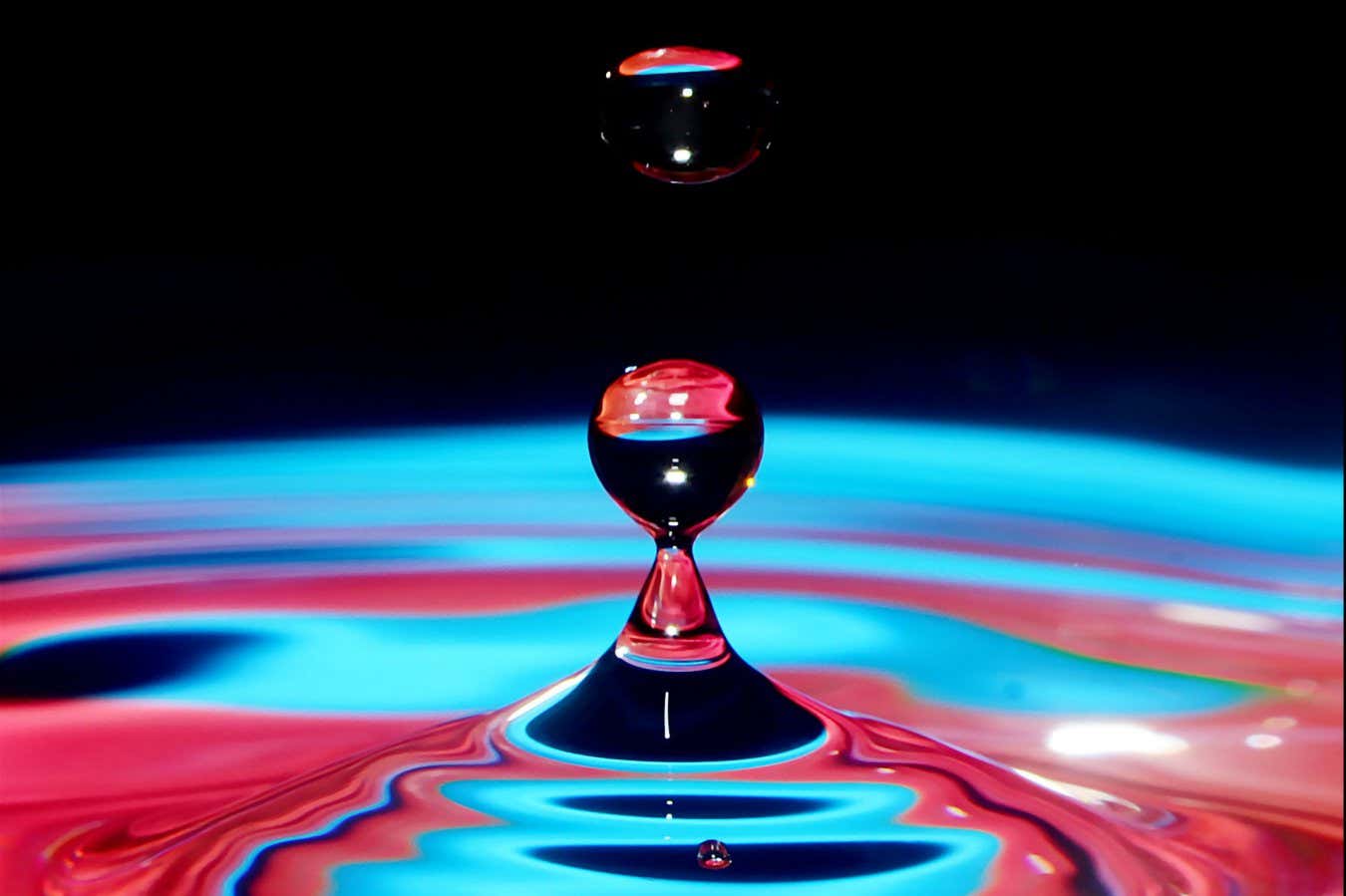
Sparks between water droplets may have started life as we know it
Shutterstock/Perry Correll
The first molecules necessary for life on Earth could have been created when tiny flickers of “microlightning” between drops of water sparked the necessary chemical reactions.
“This is a new way to think about how the building blocks of life were formed,” says Richard Zare at Stanford University in California.
There has been an enduring hole in our knowledge about the origin of life, specifically how simple gases reacted to create organic molecules with carbon and nitrogen bonded together, such as proteins and enzymes, which life as we know it relies on.
“If you look at the gases that people thought were around on early Earth, they don’t contain carbon-nitrogen bonds,” says Zare. “They are gases like methane, water, ammonia and nitrogen.”
Experiments by Stanley Miller and Harold Urey in 1952 revealed that electricity could turn water and such gases into the necessary organic molecules, but their hypothesis was that the electrical energy came from lightning.
Yet the low chance of lightning hitting a high concentration of gases in the dilute expanses of oceans or the atmosphere means many people have never been convinced that it was behind the emergence of life on Earth some 4 billion years ago.
Now, Zare and his colleagues have sprayed droplets of water into a mix of methane, carbon dioxide, ammonia and nitrogen gas – and have shown it can result in the formation of organic molecules with carbon-nitrogen bonds, with no external electricity source needed.
It works because the droplets in the water spray produce small electrical charges, says Zare. “The smaller droplets are negatively charged, the larger ones are positively charged,” he says. This is down to something called the Lenard effect, in which water droplets, such as those in a waterfall, collide and break up, generating an electrical charge.
What the team discovered using high-speed cameras, though, was that when oppositely charged droplets get close enough, tiny flashes of electricity jump between them, which Zare calls microlightning.
It is much like the way static electricity is generated, or lightning is built up and discharged in clouds. “When the water droplets come within nanometres of each other, you get an electric field and this electric field causes the breakdown,” he says.
The flashes of microlightning carried enough energy – about 12 electronvolts – to make gas molecules lose an electron and react with one another, generating organic molecules with carbon-nitrogen bonds, including hydrogen cyanide, the amino acid glycine and uracil, one of the components of RNA.
“It is surprising to me that microlightning can initiate chemistry starting with nitrogen. However, the observations reported are compelling,” says Veronica Vaida at the University of Colorado Boulder. “It brings a new and as yet unreported role for water in the origin of life.”
The work implies that tiny sparks made by crashing waves or waterfalls would have been enough to provide the chemicals needed for life to start on this planet, says Zare.
Water sprays are ubiquitous and often land on rocks, which would allow the organic chemicals to accumulate in their crevices, he says. The area would then dry out and get damp again. Such wet-dry cycles are known to make shorter molecules combine, or polymerise, into longer ones.
“The study suggests that microlightning would have been abundant in early Earth’s water-rich environments, and may have driven prebiotic chemistry, especially where other energy sources, such as lightning or UV radiation, were scarce,” says Kumar Vanka at the National Chemical Laboratory in Pune, India.
Vaida thinks the work also has implications for the search for extraterrestrial life, which is often guided by looking for the presence of water on other planets or moons. We might have to look for places that enable tiny droplets of water to collide, she says.
Topics:
