

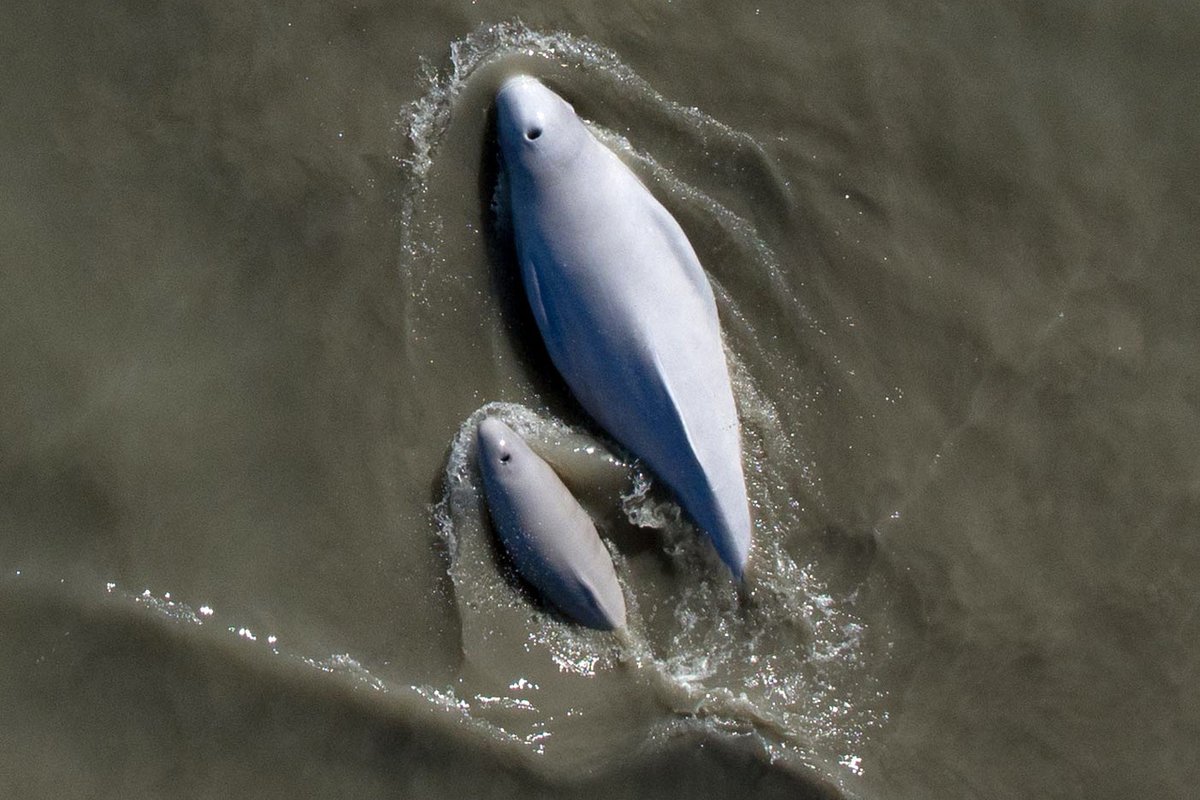
The battle over where to put data centers is heading below the waves: the Trump administration is considering proposals to build two massive underwater data centers off the country’s coast. The sites selected for the projects—one in Cook Inlet, Alaska, and one in the Gulf of Maine—are smack in the middle of two endangered whale populations’ habitats.
Whales are “skittish animals,” says Arial Brewer, a beluga researcher at the University of Washington and the National Oceanic and Atmospheric Administration. “A massive-scale project like this could really stress them out in a lot of different ways.”
Data centers, with their thousands of servers, generate considerable heat that can damage equipment if not offset in some way. Land-based facilities use massive amounts of fresh water to cool down. By putting a data center underwater, the ocean can easily dispel that heat. “Cooling is a large part of what a data center costs to run, and seawater is a free sink,” says Vishal Misra, a computer scientist and professor at Columbia University.
On supporting science journalism
If you’re enjoying this article, consider supporting our award-winning journalism by subscribing. By purchasing a subscription you are helping to ensure the future of impactful stories about the discoveries and ideas shaping our world today.
Microsoft showed that the concept could work with a pilot project off California in 2015 and another off Scotland a few years later. Currently, there are only two operational underwater data centers in the world, one off the Chinese island of Hainan and another off the coast of Shanghai, and they’re a fraction of the size of the proposed centers at the two U.S. sites.
In the Maine project, a cluster of what official documents call “subsea-compute hives” or “data center pods” would rest on the seabed, powered by up to 50 tidal turbines across 27 acres. In Cook Inlet, the data center would be made up of 66 pods and more than 300 tidal turbines. Its footprint would span 1,650 acres—more than 1,000 football fields.
The locations were chosen by DeepGreen Holdings LLC—a U.S.-based developer—because of their potential for tidal power, which works by harnessing the movement of water.
But each spot is also home to beleaguered groups of whales. A distinct population of around 300 critically endangered beluga whales lives in Cook Inlet. And the Gulf of Maine hosts feeding grounds for the North Atlantic right whale, a species whose numbers have dropped below 400 individuals.
The primary concern over data centers underwater is the same as for those on land: they are exceedingly noisy. “Pumps, fans and especially turbine arrays make continuous low-frequency sound, and pile-driving during construction is louder still,” Misra says.
Shipping noise has doubled every decade since the 1960s, and there’s evidence to suggest that when the volume goes down, marine mammals are less stressed. One study found that when ship noise decreased immediately after 9/11, right whales in the Gulf of Maine had lower levels of stress hormones. As for the belugas in Cook Inlet, they are particularly sensitive to noise, Brewer says. Because of glacial runoff, the bay is very turbid. “It literally looks like chocolate milk,” she says, so the belugas there rely almost entirely on echolocation to feed, mate and move around.
The purpose for putting the data centers underwater—heat shedding—also threatens the whales. When a pattern of warming waters hit the Gulf of Maine in the early 2010s, right whales started to abandon their feeding grounds. “Ocean warming is a big, big deal to them,” says Philip Hamilton, a senior scientist at the New England Aquarium.
In Alaska, salmon are one of the main prey sources for belugas—and the fish need cold water to develop their eggs, keep their metabolism stable and prevent energy depletion during long migratory journeys. “All that hot energy, what’s that going to do to very delicate salmon populations that rely on cold water?” Brewer says.
Community backlash has been fervent: The city of Eastport, Maine, issued a moratorium halting all permits and applications for all industrial data centers. The local Passamaquoddy tribe has also publicly expressed that it has no interest in any sort of collaboration with DeepGreen. Several groups have filed motions to intervene with the proposal for Cook Inlet.
The Federal Energy Regulatory Commission (FERC), which oversees such energy projects, notes that these proposals are just that: proposals. “A preliminary permit does not authorize construction of any kind,” says Celeste Miller, a FERC representative.
Indeed, FERC found the original proposals for both projects “deficient,” citing a lack of details and insufficient identification of Indigenous tribes who have historic ties to the local areas. But the agency has accepted amended versions; the Maine project, which originally called for 170 turbines on 400 acres of seafloor, now has a smaller proposed footprint. The public comment period for Maine closed on October 19, but the one for Cook Inlet is open until November 2. After that, FERC will review the applications and comments and issue preliminary permit decisions.
“We have no intent to build at this stage,” Louis Wolfson, the luxury real estate developer behind DeepGreen, says. “If equipment cannot operate safely well within federal marine mammal thresholds, it will never be licensed or deployed.”
But over the past two years, the federal government has sought to strip back those very thresholds. For example, the Senate is considering a bill that would delay new protections for right whales against entanglements in fishing gear. And though belugas and right whales have historically been protected under the Marine Mammal Protection Act, proposed amendments to it would drastically draw back protections.
“It feels like every day they’re chopping at another protection,” Hamilton says.
