

Happy Monday, listeners! For Scientific American’s Science Quickly, I’m Rachel Feltman. You’re listening to our weekly science news roundup.
Let’s start with some space news. Last week, the Japan Aerospace Exploration Agency, or JAXA for short, successfully launched a half-a-billion-dollar mission to land on Phobos, the largest Martian moon.
The Martian Moons Exploration spacecraft, also known as MMX, is expected to reach the vicinity of Mars in August of 2027. Once there, it will spend three years circling Mars in a path similar to Phobos’s orbit. One of its objectives is to find an ideal spot for landing on Phobos. In 2028 or 2029, MMX will send a rover down to the surface to spend 100 days observing the moon. That data will come in handy later in 2029, when MMX itself will attempt one or even two landings. If all goes well, MMX will return back up to orbit with 10 grams, or one-third of an ounce, of material from Phobos. It’s expected to make it back to Earth sometime in 2031.
On supporting science journalism
If you’re enjoying this article, consider supporting our award-winning journalism by subscribing. By purchasing a subscription you are helping to ensure the future of impactful stories about the discoveries and ideas shaping our world today.
So, why all this effort to check out a lumpy little moon? Phobos may be just 14 miles wide, but it’s got a lot to say. With an orbit of just over seven hours, it’s closer to its planet than any other moon in our solar system. That orbit is also gradually shrinking, bringing it on a slow-but-steady collision course with Mars.
Then there’s the unknown origin of Phobos and its little sibling, the Martian moon Deimos. Scientists aren’t sure whether these wee moons were once asteroids that got too close to Mars or if they formed from debris after something collided with the red planet. When the MMX sample comes home, researchers will compare its composition against Martian material and asteroids to try to solve that mystery.
Speaking of weird little guys with adorably tiny orbits, our next story features a little snake that uses cartwheels as a strange evasive maneuver.
Now, I don’t know about you, but I find cartwheels hard enough with two arms and legs to support me. But apparently there are tiny little snakes that put my acrobatic attempts to shame with nary a limb in sight. Scientists first showcased this ability with the dwarf reed snake in 2023, but now they’ve identified that same cartwheeling behavior in two additional species of the same genus, Pseudorabdion. And what’s even better is that they caught the bizarre locomotion on video.
The snakes start out by making a tight little curve, kind of like the letter “C,” with its head up top, facing the direction it wants to go, and something like the middle of its body touching the ground. Then it reels forward until its tail is the part touching the ground, which gives it the momentum to launch itself into the air. While it’s airborne, the snake twists around until it gets itself into the position of the starting point of the next roll, and it alternates which side of its body strikes the ground with each rotation. And did I mention these snakes are tiny and adorable? I’m definitely not doing the footage of their limbless leaping justice, so you really gotta check the video out for yourself. We’ll link to that in our show notes!
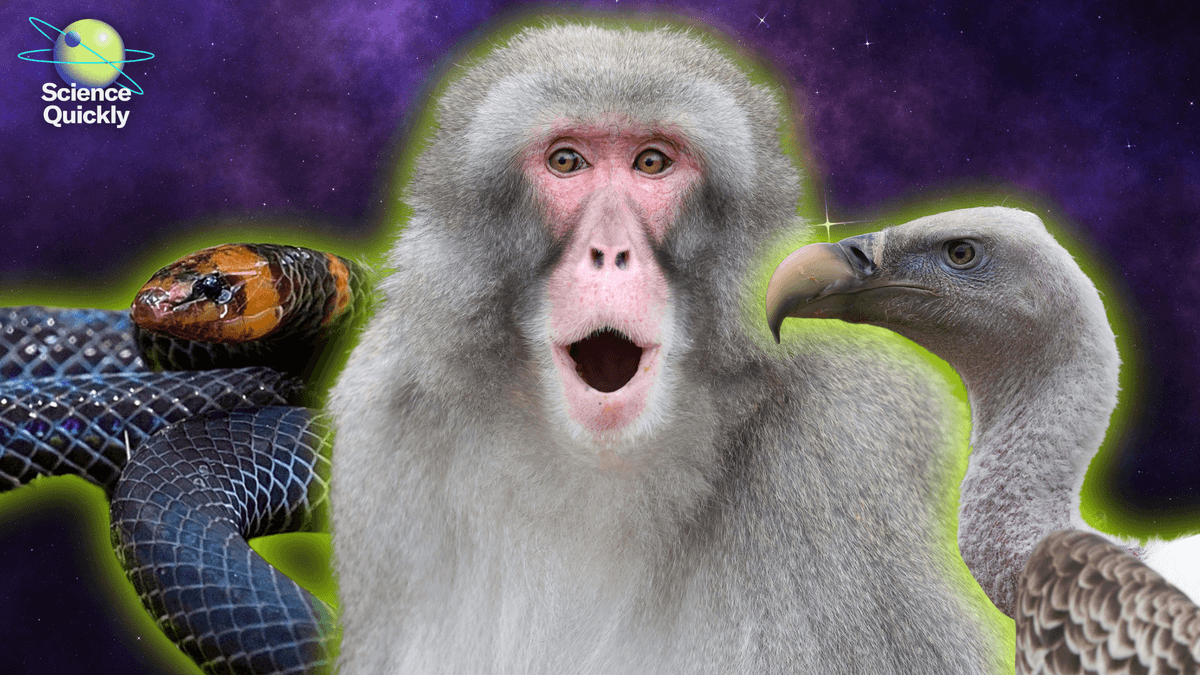
Those aren’t the only animal showoffs we saw making headlines last week. In a study published last Wednesday, researchers shared the surprisingly complex range of sounds made by birds not generally known for their gorgeous singing voices: vultures.
When you think of a vulture, you probably picture a relatively solitary and silent bird, maybe like a few of them flying around in an ominous circle but not much more than that. But the thing is that some species are quite social—and, as it turns out, those more gregarious species can also be quite vocal. Rüppell’s vultures, which nest in colonies hundreds of birds strong, are known to follow a literal pecking order when it comes time to pick a carcass clean. Some experts think that social complexity fuels the evolution of complex communication. So, the set hierarchy that these vultures live by made scientists wonder how they might use sound to communicate.
Researchers captured 150 hours of noise from two groups of vultures in captivity, which contained something like 2,500 calls. When they analyzed qualities like pitch and length, they were able to distinguish 16 distinct call types, which could be double the average for birds in general, based on previous research.
If you’re wondering what those calls sound like, well lucky for you we have some examples. The study authors dubbed the most common call the “metallic groan,” and it generally came from birds who were on the receiving end of some kind of aggression. There were also specific brays that came from vultures trying to bully other birds for food, hisses made in response, hoarse mating groans, and special calls made by parents as they lovingly puked food into their babies’ mouths.
For our next story, you know those tabloid stories that show celebrities, like, grocery shopping and stuff with the headline “they’re just like us?” Well slap some Japanese macaques onto those glossy pages. Because according to a study published last week in Royal Society Open Science, these monkeys have a lot in common with humans when it comes to responding to disease outbreaks.
Not unlike the human tendency to stock up on hand sanitizer and wipe down groceries in the wake of a pandemic, the researchers say, primates who have survived life-threatening disease outbreaks remain more cautious about potential food contamination than their peers. That’s especially interesting given the fact that, for a macaque, there’s no public health agency announcing where a deadly ailment has come from. But even with no empirical knowledge of disease transmission, like literally these guys do not have germ theory, this study suggests that a brush with contagion inspires habits that limit exposure to new bugs.
The study looked at Japanese macaques at a primate sanctuary in southern Texas, where they’re grouped into several distinct enclosures. Three groups experienced an outbreak of simian retrovirus Type II, which can cause a sickness similar to AIDS, back in 2020. A fourth enclosure was completely spared, which provided a natural control group.
To test how that experience impacted pathogen avoidance, the researchers offered macaques food from visibly clean surfaces as well as ones seemingly contaminated by monkey poop, though covered by epoxy to prevent any actual disease risk. Previous studies have shown that this species will avoid some food with fecal contamination, but will risk it all for a favorite treat like a peanut. And, indeed, in this new study, monkeys ate from a seemingly dirty surface in 79 percent of trials. But in the groups that had survived an outbreak, monkeys went for the poop food less than half of the time. Even individuals who had not personally been sick were less likely to risk contamination.
Simian retrovirus Type II doesn’t actually spread through food, but via scratches and bites. But we know that disgust and pathogen avoidance are complicated—and not always actually very useful—in humans, too.
We’ll wrap up with a story about the funnest little animals of them all: preschoolers. Researchers were curious about why people seem to think that kids are more creative than adults, despite scientific evidence showing the opposite. In a study published last week in PLOS One, they had 92 preschoolers and 70 adults tackle three creative tasks: spending eight minutes drawing freely on blank paper with colored pens and spending eight minutes inventing and drawing a made-up animal. The study subjects were all asked about how much they enjoyed those activities, how anxious the tasks made them feel, and how confident they felt about the quality of what they’d come up with. Then their results were evaluated by five people trained in a system for rating creative work.
It turns out that, at least in this case, adults were objectively more creative than preschoolers, coming up with more original and effective ideas—but they also enjoyed themselves way less and felt worse about their work. So if you often find yourself wishing you could recapture the boundless creativity of your youth, maybe you should actually just work on your self-confidence. One time a lady in my ceramic studio looked at what I was making and said, “Wow, I wish I gave myself that much freedom.” And I have to tell you, at the time, it did not feel good. But now, I think I might have changed my mind.
That’s all for this week’s news roundup. We’ll be back on Wednesday to see how science is showing up in the midterm elections.
Science Quickly is produced by me, Rachel Feltman, along with Fonda Mwangi, Sushmita Pathak, Allison Rodgers and Jeff DelViscio. This episode was edited by Alex Sugiura. Emily Makowski, Marielle Issa and Aaron Shattuck fact-check our show. Our theme music was composed by Dominic Smith. Subscribe to Scientific American for more up-to-date and in-depth science news.
For Scientific American, this is Rachel Feltman. Have a great week!
