

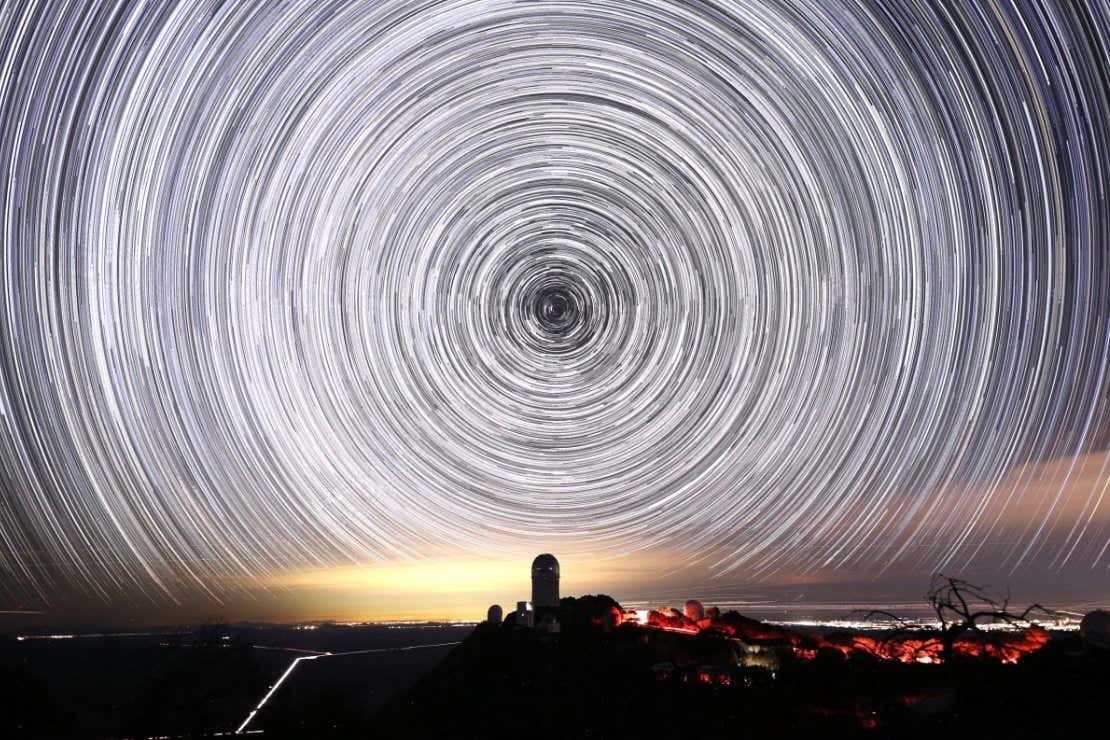
Star trails over the Mayall Telescope in Arizona, which houses the Dark Energy Spectroscopic Instrument
Luke Tyas/Berkeley Lab
Dark energy is one of the most mysterious features of our universe – we don’t know what it is, but it controls how the universe is expanding, as well as its ultimate fate. Now, a study of millions of celestial objects has revealed that we may have been thinking about it all wrong, with potentially dramatic consequences for the cosmos.
“This is the biggest hint we have about the nature of dark energy in the approximately 25 years since we discovered it,” says Adam Riess at Johns Hopkins University in Maryland.
The result comes from three years’ worth of data gathered by the Dark Energy Spectroscopic Instrument (DESI) in Arizona. By combining this data with other measurements, such as maps of the cosmic microwave background radiation and supernovae, the DESI team has concluded that dark energy may have changed over time – directly contradicting the standard model of cosmology, called lambda-CDM.
“This is the cutting edge of human knowledge,” says DESI team member Will Percival at the University of Waterloo in Canada. “We’re seeing something amazing with the whole universe.”
DESI is mounted on a telescope and works by measuring the “red shift” of light emitted by distant galaxies, or how the wavelengths of that light are stretched as it travels through the universe. From this, researchers can determine how much the universe has expanded during the light’s journey and calculate how this expansion is changing. So far, the team has analysed light from nearly 15 million galaxies and other bright objects in the sky.
For decades, physicists have agreed that the universe is expanding at a fixed rate of acceleration, a cosmological constant known as lambda that has been interpreted as the push of dark energy. But in April 2024, DESI’s measurements showed the first hints that the universe may actually be accelerating less quickly over time – making the cosmological constant not so constant.
Riess, who isn’t on the DESI team, says that at the time he wasn’t sure whether the finding would persist with more data. In fact, it has only gotten stronger. “It’s very exciting to me that it appears that [the team] did not find any problem in the analysis after another year, and after they’ve added more data. If anything, the result is more significant,” he says.
That said, the finding still doesn’t meet the “5 sigma” statistical level that physicists conventionally use to mark a discovery as genuine, rather than a statistical fluke. The current analysis reaches at most 4.2 sigma, but team member Mustapha Ishak-Boushaki at the University of Texas at Dallas says the team believes that, as DESI keeps taking data, the result should reach 5 sigma within two years. “This result about dark energy is something that we did not expect to happen in our lifetime,” he says.
One reassurance, says Ishak-Boushaki, is that the finding doesn’t rely only on data from DESI, but also on several other surveys of the universe. Riess compares the situation to a multi-legged stool, where breaking one leg – or removing one dataset – doesn’t make the conclusion fully crumble.
Assuming the legs hold, the universe could look very different from our current picture of it. If dark energy keeps becoming weaker, the universe may reach a state where it is expanding at a constant rate instead of faster and faster, says Ishak-Boushaki. Some dramatic scenarios also become more plausible, such as the “big crunch”, where the cosmos starts contracting instead of expanding and eventually collapses in on itself, he says.
The exact future of the universe remains an open question, and DESI isn’t the only tool researchers are using to answer it. Riess points to several other surveys of the universe, such as NASA’s Nancy Grace Roman Space Telescope and the Vera Rubin Observatory in Chile, which are designed to help shed light on the true nature of dark energy.
While mathematical models for a universe with changing dark energy still need to catch up with these observations, Percival says he expects future theoretical work will help design even more experiments that will directly test our assumptions about this mysterious force.
“As far as theoretical models, Pandora’s box just opened. We were stuck with a cosmological constant,” says Ishak-Boushaki. “We are not stuck anymore.”
Topics:
