

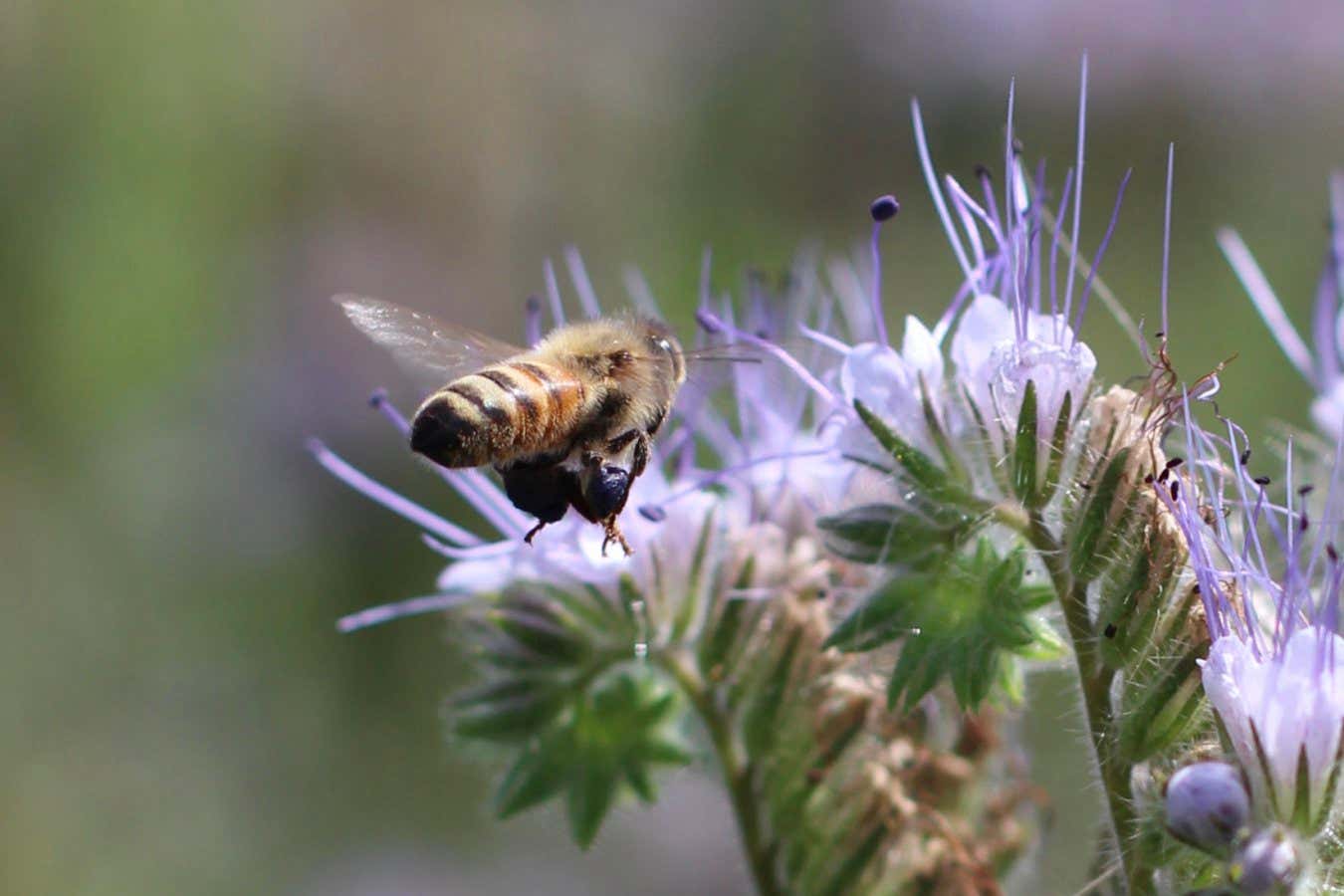
A honeybee flies with pollen balls stored in pollen baskets on its legs
Jennie Durant
Bitter Honey
Jennie Durant
Princeton University Press (US, 26 May; UK, 28 July)
Industrial farming, at its worst, conjures images of cows or pigs shoulder to shoulder in windowless warehouses pumped full of antibiotics, with little regard for their welfare. Now, replace those images – with bees.
In Bitter Honey: Big Ag’s threat to bees and the fight to save them, social scientist and environment writer Jennie Durant reveals how, in recent decades, US honeybee colonies have been industrialised: stored in refrigerated warehouses and fed on sugar syrup drips and protein bars. Each year, around 3 million colonies of honeybees are shuttled around the country on flatbed trucks, rented out to pollinate farmers’ crops. Many of these colonies teeter on the edge of collapse and must be regularly replaced, all of which is coming to bear on our food systems. But Durant argues that there is hope.
Humans have managed bees for at least 8000 years: a cave painting in Spain depicts someone hanging from a cliff with one hand and with the other hand scooping honey out of a hive. Gradually, practices intensified, with Indigenous Americans calling honeybees “white man’s fly” because swarms from domesticated bees often arrived before human colonisers.
Meanwhile, honeybees in the US began outcompeting native bee species, whose populations would be 50 times bigger than they are without honeybees’ enthusiastic consumption of nectar and pollen.

A beekeeper prepares bees to be trucked around the US as pollinators
Jennie Durant
Eventually, the invention of artificial hives in the 19th century, a design that most hives are still based on, turned bees into livestock. But it was the rise of monocrops, liberally sprayed with pesticides and devoid of wildflowers, combined with pathogens, mites and poor nutrition, that wiped out more than a third of honeybee colonies in the US in the mid-2000s. Rather than addressing the root of the problem, beekeepers joined farmers on the “pesticide treadmill”, as Durant puts it, further weakening colonies.
You can’t blame beekeepers for all this, suggests Durant. When cheap and adulterated honey from overseas flooded the US market in the 1990s, many had to turn to offering pollination services to stay afloat. Having spent several years in the field with industrial beekeepers, Durant offers an insider view of their lives and the conundrums they face.
Often, these families have been in the business for generations. They clearly love their bees, will walk miles in search of lost hives and can tell how healthy a hive is by its hum. My heart sank when I read how one man lost half his hives when he and his bees were sprayed with a concoction of fungicides and insecticides by the farm pest control adviser.
The main culprit in all of this is the almond industry, argues Durant. When selling honey became unprofitable, beekeepers turned instead to the booming California almond industry, which is worth $4 billion a year in exports. Each February, 99 per cent of domesticated bees in the US are trucked to the state to pollinate almond trees. Yet almonds are just the latest in a long line of industrialised crops that maximise yields and profits while minimising ecological diversity and resilience.
Meanwhile, the fossil fuels that power global food systems make life harder still for bees. Placing bees in warehouse-size refrigerators was a strategy to deal with irregular seasons and climate extremes, but arguably just adds more plasters to a deep wound.
Durant paints a bleak, if honest, picture. In the second section of her book, however, she does offer some solutions, with forays into innovative planting, regenerative farming and rewilding. There is space for wildflowers in between the long monocultures of almond trees or beneath solar panels, and managed burns, rooted in Indigenous land-management practices, can help grasslands bloom again – all of which might give honeybees and their native cousins a fighting chance.
Yet these ideas aren’t new, and applying them at scale often rests on the willingness of the US government to invest – or farmers to make less profit. At times, Durant goes deep into the weeds of state-level environmental policies, but such details at least show how complex and frustrating it can be to change known harmful practices.

From climate change to water scarcity, many environmental challenges have simple solutions that are hard to implement without first overturning entrenched and outmoded economic systems. Most of us inhabit these on some level (as I write, on my desk is a pack of cheap almonds grown in the US, processed in Germany and sold in the UK). Durant encourages gardeners and farmers to reconnect with the land, but never seems to really challenge the status quo.
Still, transforming your own back garden has some impact on biodiversity, even if you might be met with lawsuits from monoculturally minded neighbours, as one “rebel gardener” Durant introduces us to was in 2017 after turning her barren lawn into a wildlife haven. And it is in these spaces where new kinds of relationships are formed with critters that you begin to realise aren’t so different from us.
Closely watching bees decide which flowers to visit, and communicate their intricate knowledge of the environment to the rest of the hive, shows their intrinsic value as creatures, rather than just workers that pollinate crops for us. Making kin that way might be a better recipe for action than hearing about the grim realities of bees dying en masse that it is easy to turn away from. Putting both together makes Durant’s questions about what our landscapes and food systems should look like self-evident.
She writes: “Plant flowers. Limit pesticide. Share the land.” I would add: “Make friends with creatures.”
Three more great books on nature (and saving it)

The Mind of a Bee
by Lars Chittka
Are bees smart, with basic emotions, even consciousness? Whether or not you agree with Chittka’s conclusion, he will open your mind to how bees perceive reality and to the incredible complexity of life in the hive.

Staying With the Trouble
by Donna J. Haraway
Donna J. Haraway neither cynically believes all is lost regarding the environment, nor, naively, that tech will save the day. Instead, we must “stay with the trouble”, cultivating messy relations with all sorts of beings.

The Book of Wilding
by Isabella Tree and Charlie Burrell
The story of how the Knepp Estate in southern England was transformed from barren clay to blooming marvel is inspiring. We may not all have a vast estate to play with, but the book has many useful tips regardless.
Topics:
