

According to my pathetic map, I should have been close to the royal palace. But nothing in Casablanca’s bustling Mers Sultan quarter, where trams rumble past shoe stores and cafes, looked remotely palatial. I tried one street, then the next. Finally, I approached some teenage girls in jeans and head scarves downing Diet Cokes outside a snack bar.
“I’m looking for the palace,” I said in rudimentary French, and pointed to my map. “It says it should be near here.”
One of the girls glanced at the creased sheet of paper, and in a voice laden with teenage contempt, asked, “Don’t you have a phone?”
No, I did not have a phone. Or rather, I did, but I wasn’t using it.
Except for buying my airplane ticket, my plan was to explore Casablanca — a Moroccan city I had never visited — without using the internet. That meant no online research, no GPS, no Ubers or Airbnbs, no virtual dictionary and no mindless scrolling to avoid social awkwardness.
At a time when more and more of us are feeling the need for a digital detox, I am keenly aware of how the internet, for all its benefits, has also changed travel for the worse. Not only does it play a key role in overtourism, but it has also flattened the sense of discovery. By allowing us to peruse restaurant menus, visualize sites and compile must-see lists, the internet tells us what we will experience before we arrive.
I could have used a guidebook, but that seemed contrary to the spirit of the endeavor. After all, my main goal was to see if I might restore the serendipity of exploring — and learn a few retro travel lessons along the way.
Lesson 1: Get a Good Map
After flying into Casablanca’s Mohammed V Airport, my first order of business was to locate a map. I approached a woman seated at what I took to be the information desk. “Of course I have a map,” she replied. “I have a phone.”
She did, however, direct me toward the train to the city center. When I arrived at the airy station, I understood how difficult traveling unplugged here might be. There were no “You are here” signposts, no place to stash my luggage while I got oriented and no clear indications — at least not to this non-Arabic reader — of which direction led to the city center.
Still mapless, I picked a direction and started walking. A palm-lined boulevard seemed like a good bet, and soon I was amid shops and restaurants. Beyond a gate into what I took to be the old medina, I saw a hand-painted sign: “Ryad 91.”
Lesson 2: Ask to See a Room
I knew from previous trips to other Moroccan cities that “ryad” or “riad” means “inn.” Soon Mohammed, a tall, bespectacled man, was welcoming me in the cushion-bedecked lobby, and didn’t seem offended when I asked to see the sole remaining room, a bargain at 360 dirhams, or about $37. It was simple and clean, but a little claustrophobic, with a window that opened onto an interior courtyard. I took the room, deciding I would look for something more spacious the next day.
In the meantime, I asked Mohammed for a map. “One minute,” he said, sitting down at his computer and printing one out from Google. About a dozen streets on it bore names; the rest was a tangle of lines.
Lesson 3: Embrace Your Ignorance
The good thing about ignorance is that it can turn everything into a discovery. And there was plenty that fascinated me along Casablanca’s winding alleyways: graceful minarets; bakers pulling hot, flat loaves from open-air ovens; the splash of street art, vivid against the whitewashed walls that gave Casablanca its name.
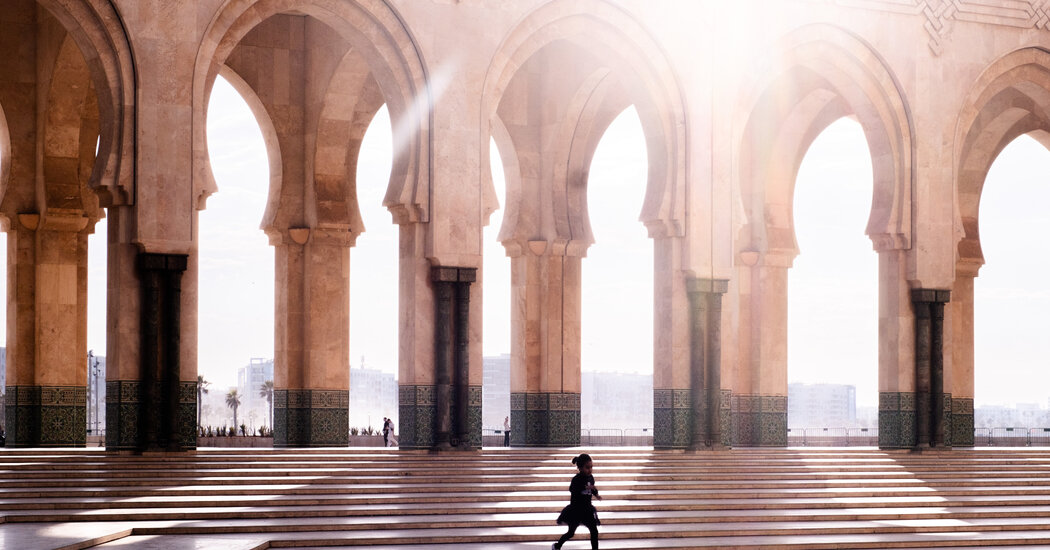
My wanderings began outside the inn’s door. Keeping the harbor to the right, I meandered westward, through the raucous food market, where vendors sold fat walnuts from carts, and leafy squares where men sat at low tables eating fried-fish sandwiches. Walking along bastions built when Portugal ruled the harbor, I saw a massive structure. I asked some boys who were diving into the ocean from a rocky beach what it was. “C’est la plus grande mosquée du monde” was the reply.
Had I really just stumbled across the largest mosque in the world? Alas, my informants were not entirely reliable. The Hassan II Mosque may have one of the world’s largest minarets, but is not itself the biggest. And as the tour buses around the corner proved, it is Casablanca’s chief attraction.
I could see why the boys exaggerated; with a capacity for 25,000 people, the mosque is designed to awe, and not only with its size. Every centimeter is covered in intricate craftsmanship, from plasterwork to mosaics to fretwork. At the accompanying museum, I learned it had taken 12,000 artisans to complete.
My strolls brought more discoveries: downtown streets lined with Art Deco buildings; contemporary Moroccan art at the elegant Villa des Arts; the Abderrahman Slaoui museum, with its Berber jewelry and colonial-era travel posters.
Traveling without expectations also makes you more observant of ordinary life. I loved coming across a man in a square selling coffee from a small pot, and the housewares store where frantic women in djellabas scrambled to get their hands on air fryers that had just gone on sale, some carting off three or four.
Casablanca wasn’t preening for tourists; it was too busy living its own life.
Lesson 4: Let Go of FOMO
I found my second hotel on a street of bougainvillea-draped villas. The rooms at the Doge (about 2,200 dirham), once a private home, leaned hard into their Jazz Age origins, with velvet-lined walls and at least one Josephine Baker photo. Staying there, amid the inlaid furniture and orange-blossom-scented soaps, I tried not to wonder whether there was even a more exquisite Casablanca hotel I hadn’t found.
Traveling unplugged means letting go of the fear of missing out. The internet can convince us that its best-of lists are objective truths and that any traveler who does not work her way through them has settled for less.
I had to fight a twinge at the Central Market, where dozens of seafood stalls served fresh oysters and fish tagines. How to choose? I settled on Nadia’s because of the local businessmen there. Were the juicy grilled sardines drizzled with pungent chermoula sauce there the best in the market? They were the best I ate.
The same held true for the perfectly spiced chicken shawarma I sampled in the upscale Racine neighborhood, and the delicate gazelle horn pastries at a bakery in the Gauthier quarter — places I had chosen because they were busy with local customers.
But that strategy didn’t work in my quest for a sit-down restaurant serving traditional Moroccan food, since local diners often choose a cuisine different from the one they get at home. So when I walked into Le Cuistot’s tiled dining room, and heard Castilian Spanish, British English and New Jersey accents, I didn’t have high hopes.
But my couscous tfaya was fluffy, the vegetables flavorful, and the caramelized onions and almonds added just the right sweetness and crunch. When Aziz Berrada, the chef and owner, told me his couscous was the best in Casablanca, I believed him.
If so, it was just one of his talents. Before Aziz became a chef, he told me, he had been a photographer for Hassan II, the same monarch who had ordered the construction of the imposing mosque. When that monarch died, Aziz decided it was time for a career change.
Lesson 5: Talk to People
My conversation with Aziz — which wouldn’t have happened if I had been buried in my phone while dining — made me eager to see the palace where he had worked. So on my last day, the receptionist at the Doge printed out yet another Google map.
That’s when I got lost. After getting no help from the soda-drinking teenagers, I wandered for blocks, eventually asking directions from an older man who pointed to red flags in the distance: the palace.
Only it wasn’t open to the public. Ever, apparently.
The internet would have revealed this. Yet as I grappled with the realization that I had spent hours to reach those impenetrable walls, I spied a street lined with bookshops. At the very least, I thought, I might find a decent map.
And I did. But the street also led to shops selling handwoven rugs and copper tea sets, a courtyard filled with barrels of olives and a warren of whitewashed alleys that reminded me of Andalusia even before I came across a tiny museum of Andalusian instruments.
The Habous neighborhood almost looked like a stage set of Morocco, which is fitting, since it was designed by the French in the 1920s and ’30s.
I learned this from a woman who introduced herself as Imane, when I stopped for mint tea at the Imperial Café. She was seated near me, and appeared to be either a celebrity or the mayor, so frequent were the salutations from passers-by. I asked if I could talk with her about the neighborhood.
“Of course, sweetheart,” she said in perfect English. “I love Americans. You’re so spontaneous.”
Lesson 6: Stay Open
Imane suggested we move our conversation to a nearby location that she promised I would adore. I overcame my skepticism, figuring I might get some local recommendations.
As we walked, Imane’s rapid-fire monologue left little room to ask about her favorite restaurants. But I learned that she had once lived in the United States, selling real estate, working for a jewelry company and driving an Uber.
Finally we arrived at a set of walls only marginally less imposing than the palace’s. The guard ushered us through a carved door into a gorgeous building, with walls of green and blue geometric tiles and intricate plasterwork, and courtyards dotted with orange trees. I still had no idea where I was (later I learned it was a former courthouse and residence for the pasha, and is now used for cultural events). And I was mystified by the staff, including a stern-faced bureaucrat and a cleaning woman who greeted Imane effusively.
Who was Imane? A politician? A movie star?
Finally, it dawned on me. “Are you an influencer?” I asked.
“I don’t like labels,” she replied.
I never did learn Imane’s favorite restaurants. But she told me of her mission to spread the message that we are all connected. Eventually, she pulled out her phone to broadcast us, live, as we chatted.
I had come all this way without my phone. I had gotten lost and found my way, discovered monuments and tiny jewels. I had developed a sense of the city as a place that still existed primarily for its residents, not its visitors.
And there I was on someone else’s live social media feed.
Follow New York Times Travel on Instagram and sign up for our Travel Dispatch newsletter to get expert tips on traveling smarter and inspiration for your next vacation. Dreaming up a future getaway or just armchair traveling? Check out our 52 Places to Go in 2025.
