

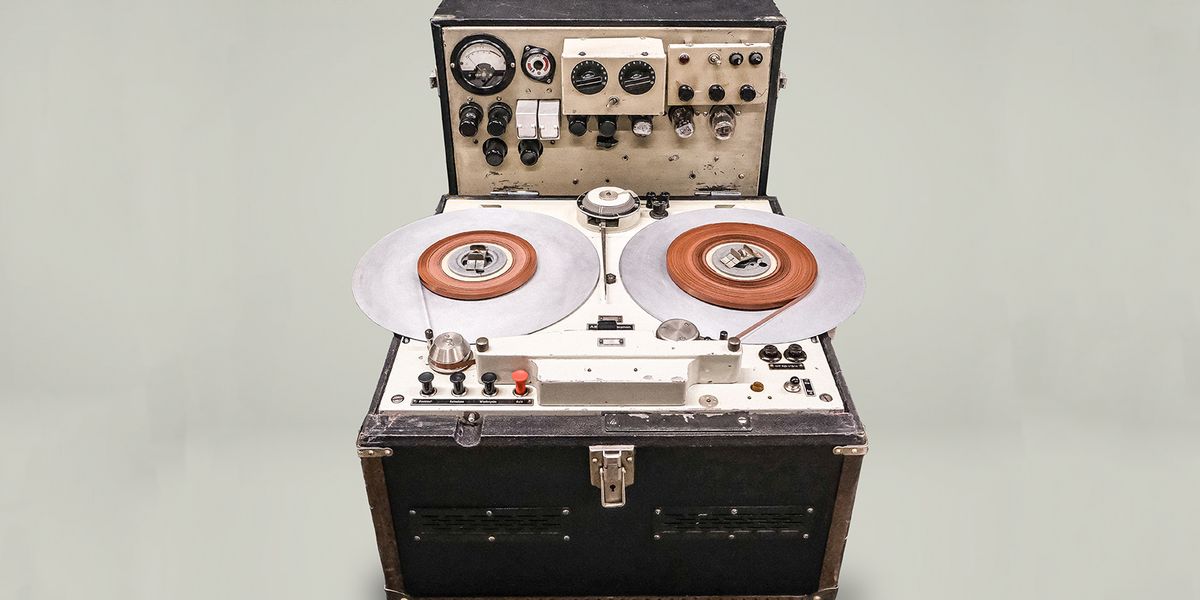
A German engineer wanted a cheaper cigarette. The popular crooner Bing Crosby wanted a vacation. Satisfying both desires inadvertently led to the invention of the laugh track. Along the way there were Nazis, spoils of war, and more than one accidental encounter. Tying together this quirky history is the Magnetophon.
What Was the Magnetophon?
The Magnetophon was a high-fidelity reel-to-reel magnetic tape recorder. The hit of the Berlin Radio Show when it debuted in 1935, it was developed by the German electronics manufacturer AEG. The magnetic tape was produced by I.G. Farben (now known as BASF).
German inventor Fritz Pfleumer came up with the idea of recording sound on magnetized paper tape coated with metal.ullstein bild/Getty Images
The tale of that tape runs through German inventor Fritz Pfleumer. In the early 1920s, Pfleumer was working on industrial paper products in Dresden. At the time, fancy cigarettes had gold leaf to decorate the tip. Cheaper manufacturers achieved a similar effect using colored paper, but the dye could stain smokers’ lips, and no one wanted that. Pfleumer devised a less expensive process using powdered bronze to simulate the gold band.
Pfleumer didn’t work in the recording industry, but he was familiar with the technology of electromechanical recording, which was done on metal wire—a 1898 invention of the Danish engineer Valdemar Poulsen. Pfleumer thought he could do something similar with paper by replacing his powdered bronze with a magnetized material. He patented his “sounding paper” in 1928 and also invented an audio tape recorder to go with it. The sound quality wasn’t great, and the paper tore easily, but it was the start of a promising idea. Two points in its favor: The paper could be sliced, allowing edits, and it could be erased and re-recorded over.
Pfleumer knew he needed to partner with a larger company to commercialize his idea, and so he signed a contract with AEG in 1932. Hermann Bücher, chairman of the AEG board of directors, took a personal interest in the project, helping shepherd it to completion. Although AEG originally planned on developing both a recorder and the tape, it didn’t take long for Bücher to reach out to his friend Wilhelm Gaus, managing director at I.G. Farben. AEG developed the hardware, while I.G. Farben worked on the tape.
The two teams dubbed their product the Magnetophon, or magnetic phonograph, and planned on launching it at the 1934 Berlin Radio Show to compete directly with machines that recorded on steel tape or wire. But the product wasn’t quite ready. Two days before the show, they canceled the debut.
A year later, the bugs had been worked out. The Magnetophon’s introduction at the 1935 show was a resounding success. AEG fielded inquiries for many variations on the recorder, including one that combined the recorder with a telephone, a player for prerecorded music, and a special version to add artificial reverberation for recording open-air concerts. Over the next three years, AEG developed several iterations, resulting in the Magnetophon K4 in 1938, its first commercially successful tape recorder.
The K4 eliminated the hiss and distortion that magnetic recordings previously suffered from by incorporating AC bias, which added a high-frequency signal, typically around 40 to 150 kilohertz, to the recording. Inaudible to the human ear, the signal reduced distortion, especially when recording quieter passages. The fidelity of the Magnetophon was such that radio listeners couldn’t distinguish between live broadcasts and prerecorded performances.
The Magnetophon During and After the War
This is where the Nazis come in. Adolf Hitler and his propaganda minister, Joseph Goebbels, understood the power of radio. The Magnetophon became a powerful tool for both political messaging and military strategy. Because the device could record and play back sound at the same quality as a live radio broadcast, it allowed Hitler’s recorded speeches to be aired from one radio station while the dictator was in another part of the country. This made it more difficult for the Allies to pinpoint his location.
Meanwhile, World War II disrupted the exchange of technical information and prevented Americans from learning about the Magnetophon until after the war. At least, that’s the shorthand version of this history I kept running across during my preliminary research for this column.

 During World War II, U.S. Army Signal Corps engineer Jack Mullin [top] came across the Magnetophon. After the war, he got approval [bottom] to ship two of the disassembled machines and reels of magnetic tape back to the U.S.Top: Pavek Museum; Bottom: Richard L. Hess/The Mullin Family Collection/Archive of Recorded Sound/Stanford University
But then I read Friedrich K. Engel’s account in the book Magnetic Recording: The First 100 Years, which provides a wealth of detail about the Magnetophon. Among other things, Engel notes that the AEG affiliate in Schenectady, N.Y., received a Magnetophon in November 1937, well before the United States entered the war, and AEG engineers demonstrated it for their colleagues at nearby General Electric. The GE engineers dismissed the technology out of hand, though, and so Americans had to wait until after the war for the Magnetophon to be reintroduced.
We have electrical engineer John T. “Jack” Mullin to thank for that reintroduction. Mullin served in the U.S. Army Signal Corps, stationed in the United Kingdom and Paris during the war, and he liked listening to the radio. He realized that “live” orchestral broadcasts coming from Germany in the middle of the night, when no musicians would have actually been in the studio, lacked the telltale hiss and crackle of prerecorded music. Clearly, German engineers had recording technology far superior to the Americans’.
Sent to Germany at the war’s end, Mullin eventually came across that technology at a radio station, and in 1945 when he returned home to California, he shipped two disassembled Magnetophons, a case of tape, schematic drawings, and the determination to change the U.S. recording industry.
Bing Crosby Championed the Magnetophon
Enter Bing Crosby. In the 1940s, Crosby was perhaps the most popular performer on the radio. But he was tired of performing two weekly shows three hours apart (one for each coast). He wanted to prerecord his performances and take a break. He sent in his lawyers to talk to executives at NBC, which aired his program. The audio recording technology at the time used vinyl or shellac transcription discs, but radio listeners could hear the pops and hisses and knew it wasn’t live. NBC refused Crosby’s request, and so Crosby took a year off from radio and then signed with the upstart network ABC, which was willing to let him record his shows for later airing.
 Radio producer Murdo MacKenzie [right] arranged for Jack Mullin [left] to demonstrate the Magnetophon to Bing Crosby in 1946.Pavek Museum
Serendipitously, Mullin had begun demoing the Magnetophon in California. In October 1946, Crosby’s technical producer, Murdo MacKenzie, heard about the demonstrations and arranged one for Crosby at the Metro-Goldwyn-Mayer studios in Hollywood. Crosby was delighted and promptly invested US $50,000 (about $800,000 today) in Ampex, the company working with Mullin to engineer an American version of the Magnetophon. Mullin became Crosby’s chief engineer. 3M developed the magnetic tape.
In 1947, Crosby became the first major radio star in the United States to prerecord performances. Much of the success was due to the recording equipment, but Mullin was also an excellent editor. Crosby and his team would record multiple takes, and Mullin would deftly splice together the best to create a seamless performance.
 After seeing a demo of the Magnetophon, Bing Crosby invested $50,000 in Ampex, which developed a U.S. version of the tape recorder. Cinematic/Alamy
One day a guest told a joke that was uproariously funny, but a little too spicy for radio. Even though the joke couldn’t be aired, the audience’s laughter was worth keeping. Soon, the producers created a whole catalog of different laugh tracks. If a joke didn’t land, it didn’t matter. The editor could just add a laugh in postproduction, from polite titters to hearty guffaws.
According to Crosby’s daughter Mary, Bing didn’t have a problem with this type of editing. The live audience was immaterial as long as the jokes were funny. But according to Mullin’s daughter, Eve Mullin Collier, the manipulation didn’t sit well with her father. He disliked the inauthenticity of the moment, of editing joy.
The history of technology is filled with such episodes of unintended consequences. Mullin admired the Magnetophon precisely because it could faithfully record a performance, an event, a moment in time. He worked tirelessly to refine the machine for the benefit of radio audiences everywhere. And so I understand why its appropriation for capturing canned reactions and manipulating reality must have rankled. He championed the technology, but ultimately it moved beyond his control.
Part of a continuing series looking at historical artifacts that embrace the boundless potential of technology.
An abridged version of this article appears in the August 2026 print issue as “Birth of the Laugh Track.”
From Your Site Articles
Related Articles Around the Web
