

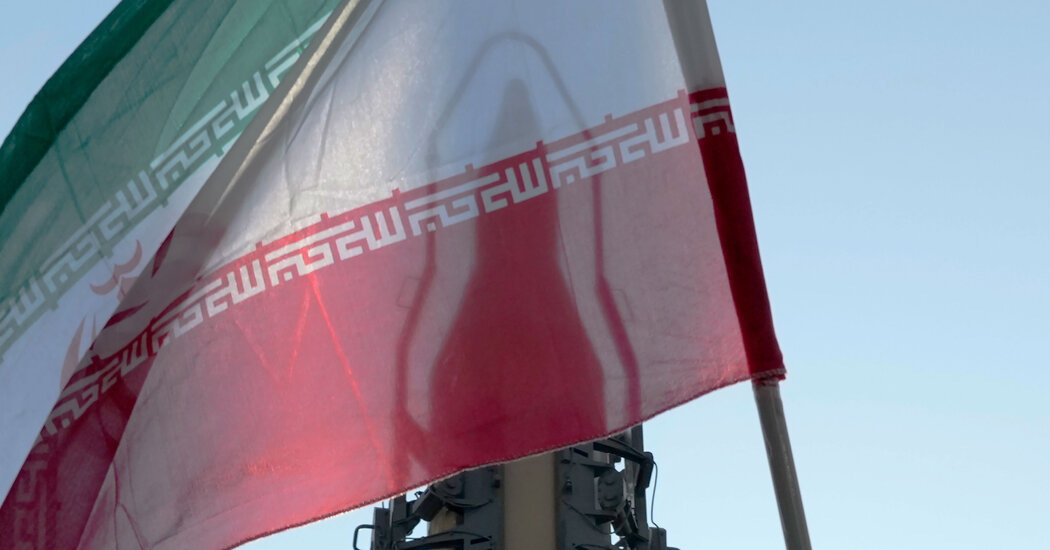
In trying to rein in Iran’s nuclear program, the Trump administration faces a thorny dilemma.
Part of it is of the president’s own making: In 2018, President Trump pulled out of the existing nuclear deal — the Joint Comprehensive Plan of Action — after calling it the “worst deal ever.” In the intervening years, Iran has vastly expanded its nuclear program, adding thousands of advanced centrifuges, including some buried deep underground, and has reportedly enriched enough uranium to produce multiple nuclear weapons in a matter of weeks. Under the former deal, most of whose provisions would have remained in place until 2031, it would have been many months or even a year away from doing so.
Now, Mr. Trump wants a new nuclear deal and is hoping it will include the “total dismantlement” of Iran’s enrichment program. As U.S. negotiators head to Oman this weekend for a fourth round of nuclear talks, however, they are running headlong into the same challenges that led former President Barack Obama to agree to the J.C.P.O.A. in the first place: how to persuade Iran to agree to meaningful nuclear constraints without having to use military force if it refuses.
That deal provided Iran with partial sanctions relief in exchange for long-term restrictions on its enrichment program and a rigorous inspections regime. To get Tehran to agree to those terms, the United States had to accept certain compromises, such as allowing Iran to continue domestic enrichment, and including “sunset clauses” on certain provisions. The deal also did not address Iran’s ballistic missile program or its funding of proxy militias such as Hezbollah and Hamas that have been a source of conflict and instability across the Middle East for decades. But the Obama administration did achieve its main objective — blocking Iran’s paths to developing a nuclear weapon — and avoided having to try to eliminate Tehran’s nuclear program by force.
Today, with its regional proxies militarily decimated and its air defenses weakened by Israeli strikes, Iran is arguably more vulnerable than it has been since the 1979 revolution. But on nuclear issues its leaders remain defiant. Iran’s leaders insist they will not abandon their nuclear enrichment program or ballistic missile programs, and will agree to a new deal only if it provides significant economic relief and guarantees against a future U.S. withdrawal from any new agreement. Maybe they are bluffing, but unless Tehran backs down, Mr. Trump will ultimately either have to accept a nuclear deal that looks very much like the one he denounced, or use military force to set back the program, with hugely unpredictable consequences.
There may be a way out of this.
Instead of updating the 2015 agreement along very similar lines — “same for same” — Mr. Trump could offer Iran “more for more”: more sanctions relief in exchange for greater and more lasting restrictions on Iran’s nuclear program. The United States would agree to provide Iran the economic relief it desperately needs, including lifting secondary sanctions on oil sales, for a long-term or indefinite agreement and significantly greater constraints on its nuclear program and other destabilizing activities. It would have to accept the reality of an Iranian enrichment program, but insist on more far-reaching restrictions on advanced centrifuges, the size and level of the uranium stockpile and underground enrichment, as well as more comprehensive verification. If the economic relief were significant enough, it might also include constraints on Iran’s long-range ballistic missile program and its military support to U.S. adversaries such as Russia or the Houthis in Yemen.
Such an arrangement should be of interest to Iran. Plagued by years of mismanagement and now collapsing oil prices, Iran’s economy is in terrible condition, with growth stagnant, inflation soaring to more than 30 percent, unemployment nearly 10 percent, and its currency at a new record low against the dollar. The Iranian public, which elected a new president, Masoud Pezeshkian, last year on a platform of rescuing the economy, is desperate for relief and would almost certainly cheer any sort of nuclear deal that provided it. It would also be a win for Mr. Trump, who could make the political claim of having gotten a “better” deal than Mr. Obama did, with greater restrictions on Iran’s nuclear program and benefits for the U.S. economy at the same time.
Iran appears to know how to get Mr. Trump’s attention. Its foreign minister, Abbas Araghchi, has been publicly touting Iran’s economy as a “trillion-dollar opportunity” and floating the prospect of deals for companies such as Boeing, which could create American jobs. A complete lifting of the U.S. embargo on Iran may be unlikely — and unwise — as long as the current regime is in power. But for the right terms, Mr. Trump could provide specific export licenses to U.S. companies to invest in or sell goods to Iran, allow U.S. subsidiaries to resume business in Iran, and promote U.S. farm exports — now suffering from his new tariff policy — under humanitarian exemptions.
There would obviously be downsides to giving any economic relief to a regime that is still deeply hostile to the United States, fosters instability in the Middle East and beyond, mistreats its own people and supports terrorism and targeted killings. At the same time, Iran does all those relatively inexpensive things even when under strict sanctions, and an Iran with a nuclear weapon would be a vastly greater threat to the United States and the world.
There have never been any good options for dealing with Iran’s nuclear program, just choices to make among bad ones. A “more for more” nuclear deal should be attractive to Mr. Trump: a “better deal” than Mr. Obama’s, good business for the United States, and avoiding a costly war in the Middle East. Even more important, it would be the right thing to do.
Philip H. Gordon is the Sydney Stein Jr. Scholar at the Brookings Institution. He served as national security adviser to Vice President Kamala Harris and as White House coordinator for the Middle East under President Barack Obama.
The Times is committed to publishing a diversity of letters to the editor. We’d like to hear what you think about this or any of our articles. Here are some tips. And here’s our email: letters@nytimes.com.
Follow the New York Times Opinion section on Facebook, Instagram, TikTok, Bluesky, WhatsApp and Threads.
