

In 2018, the United Nations became so concerned about threats to the well-being of bees it designated a World Bee Day every May. Concern for the bees has certainly made its way into the mainstream. In any American town it’s easy to find bee-themed gifts galore, along with a vague sense among residents that we need to “save the bees.”
However, this challenge is not just about honeybees. In fact, there are more than 20,000 species of bees in the world and more than 4,000 in North America, and all of them deserve our concern. The Western honeybee (Apis mellifera), the one dancing across the festive tea towels, pencil cases and coffee mugs I’ve been gifted as a beekeeper and novelist who writes about bees, is only one of them.
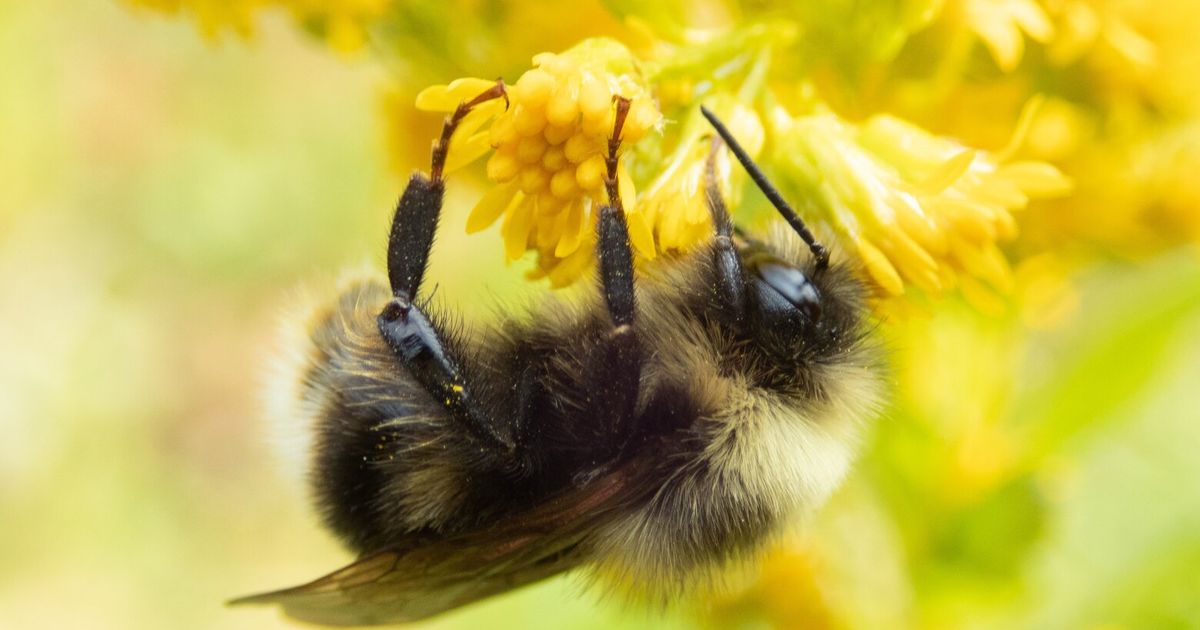
Among other imperiled pollinators are bumblebees, of which there are more than 250 distinct species in the world and about 50 in North America. By some estimates, about one-quarter of the bumblebees on this continent are at risk of extinction. Happily, a conservation alliance is working to better understand and aid bumblebees.
The Bumble Bee Atlas, founded in 2018 in the Pacific Northwest, is a conservation initiative focused on collecting data to track and conserve bumblebees. The project is led by the Xerces Society for Invertebrate Conservation in partnership with many other organizations, including state departments of fish and wildlife and departments of natural resources. The effort relies heavily on volunteer citizen scientists who are trained to monitor and document bumblebee activity to help assess the health and well-being of native populations. Since its inception, the Bumble Bee Atlas has grown to include 20 states with monitoring projects happening coast to coast.
The Bumble Bee Atlas reports that in 2025, citizen scientists in the Pacific Northwest — my home — recorded more than 4,300 bumblebees of 23 species through 534 surveys. To date nationwide, the project has documented almost 150,000 observations of 36 species with about 5,000 people completing almost 30,000 surveys. The Atlas has documented bumblebees living in grasslands and meadows, woodland forests, shrubs and scrub, riparian areas and roadsides — basically everywhere people looked.
Why do bumblebees matter? For one thing, bumblebees are an indicator species that signal how healthy the environment is in general. For another, more than 100 U.S. crop plants, worth an estimated $3 billion per year, depend on pollinators. Bumblebees play a big role in that harvest.
“They are second to honeybees in dollar value,” said Rich Hatfield, a conservation biologist with the Xerces Society and regional coordinator for the Pacific Northwest region of the Bumble Bee Atlas.
But Hatfield doesn’t believe in quantifying bumblebees’ value by their benefit to humans alone.
“They have a place on the planet and should be honored and enjoyed for that,” he said. “We find them in every environment across the country, fearlessly pollinating out in cold and wet weather trying to feed their families.”
My own connection to bumblebees formed in May 2020, when I became smitten with several large bumblebees buzzing through the woods behind my family’s lake house. The place has been ours for five decades and this was the first time I’d been out there on my own without any of my four siblings or our parents — a consequence of pandemic precautions not to gather. It was a quiet season. The lake was empty of fishermen trolling the shoreline at dawn, their murmured conversations traveling across the water. No wake boats zoomed along the bay blasting their stereos. The ever-present lake cruises were absent, too. These were still, tranquil days, which was probably why I heard the bumblebees in the first place.
I worked at the dining room table, and when I heard a heavy drone through the screen door, I’d hurry outside. These bumblebees did not move with haste and were easy to follow, and follow I did, waiting for the moment a bee would land. Clambering into a white, star-shaped thimbleberry blossom, she’d grasp the flower’s anthers and use her flight muscles to shake the pollen free, her tone rising from a calm baritone to a gritty tenor in the distinct process of buzz pollination. After, she might rest for a moment in the cushion of the blossom, combing bright yellow pollen out of her face and down into the corbiculae, or pollen baskets, on her legs before moving on. I had time to admire the golden saddle of her back and orange rump, the soft downy pile covering her body.
I made videos of these encounters and they are all alike — thick woods in the background, the soft understory of thimbleberry bushes waving their leaves in the sunlight, and the low drone as a bee — which I’ve since identified as Bombus mixtus, or the fuzzy-horned bumblebee — lowers herself into a blossom. In some videos, you can hear the patter of rain, the cronk of a raven, or the melodious song of a thrush spiraling up into the deep woods.
I rediscovered these videos while completing my third novel, “Bumblebee Season.” At the center of it, a young biologist is awed by the sighting of a long-absent native bee at a time when she needs to believe in the future and is longing for connection. The echoes of that first COVID summer couldn’t be more apparent.
In earlier writing, I’d focused on a different bee, that well known Western honeybee. My first novel, “The Music of Bees,” tells the story of a grieving widow and an injured young man finding community and solace through tending honeybees. The idea for that book was inspired by my own backyard beekeeping. At the time, I was so engaged in learning how to manage the hive that it completely escaped me that honeybees are not native to North America. Honeybees originated in Afro-Asia about 100 million years ago. After migrating to Europe over time, honeybees were brought to what is now the U.S. in the 17th century by German orchardists keen to pollinate their trees. They are a species we propagate and rely on for annual pollination of such crops as almonds, apples and coffee.
Honeybees and bumblebees are from the same family: apidae. But as wild residents of this continent, the bumblebees have had a presence in North America for 20 million years. However different in their origins, honeybees and bumblebees share vulnerability to many of the same threats, including habitat loss, pesticide use and climate change. I was surprised and saddened to learn that honeybees threaten bumblebees in competition for resources. This knowledge has made me question whether to continue keeping bees.
In the Pacific Northwest, the Bumblebee Atlas’ target species are the Western bumblebee (Bombus occidentalis) and Morrison bumblebee (Bombus morrisoni), which are among those identified as “Species of Greatest Conservation Need” by the International Union for Conservation of Nature. Historically prolific from California to the Dakotas and from the Southwest to Alaska, the Western bumblebee has virtually disappeared from the Pacific Northwest and California. In my home state of Oregon, Hatfield, of the Xerces Society, saw the first Western bumblebee on Mount Hood in 2013 after years of absence. At that time, he said of pollinator decline, “The thing that gives me hope is that if it is caused by people, maybe people can do something to reverse it.”
“Bumblebee Season” concludes without a definitive answer about the fate of the Western bumblebee. In real life, Hatfield says long-term data anticipates significant declines in all regions. The Western bumblebee has been petitioned for protection under the Endangered Species Act.
“It’s a good time to start building habitat for that species,” he said.
Creating habitat can be as simple as putting a flower pot on an apartment balcony or replacing part of your yard with native plants. We can help all pollinators — native and nonnative — by avoiding pesticides and plants pretreated with pesticides, buying organic food, supporting sustainable farming practices and voting to support advocacy efforts in our communities.
After writing about honeybees and bumblebees in fiction, I now see them everywhere I go, from honeybees buzzing my lemonade at a taqueria in Mexico to an enormous Nevada bumblebee throatily careening through the ornamental gardens near my mother’s house in Eastern Washington.
I’ve been replaying my bumblebee videos and thinking about my accidental introduction to the fuzzy-horned bumblebee. I’ve hiked that patch of lake woods and eaten bright-red thimbleberries since I was 3. It took a global pandemic to get me to notice those bees hard at work pollinating the berry bushes, wildflowers and native plants I’ve loved for decades. Those bees have been a gift in my life for creating the wild beauty of the woods, and also for sparking a story about the magic of small creatures.
The bumblebees have inspired me to explore our interconnections, our interdependencies and accidental impacts on one another. They’ve led me to a new understanding that each one of us truly can make a difference — one small act at a time. This idea gives me hope: That we’re gathering information as we go, like bees ourselves, collecting what we need to know, what we need to make meaningful change, from what has been there, right in front of us, all along.
