

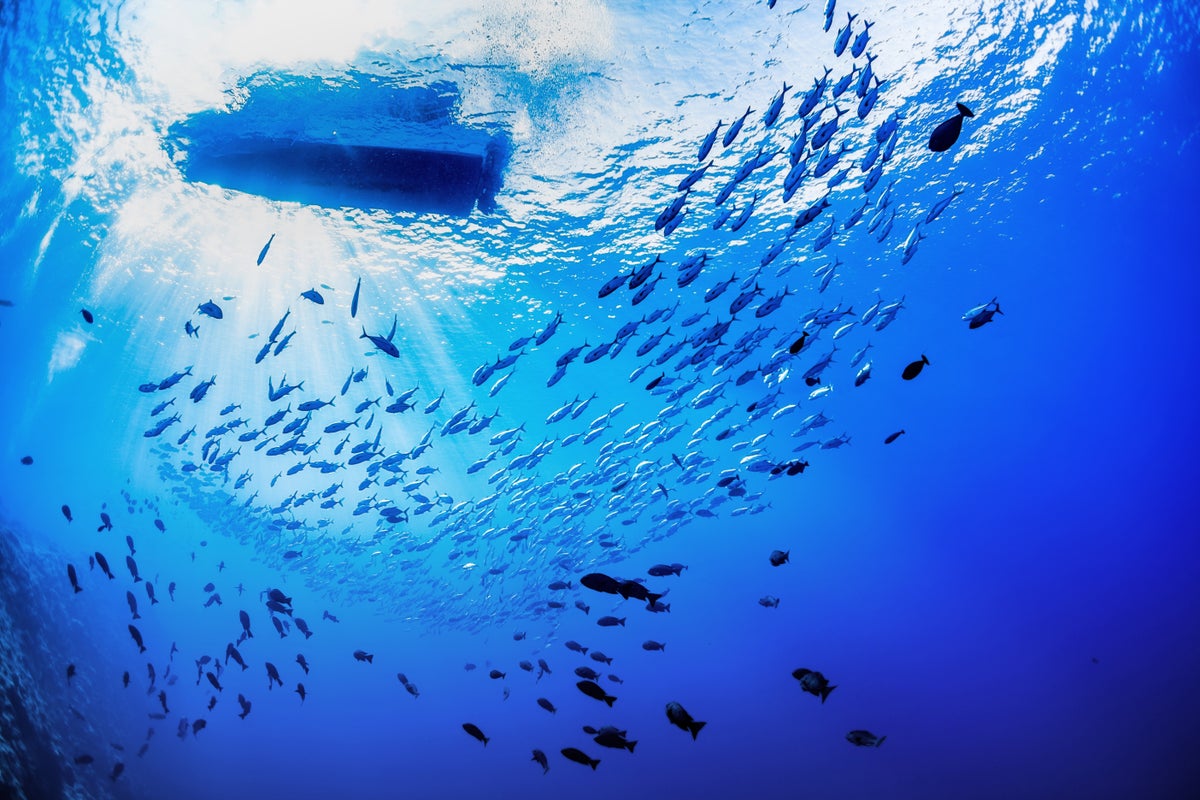
What do we really know about the deep ocean? Whether Earth’s ocean is an ecological paradise teeming with wildlife or a mysterious, stormy underworld hiding mythological sea monsters, it goes without saying that our ignorance of the aqueous abyss has shaped our perception of what could exist there. But in terms of actually tallying up what we do know about the deep seafloor, establishing certainty has been elusive.
“In scientific papers, some people [said] we’ve explored 5 percent or 10 percent or 1 percent [of the deep ocean]—and there was no consensus,” says Katy Croff Bell, a marine scientist and founder of the Ocean Discovery League. She wondered “Has anybody actually calculated this?” Bell adds. “And I couldn’t find anything. So I started to do just initial estimates about four or five years ago, and the numbers seemed ridiculously small: 0.001 percent [visited and explored] over almost [the past] 70 years.”
That couldn’t be right, Bell remembers thinking. But follow-up investigations confirmed her suspicions that we humans indeed had only directly observed less than 0.001 percent of the global seafloor—a total area that is about the same as that of Rhode Island. That’s a shockingly tiny amount, considering we’ve now managed to obtain high-resolution images of practically all of the surfaces of the moon and Mars.
On supporting science journalism
If you’re enjoying this article, consider supporting our award-winning journalism by subscribing. By purchasing a subscription you are helping to ensure the future of impactful stories about the discoveries and ideas shaping our world today.
As detailed in a study published on May 7 in Science Advances, Bell and her co-authors compared 43,681 records from submersible expeditions that were conducted by institutions in by 14 countries and territories and had each reached a minimum of 200 meters (about 656 feet) beneath the waves. In addition to our generally limited understanding of the global seafloor, Bell and her colleagues also found a significant bias in the regions that did have visual reconnaissance. Unsurprisingly, most direct observations of the deep sea occurred in the waters around wealthy countries with the capability to conduct them—especially the U.S., Japan and New Zealand.
This heatmap shows the concentration of known deep-sea dives with visual observations in U.S. exclusive economic zones.

This heatmap shows the concentration of known deep-sea dives with visual observations in the Pacific Ocean.

This heatmap shows the concentration of known deep-sea dives with visual observations in the North Atlantic.
But what does Bell’s “0.001 percent” figure really mean? Do we truly know less of the sea floor than we do of the moon or Mars? The correct answer, according to researchers, is no, although this pushback comes with important caveats. For one, it’s worth noting that the 99.999 percent statistic explicitly represents what we have not “directly seen” of the deep seafloor—meaning all that we have not surveyed via visual imaging. This is different from mapping, which can measure seafloor topography with or without visual data collection. “Seeing” is also not the same as “sampling,” the gathering of geological or biological specimens from a particular area. These three elements—visual imaging, terrain mapping and physical sampling—constitute fully “exploring” an unknown environment, Bell says.
With that in mind, it’s not so shocking that Bell’s number would be so small, says Alfred McEwen, principal investigator for the High Resolution Imaging Experiment on NASA’s Mars Reconnaissance Orbiter and a planetary geologist at the University of Arizona, who was not involved in the new work. Orbital surveillance has indeed allowed us to create stunningly detailed visual maps of the surface of the moon and Mars that far exceed those we have for Earth’s ocean floor. But that’s different from understanding, McEwen says. “I mean, you can map the topography and the brightness and color variations and have nice-looking maps,” he adds. “But that doesn’t mean you understand what’s there in terms of composition, relevant processes, and so on.”
Additionally, any talk of directly observing Earth’s seafloor versus the surfaces of Mars and the moon “is a little bit of an apples-to-oranges comparison,” says Mathieu Lapôtre, a geophysicist at Stanford University, who was also not involved in the study. The former is hidden beneath kilometers of cold, dark, crushingly pressurized water, while the latter can be seen clearly from a spacecraft passing far overhead.
But we’ve managed to come up with very clever ways to unveil the ocean’s depths, Lapôtre says. For example, using altimeters on satellites or sonar technology, it’s more than possible to build a pretty accurate model of what the bottom of the sea looks like. In that sense, there’s probably more we “understand” about the ocean floor—particularly regarding its role in shaping Earth systems—than we do about the surface of the moon or Mars, McEwen says. And at least partially by virtue of our proximity and familiarity with the ocean and all its complexities, he adds, it seems to us a richer, more vibrant place, with “dynamically changing environments, undersea vents, and so forth—there’s a lot more to understand on Earth.”
Even if we do, in fact, “know” Earth’s oceans better than the surface of any otherworldly body, that doesn’t mean we know everything or that there are no benefits to higher-resolution optical data of the deep sea, says Brett Denevi, a planetary scientist at Johns Hopkins Applied Physics Laboratory, who is involved with NASA’s Lunar Reconnaissance Orbiter and was not a part of the new work. As our maps of the moon have improved, Denevi explains, we have not solved all lunar mysteries but instead revealed new ones. The more we learn, the more we see, the better, it seems, that we can pinpoint smaller, more subtle environmental details that coarser-grained mapping or sampling might otherwise miss.
“And often, the smaller things might be the important things, right?” Lapôtre says. “The ocean bottom, we know, is very complex. It has all these features that are fascinating for many reasons—for example, the origins of life, plate tectonics, and the subduction zones and all those things—it’s a complex terrain. And right now we’re missing a lot of that complexity.”
“Imagine owning a house but never going down to the basement to figure out how your heater or electrical system works,” Bell says. For example, she says, it was only in the 1970s that humanity found out about thriving ecosystems around hydrothermal vents—a discovery that showed biology could flourish even in the ocean’s sunless depths and “changed our understanding of life on Earth.” Indirect mapping from sonar and other techniques allows you to “see” the mid-ocean ridges that host some of these vents. But actually finding the vents was a serendipitous discovery that was only made possible by deep-sea cameras.
And, Bell points out, given the wonders we’ve already witnessed by our direct visitations of just 0.001 percent of the seafloor, the prospects for further revolutionary observations are good. The abysmally low figure for our visual knowledge of the abyss is cause for excitement, not dismay, she says. Paired with burgeoning technological advances to make submarine exploration better, cheaper and safer, Bell’s assessment is an invitation to begin “an unbiased and more representative look at the global deep seafloor.”
“On the exploration side of things, the [new study] really lays the groundwork for setting out a global initiative that we should undertake in the next 10 to 20 years,” Bell says. “Being able to explore, or at least accelerate, the exploration of the other 99.999 percent of the deep ocean is really going to give us an amazing opportunity to ask new questions we’d never even thought of before.”
