

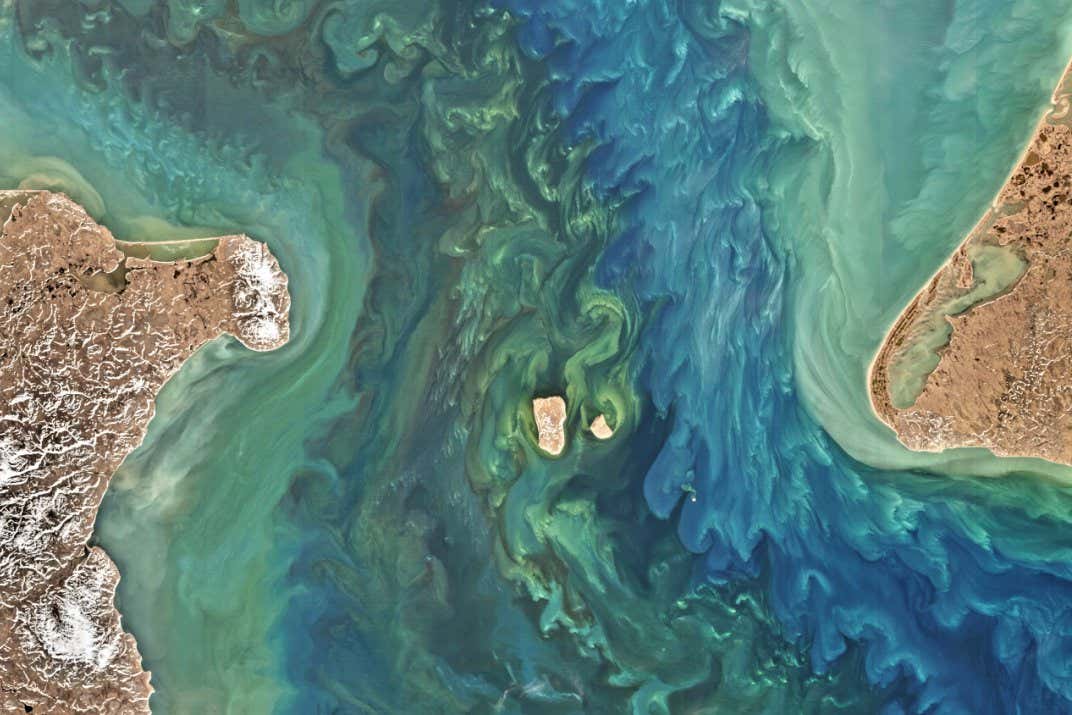
The Bering Strait separates Alaska and Russia
Ocean Color/OB.DAAC/OBPG/NASA
It would be an engineering project on a truly epic scale, but we may one day need to consider building a dam between Alaska and eastern Russia. The audacious proposal would be designed to stave off the worst consequences of the collapse of a vital ocean current, and researchers have been mulling it over this week at a major conference.
The idea comes from Jelle Soons and his colleague Henk Dijkstra at the University of Utrecht in the Netherlands, who study the Atlantic Meridional Overturning Circulation or AMOC. This current system, which includes the Gulf Stream, is a major reason why northern Europe has a relatively mild climate for its latitude.
However, we know the current is weakening. There is huge uncertainty about what would happen if it collapses, but some models suggest it could see temperatures in northern Europe drastically plunge.
Soons thought a dam could be a possible intervention after hearing about how during the Pliocene era, from roughly 5.3 to 2.6 million years ago, sea levels were lower and there was a land bridge where we now find the Bering Strait. Simulations of the Pliocene climate show the AMOC was stronger then, mainly thanks to that land bridge. “I was like: ok, could we do this again?” says Soons.
To investigate the effects of building such a dam, Soons and Dijkstra ran simulations of the AMOC varying both the date when the dam would be built and the exact amount of freshwater present.
Freshwater is a key part of the equation because it currently flows from the Pacific through the Bering Strait into the north Atlantic, which weakens the AMOC. Building a dam would stop or slow the flow.
In work published a few weeks ago, Soons and Dijkstra obtained mixed results: in some scenarios the dam appeared to strengthen the AMOC, but in others it had the opposite effect. However, those results came from a relatively simple and low-resolution model.
On 5 May at the European Geosciences Union general assembly in Vienna, Austria, Soons presented work that repeated the simulations on a supercomputer using a much more advanced climate model. This indicated that closing the Strait would strengthen AMOC, especially if the dam were built early – by at least 2050. “I was surprised at how strong the recovery was,” says Soons.
The Bering Strait is only 59 metres deep at its deepest point and there are two small islands in the middle, meaning any barrier could conceivably be built in two halves. Ed McCann, a past president of the Institution of Civil Engineers and now at Expedition Engineering says the best way to do this would be to avoid concrete and instead use floating machinery to build a barrier of rock and dredged sand. “This sort of construction is pretty simple, just very big and very expensive,” he wrote in an email.
Jonathan Rosser at the London School of Economics says that the work is interesting but that because we don’t fully understand the AMOC, we can’t be sure of the consequences of such an intervention. “These drastic things really do have big uncertainties attached.”
Soons agrees and says that while building a dam might be helpful to northern Europe, it could create other problems, such as altering rainfall patterns, elsewhere. “Whether you would consider this a serious proposal? I don’t think we’re there yet,” he says.
This is not the first time that researchers have mulled the idea of building a huge sea dam to mitigate climate change. In 2020, Sjoerd Groeskamp at the Royal Netherlands Institute for Sea Research unveiled an idea called the Northern European Enclosure Dam, which would involve building two barriers to hem in the sea between the UK and Europe and prevent rising sea levels from inundating low-lying parts of the continent.
As well as effects on climate, any such dam would have other side effects on things like marine-mammal migrations, tides and shipping to remote communities. Soons says he has toyed with ideas like building half a barrier or having it descend to a depth of only say 10 metres. These are “interesting ideas” he says, although he hasn’t yet had a chance to consider their merits properly.
Topics:
