

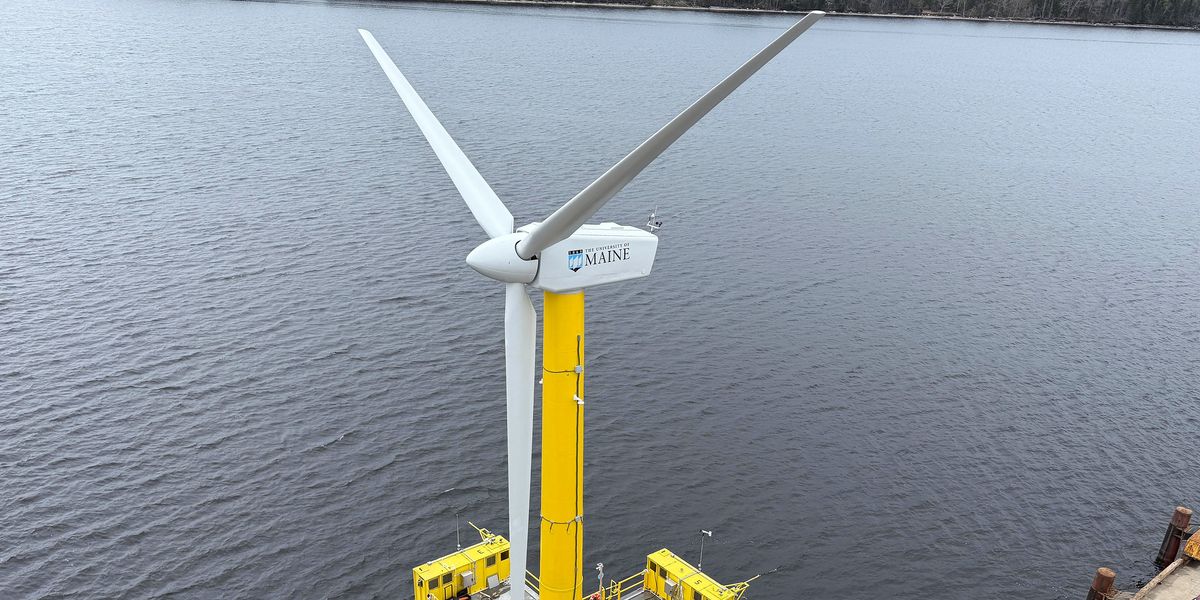
When the platform for a prototype floating offshore wind turbine arrived at a dock in Searsport, Maine, on April 11, engineers at the University of Maine were ready to add a tower and a turbine and set it afloat in the Gulf of Maine. The prototype, called the VolturnUS+, was a 1:4 scale model of a 15-megawatt version, and its deployment would mark only the second wind turbine to float in U.S. waters.
But on the very same day, university officials received a letter from the U.S. Department of Energy’s Advanced Research Projects Agency – Energy (ARPA-E) saying it was “suspending all activity” remaining on the project’s $12.6 million grant. The move left the university’s 375-tonne concrete hull tied up dockside and its creators scrambling to resolve the situation.
VolturnUS+ is one of many offshore wind projects that have been delayed or killed in the United States since President Trump’s second inauguration. On his first day back in office, Trump signed an executive order freezing all permitting of offshore wind projects, impacting nearly all that were not yet under construction. And in an unprecedented move, the President on April 16 froze work on one offshore wind farm that was already being built off of New York’s coast, before withdrawing the order last week.
In response, wind developers are pulling back on U.S. projects. Multinational wind giant RWE paused work on its entire 6-gigawatt U.S. portfolio, citing “the political environment.”
The turmoil may prove particularly devastating for floating wind projects like VolturnUS+. Floating turbines are designed to function farther offshore in waters too deep to anchor turbine towers to the sea floor, and the fledgling industry has yet to install a single commercial-scale turbine in U.S. waters.
Trump’s Impact on Floating Offshore Wind
Tokyo-based Mitsubishi Corporation in March paused work on what could have been a U.S. first: a 12-turbine, 144-MW floating ”research array” planned for a spot 50 kilometers east of Portland, Maine. The company cited “recent shifts in the energy landscape that have, in particular, caused uncertainty in the offshore wind industry.”
Maine policymakers have been counting on Mitsubishi’s research array to jump-start development in floating wind and thus secure the state’s energy transition and bolster coastal economies. These small floating arrays serve as testbeds to help de-risk gigawatt-scale projects to come and provide an opportunity to engage with stakeholders. “It’s important because the technology is still relatively immature,” says Steve Clemmer, director of energy research at the Union of Concerned Scientists. “You’ve got to start somewhere demonstrating the technology, researching impacts on the fishing industry and wildlife, especially related to the mooring systems,” he says.
Indeed, developers of a California floating demonstration project, Cademo, had also been closely watching Maine’s progress. Floating turbines are the U.S. Pacific Coast’s only offshore wind option due to its deeper waters.
In response to federal opposition to wind development, proponents of floating technology are taking a variety of strategies. For the VolturnUS+ team, leaving their massive concrete platform tied to a dock would have been unsafe and financially ruinous, says Habib Dagher, executive director of the University of Maine’s Advanced Structures & Composites Center in Orono and VolturnUS+ co-director. “You’re going to destroy the pier if you get weather. And we were paying fees to stay at the pier—fees that we can’t even afford,” he says.
Blocked from accessing more than $3 million remaining in their ARPA-E grant, Dagher’s team cobbled together enough cash from industry partners and state funds to do what needed to be done: mate the tower and turbine to the platform and then tow the package to its planned test site about 600 meters off the coast of Castine, Maine. It was the only viable option, says Dagher. “We had no choice but to find emergency funds to get it out of there,” he says.
It was the only viable option, says Dagher. “We had no choice but to find emergency funds to get it out of there.”
For Mitsubishi, the challenges appear more widespread than the U.S. political climate, and the international conglomerate is responding by hitting the pause button. In February it paused three conventional offshore wind projects in Japan, citing “material changes in the macroeconomic environment,” including the war in Ukraine, depreciation of the yen, and tight supply chains.
California, however, is pressing on. In February, California governor Gavin Newsom proposed a $228 million investment to prepare ports for major offshore wind farm construction expected in the next decade. And in March, the state of California awarded $20 million to the Port of Long Beach and $18 million to the Port of Humboldt to foster public engagement and conduct studies required for permit filings.
“They’re not pulling back money that was previously allocated for offshore wind. They’re sticking to the course,” says Matt Simmons, climate attorney for the Environmental Protection Information Center, an Arcata, Calif.–based nonprofit.
Of course, California can only do so much without federal cooperation. The Cademo demonstration on California’s Central Coast hopes to sell its power to the nearby Vandenberg Space Force Base. They also need a green light from the U.S. National Oceanic and Atmospheric Administration, which designated a National Marine Sanctuary in October that spans Cademo’s site.
What Are the Next Steps for VolturnUS+?
Maine’s VolturnUS+ floating turbine is a follow-on to its much smaller VolturnUS test turbine, which was a semi-submersible assemblage of pontoon beams and flotation columns. In making the VolturnUS+, the University of Maine streamlined the design to lower cost—it’s essentially a barge that sits atop the water. On their own, barges are less stable, but Dagher says his team made the design workable by taking inspiration from the mass-dampers that sway in high-rise buildings to counteract earthquakes. “You negate some of the earthquake motions by moving the mass back and forth to oppose the motions of the earthquake,” he explains.
In the case of VolturnUS+, mass shifting within each of the hull’s crossed arms counteracts tilting forces from winds and waves. Based on a 2023 patent filing, that mass could be seawater. The resulting stability reduced the size of the float required. Combined with the relative ease of construction, the design changes cut the platform costs by 20 to 30 percent, Dagher says.
ARPA-E’s suspension letter to the University of Maine alleged a “failure to comply with one or more” federal policies. When asked for comment on the matter, a spokesperson for ARPA-E referred Spectrum to the U.S. Department of Energy (DOE), and the DOE did not respond to Spectrum‘s inquiry. The university says it is “compliant with all state and federal laws, and the conditions of its federal grants and contracts.”
Thanks to the emergency funds, the completed VolturnUS+ test rig is now moored in 21 meters of water. The next step for the project’s leaders is to install a power cable that connects the turbine to the onshore grid—a project they hope to complete in the next two to three months. Dagher says the turbine will operate for 18 months, as planned, to evaluate the platform’s stability. But, in a statement provided to Spectrum, the university says that, without resumption of the ARPA-E funds, researchers will have less ability to analyze results and to craft a commercialization plan.
The University of Maine announced in mid-May that it would lay off nine people at Dagher’s Advanced Structures & Composites Center, citing “unexpected pauses and delays in federal funding.”
From Your Site Articles
Related Articles Around the Web
