

Here is a small selection of stories concerning either the president, a member of his family or a member of his Cabinet.
Last week, President Donald Trump welcomed Crown Prince Mohammed bin Salman of Saudi Arabia with a lavish reception at the White House. Part of the president’s relationship with Prince Mohammed includes lucrative ties between the Trump Organization and Saudi firms, to the tune of tens of millions of dollars. It is for this reason, perhaps, that the president angrily dismissed the idea, evidence of which U.S. intelligence long ago gathered, that Prince Mohammed ordered the killing and dismemberment of a Washington Post columnist, Jamal Khashoggi, in 2018. The crown prince denies it. “Things happen,” Trump said.
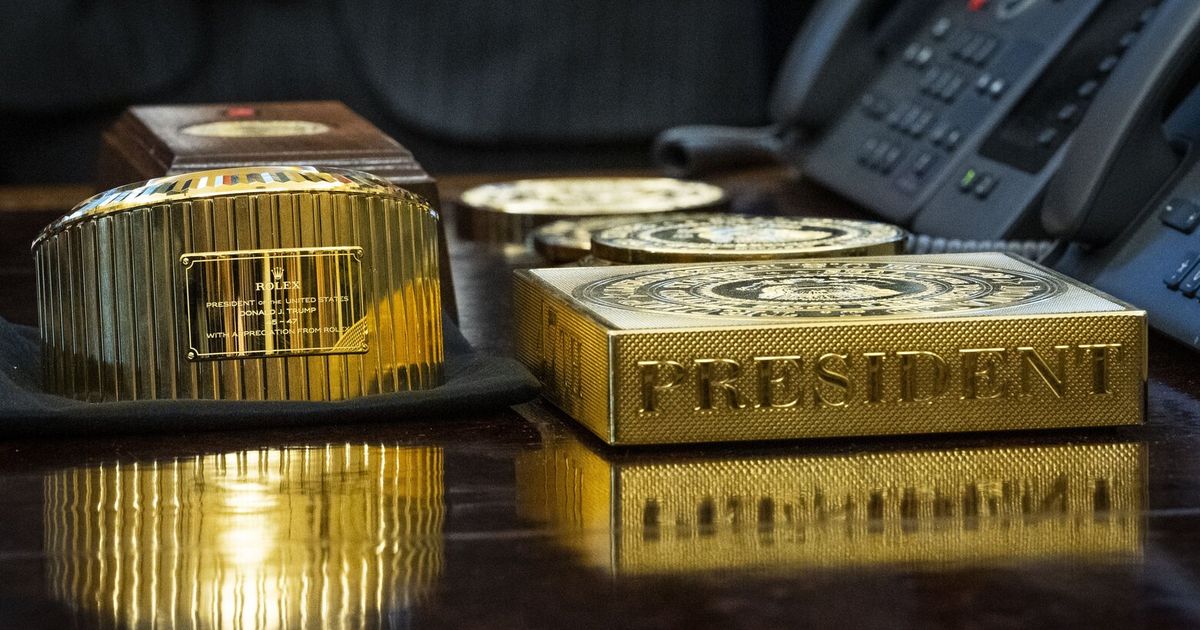
Earlier this month, top Swiss business leaders arrived at the White House bearing lavish gifts fit for a king. The chief executive of Rolex gave Trump a gold-plated desk clock. Not to be outdone, the chief executive of a gold-refining company presented him with a 2-pound gold bar engraved with 45 and 47, in honor of his two presidencies. A week later, the president rewarded Switzerland with a favorable break on tariffs, reducing them from 39% to 15%.
This summer, The New Yorker reported that the Trump family had earned $3.4 billion through deals it had arranged since Trump entered the White House in 2017. The Trump Organization is also expanding its operations around the world, developing more than 22 properties in at least 10 countries, whose leaders have every incentive to flatter the president with gifts and handouts.
And ProPublica reports that Kristi Noem, secretary of the Department of Homeland Security, directed more than $220 million worth of funding for an ad campaign to a consulting firm with “long-standing personal and business ties to Noem and her senior aides at DHS.”
In any other administration, at any other time in American history, this level of corruption would be a political disaster — a scandal that could bring down the administration. For the Trump administration, it is a Tuesday.
If Trump’s first term was marked by a level of graft and self-dealing that would have embarrassed a Tammany stalwart, then his second term seems to be an explicit effort to outpace his previous record and set a new high-water mark for political corruption in the United States.
In the first six months of his second term, Trump made nearly a hundred visits to his properties — paid for by the American taxpayer. Foreign governments and special interest groups routinely use those properties for events — putting millions of dollars directly in the family’s coffers. And then there are the pardons for donors and supporters like Changpeng Zhao, the billionaire founder of Binance, the world’s largest exchange for cryptocurrency. Zhao had been working to give a boost to a crypto company founded by Trump’s sons.
By any and every measure, in other words, Trump is the most corrupt person to ever sit in the Oval Office. And if the A plot of the second Trump presidency is his authoritarian aspirations, then its B plot is his shameless and pervasive corruption.
Here, it’s easy to imagine the response of one of the president’s many apologists. This is normal, they would say, don’t kid yourself. Washington has always been corrupt. Isn’t it better that Trump is honest about his self-dealing? At least he’s not a hypocrite.
This is a common tactic of those who would abuse the public trust. If everyone does it, then there is no point in blaming anyone in particular. The MAGA effort to make Hunter Biden the poster child for political corruption under the previous administration was an example of just this, a tactic meant to obscure the wanton corruption of Trump and his allies.
There is no question that American politics has had its fair share of corrupt acts and corrupt people. But the office of the presidency in particular has never seen anything like the petty jobbery and open malfeasance of Trump and the people around him. All misdeeds are not the same, and there is a real difference between the unseemly revolving door between business and government — the plum position on a corporate board or an easy lobbying gig — and a new status quo in which business leaders and heads of state give the president actual tribute in order to put themselves in the good graces of the White House.
Consider the way that FIFA, the international soccer organization, created a new global “peace prize” following Trump’s failed effort to win a Nobel Peace Prize. It will be announced Dec. 5 in Washington, D.C. I wonder who’s going to win. It would be funny — the stuff, at least, of a late-night television sketch — if it weren’t so corrosive.
In truth, it is probably wrong to describe the president’s corruption as the B plot of his administration. When we look at authoritarian leaders abroad, we see a tight connection between autocratic governance and extreme graft. If the regimes of both Vladimir Putin in Russia and Viktor Orban in Hungary are models for Trump and his far-right allies in both ideological and practical terms, then it is worth observing the extent to which both men use their governments to siphon wealth from the public and hand it to small cadres of regime loyalists. Their obsession with national greatness — with ethnic chauvinism and so-called traditional values — is little more than a cover story for common thieves whose great aspiration is to steal and loot with abandon.
So it goes for Trump, whose effort to rule the United States as an autocrat is as much about clearing the way for a smash and grab as it is anything else. The old Republican Party was a stool with three legs: social conservatism, economic conservatism and national security conservatism. So too is the MAGA Republican Party. One of those legs is the nativist extremism of Stephen Miller. The second is the anti-government extremism of Russell Vought. And the last is the open, flamboyant corruption of Trump — a corruption that degrades a people’s faith in government and makes it all the easier to remake the state in the image of a single man.
Americans of the Revolutionary era feared nothing more than the specter of corruption which was, in this usage, a malady of both the individual spirit and the body politic.
“In a Republic,” declared Samuel West, a prominent Massachusetts Congregationalist minister, in 1786, “the people are not only the source of authority, but the exercise of it, is in a great measure, lodged in their hands. Corruption therefore among the people at large, must be immediately felt, and if not seasonably prevented, proves fatal in the end.”
Americans fretted over the potential corruption of the political system, in which public good was captured by private interest. In the years before independence, those colonists steeped in republican ideology identified this with the Crown’s use of personal flattery and patronage to try to curb popular discontent. To bestow favors and titles on Americans was, for these critics, to erode the people’s capacity for self-government. In “The Creation of the American Republic: 1776-1787,” historian Gordon Wood quotes a Virginian lamenting, in 1775, that the “vices” of Britain had “extended to America”: “The torrent as yet is but small; only a few are involved in it; it must soon be stopped, or it will bear all before it with an impetuous sway.”
Americans also believed that this political corruption would fuel personal corruption and degrade the morals of society as a whole. “Whenever democratic states degenerate from those noble republican virtues which constitute the chief excellency, spring, and even basis of their government, and instead of industry, frugality, and economy, encourage luxury, dissipation and extravagance,” Joel Barlow, a poet, politician and later United States minister to France, warned in 1787, “we may justly conclude that ruin is near at hand.”
This preoccupation with corruption made its way into the Constitution, both as a set of specific prohibitions on titles and emoluments — as well as one of the named offenses (“bribery”) that would justify impeachment — and as a vital part of the structure of the system itself. Why does the Constitution require members of Congress to resign their positions before taking service in the federal government? To guard against “intrigue” among those who serve in the national legislature. “If we do not provide against corruption,” Virginia’s George Mason said in reference to this provision at the constitutional convention in Philadelphia, “our government will soon be at an end.”
Why, in the case of an Electoral College tie or plurality, does the House and not the Senate choose the president? Because to have such a small and unrepresentative chamber make the decision “lays a certain foundation for corruption and aristocracy,” as another delegate in Philadelphia put it. And why did the framers easily agree to give federal judges life tenure as well as constitutional protection for their compensation? To preclude the corrupt manipulation of the judiciary by those in power. Recall that in the Declaration of Independence, American revolutionaries complained that King George III had “made Judges dependent on his Will alone, for the Tenure of their Offices, and the Amount and Payment of their Salaries.”
The Constitution was meant, in other words, to be a bulwark against corruption of the system and thus of the people. It is obviously not working.
When either laws or customs degrade, when the body politic begins to drift toward corruption, the only recourse — if the people hope to preserve a republic — is to build new institutions and with them new ways of political life.
