

Fashion Weeks in New York, Milan and Paris have been unapologetically decadent this year. Beige is out, red is in. Real fur is back. Eighties maximalism is elbowing aside ’90s minimalism. Sean Monahan, a trend forecaster, calls it the “boom boom” aesthetic.
Admittedly, opulence is kind of the point when you are creating and selling beautiful, expensive things. But for the past decade, fashion was trying to be socially and environmentally conscious as well. However sincere the motivation — many people, especially on the creative side of fashion, share progressive values — making the world a more diverse, equitable, inclusive and sustainable place didn’t always sit well with luxury, either practically or aesthetically.
Now all that seems to be over, and maybe that’s OK. The fashion industry had aligned with liberal-left movements leading up to and after Donald Trump’s 2016 victory, but it’s hard to argue that the endorsement of Kamala Harris by Vogue magazine and its editor Anna Wintour last year moved the needle for anyone. It might have even made the Democrats seem out of touch to some voters.
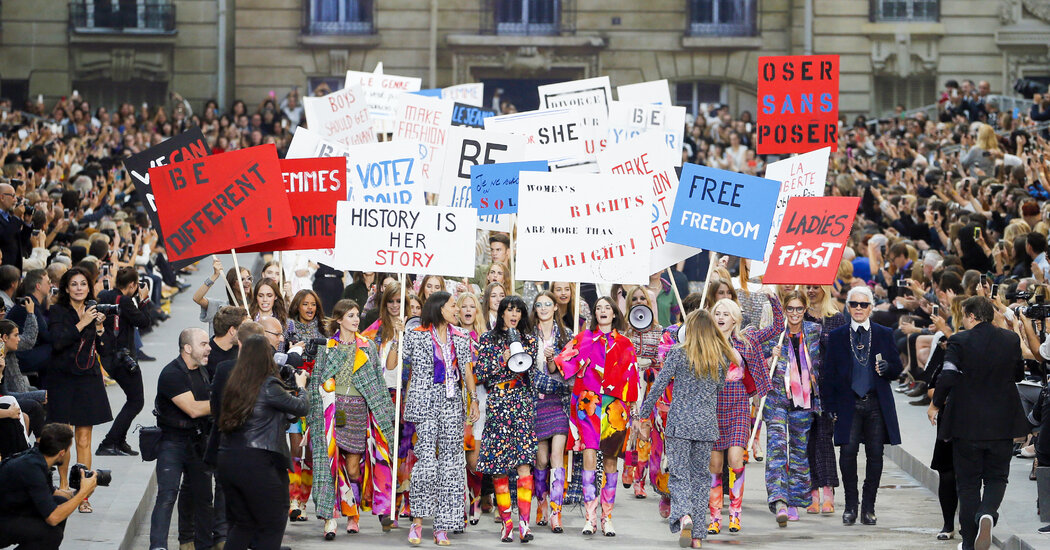
Activism and fashion have always been an uneasy mix. Back in 2014, the designer Karl Lagerfeld staged a Chanel ready-to-wear show in Paris where models cosplayed a protest, holding signs that read, “Women’s rights are more than all right,” “History is her story” and “Make fashion not war.” If it felt anodyne and frivolous (it’s not as if any of the signs made pointed statements about, say, abortion), Mr. Lagerfeld told the website Fashionista at the time that this was exactly the point: “I like the idea of feminism being something lighthearted, not a truck driver for the feminist movement.”
The next year, the New York show for Kerby Jean-Raymond’s label Pyer Moss took on a far more serious tone, opening with a 12-minute film about police brutality against Black men. Family members of victims sat in front, pushing the important fashion people that those seats are typically reserved for to the second or third row. They watched models walk the runway in white boots inscribed with Eric Garner’s last words, “I can’t breathe.”
Fashion continued advancing political messages as the 2016 election approached. That September, with Hillary Clinton running for president on the Democratic ticket, Maria Grazia Chiuri presented her debut collection for Christian Dior as its first female creative director. It featured T-shirts that read, “We should all be feminists” (borrowing the title of a book by Chimamanda Ngozi Adichie), tucked into extravagant but by runway standards easygoing tulle skirts. You can still buy the T-shirts for $920. You can definitely still be a feminist without owning one.
Later that year, Vogue for the first time issued a presidential endorsement, of Mrs. Clinton, while its sister publication Teen Vogue became as well known for political coverage as its fashion recommendations. One litmus test for fashion-world acceptability during Trump 1.0 was asking designers if they would dress Melania Trump for the inauguration. Marc Jacobs, Derek Lam and Christian Siriano were among those who said they wouldn’t. (Tom Ford also said he wouldn’t — not because of her politics but because “she’s not necessarily my image.”)
This all made some sense at the time. Ms. Wintour, fashion’s de facto leader, had held fund-raisers for Democratic presidential candidates including Mrs. Clinton and Barack Obama. High fashion’s flirtation with politics trickled down to mass-market brands such as DSW, which in 2017 ran a #MarchOn ad campaign, depicting 20-something models alongside copy including, “ ‘He said women belong in the house. I said yep. And in the Senate.’”
Yet before the 2010s, luxury fashion seldom tried to stand for anything, politically. Vogue has endorsed only Democratic candidates since it started endorsing anybody but has featured first ladies of both parties, beginning with Lou Henry Hoover in 1929. Nancy Reagan and Laura Bush were profiled in the magazine before Mrs. Clinton became the first first lady to get a cover in 1998. In 2022, Mrs. Trump accused Vogue of being “biased” for putting Jill Biden on its cover; according to Stephanie Winston Wolkoff’s book “Melania and Me,” the magazine had proposed featuring Mrs. Trump when she was first lady but wouldn’t guarantee her the cover.
The designers who said in 2016 they would dress Mrs. Trump, including Dolce & Gabbana, Thom Browne and Carolina Herrera, don’t seem any worse off for it. Dolce & Gabbana, which often courted controversy and spent years being targeted by activists, weathered those critiques, to the point where Vanessa Friedman argued last year in The Times that fashion seemed to have given up on trying to cancel anybody.
Oscar de la Renta often dressed Mrs. Clinton, but he dressed Mrs. Reagan (famously in Reagan red) and Mrs. Bush before her. Adam Lippes joined the company as creative director in 1996 and told Women’s Wear Daily that that’s where he came to view dressing first ladies as a patriotic act rather than a political one.
In certain ways, with this second low-tax, oligarch-friendly Trump era (maybe even the fabled Russian shoppers will be welcomed back), happy days might be here again for fancy brands that had started to lose their footing the past few years. Perhaps no president in history has more ties to the world of luxury goods than Mr. Trump, who has been friends with the owner of the fashion conglomerate LVMH, Bernard Arnault, since the 1980s.
Between the two of them they operate some of the most valuable retail space in the world, at the crossroads of 57th Street and Fifth Avenue. Mr. Arnault attended Mr. Trump’s inauguration, seated behind the Clintons, along with his wife, Hélène Mercier-Arnault, and his children Alexandre and Delphine, both LVMH executives. LVMH, the parent company of Dior and Givenchy, made two couture looks for Ivanka Trump for the inauguration.
LVMH brands weren’t the only ones proud to dress the Trumps and their associates. Oscar de la Renta shared photos of its looks for Ivanka Trump and Vice President JD Vance’s wife, Usha, on social media. Meanwhile, Sergio Hudson, who had enthusiastically dressed Michelle Obama and Kamala Harris, was taken by surprise when Mrs. Vance wore one of his dresses and coat to an event.
Mr. Lippes, on the other hand, had no hesitation about making Mrs. Trump’s Inauguration Day coat, after her stylist, Hervé Pierre, called him with the request. “There was no greater honor than to dress a first lady,” Mr. Lippes, who now runs his own label, told Women’s Wear Daily. “‘We dress who’s in power’ was I think maybe what he,” referring to his former boss Mr. de la Renta, “used to say. ‘That’s my job.’”
It’s certainly a good business decision. After the inauguration, a representative for Mr. Lippes’s brand told Business of Fashion that the company had just had its best sales week ever.
