

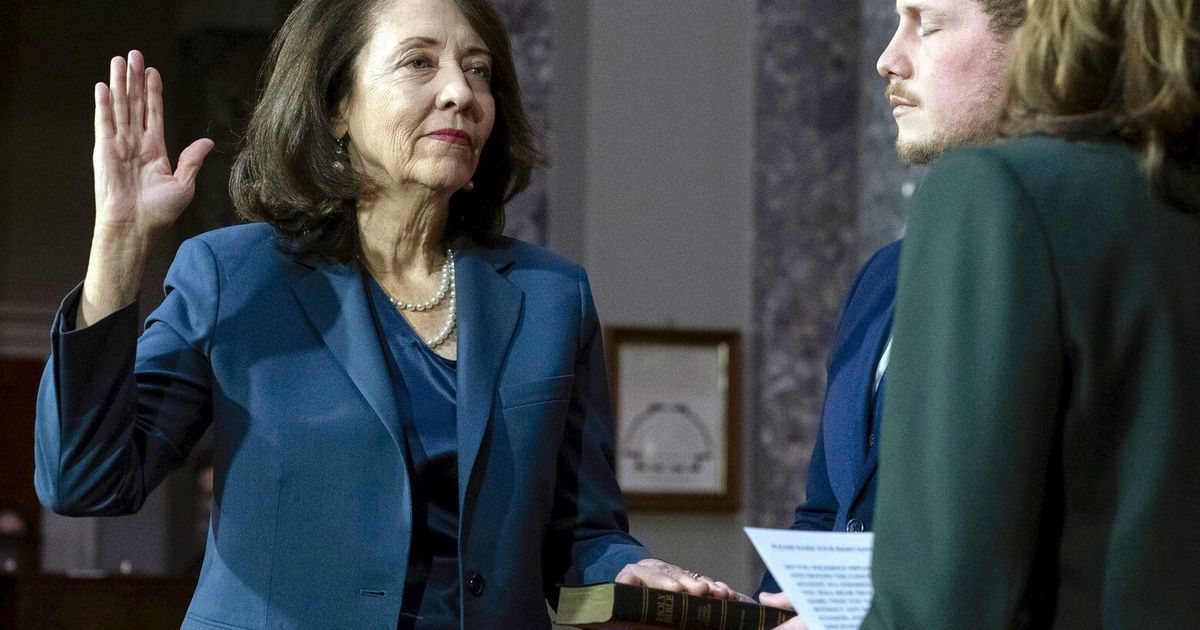
Five years ago U.S. Sen. Maria Cantwell published a report on the dire situation facing local journalism that’s essential to democracy.
In retrospect, she nailed it.
As detailed by the Edmonds Democrat, America’s local news industry was threatened by the proliferation of online content and “unfair market practices by some of the world’s largest technology companies that reuse local news’ content, data, customers, and advertisers.”
Federal judges are now considering whether to break Google apart to remedy its illegal conduct in the search and digital advertising markets that harmed publishers.
But solutions to the local journalism crisis remain elusive, despite great effort by Cantwell and others in Washington’s Congressional delegation. Meanwhile around 2.5 newspapers close per week, on average, and 55 million Americans have little to no local news available.
In the current political environment, chances are slim that Congress will act anytime soon to save newsroom jobs with tax credits or tweak antitrust law to give publishers a chance to negotiate fair compensation from tech giants.
As with the current battle over defunding PBS and NPR, discussions about journalism devolve into partisan conflict. Cantwell considers these nonpartisan issues and said Republicans help occasionally “but right now, there’s not a lot of brave souls.”
Even so, Cantwell said she’s still committed to helping save independent and local journalism that she believes is critical to Washington and the nation.
In an interview, Cantwell said she’s still working the journalism issue, pursuing new angles, trying to defend public broadcasting and considering an update to her report on the journalism crisis.
A new tack is the COPIED Act that Cantwell introduced with Tennessee Republican Marsha Blackburn. It’s modeled on a 2024 Tennessee law, the Elvis Act, that prevents AI companies and digital platforms from unauthorized use of artists’ voices and images.
The COPIED Act would create federal standards for watermarking and authenticating digital content, to prevent what the senators have described as “AI-driven theft.”
This would help the public by making it easier to identify whether material online is authentic or AI-generated.
The bill would also help news outlets, whose future depends on getting paid for their work, along with actors, musicians, artists and others whose work is being pilfered to train AI systems and generate AI content.
“You know, maybe Elvis is going to help me here,” Cantwell said. “Maybe the COPIED Act, based on the Elvis Act in Tennessee, will help communicate to people what (digital) rights are and that you should have these basic rights.”
Here are edited excerpts of our conversation:
Dudley: I appreciate your comments opposing cuts to the Corporation for Public Broadcasting. Will Congress preserve its funding?
Cantwell: I’ve tried to talk to a few colleagues already about it and I just don’t know what to say. We’ve tried to show that this is an essential tool in all sorts of issues, like rural, agricultural issues, a whole bunch of things that are important, the parts of alert systems. And you know, just, why would you do this? It’s so stupid. But I do think there’s some chest pounding by people and so they might make some changes and do it. I don’t know.
Q: Is it possible to discuss issues like funding authority and the value of independent media without it becoming a culture war?
A: I’m not sure. After we did the journalism report somebody came to me and said “oh my God, I saw that, I want to get on it.” And then they came back to me and said “I can’t. Just between you and me, the newspaper in my state hates me, Donald Trump hates the newspaper in my state and I can’t get on it.” We tried to lay out how you need many voices to have a competitive model. And so, yeah, that’s why we haven’t made more traction, because they basically have seen it as a partisan question.
Q: The COPIED Act is bipartisan.
A: Well we’re trying to get (Sen. Ted) Cruz to mark it up. We think, with that tool in mind, it clarifies everything.
Q: The House budget bill includes a ban on states regulating AI. Would that prohibit states from requiring AI firms, including Google, to pay for news they’re using?
A: Yeah, that’s why we don’t support it, because it’s too broad. It covers everything. I mean, you have a Republican attorney general calling and saying “Don’t do this!”
Q: It sounds like a ruse, saying we can’t have a patchwork of state regulations, we need a federal policy, then not passing anything.
A: Right? Yeah. I never thought (U.S. Rep.) Marjorie Taylor Greene and I would be on the same page. We are on this AI issue because people get it, that this is a very powerful tool. And basically it would be devastating to existing law, existing laws that are on the books.
Q: How about copyright reform? Is that necessary to address the misuse of journalism?
A: The COPIED Act is a step in that direction because it’s showing you whose content it is and saying, in this complicated world — where you don’t know what is the link, who’s is it — what am I looking at, what website am I looking at, who owns it.
Q: It’s back to the future, since you worked at RealNetworks, an early streaming media company.
A: In those early days, when audio came first, the record industry tried lots of different things, including locking CDs so you can’t play them on anything else. I learned that the business models take a lot longer than the technology, like 20 to 25 years for the business models to show up once the technology advent is there. It took all that time, until 2019 or whenever it was, for the (music) revenue to recover from that technology innovation. And so here, our job is to keep journalism as strong and as healthy as it could possibly be, see how to enable the new models, and certainly stop people from using their content in some unfair and deleterious way.
Q: That’s hopeful. If the business model takes 20 years to crystallize, well, we’re only 10 or 15 years from newspapers adopting paywalls.
A: You do want the industry, in its core essence, which is the workforce that produces this content, to exist. You really need lots of voices in journalism, and you really need to rein in these companies who basically are cannibalizing the content, and now may take the content in a major way with AI.
Q: Are you still hearing from constituents concerned about local journalism?
A: We do but there’s so much right now — they’re freaked out about everything, you know, the science budget being cut, the health care budget being cut. Every day is another thing, a huge shift in federal policy.
Q: Much of this seems affected by the loss of local news and the civic engagement and knowledge it imparts.
A: We believe that this is a cornerstone to all of those issues. We’re just trying to figure out how we can make progress and, you know, eliminate the dangers.
